

Archive position — measured, not model output
0 likes on Devpost
2,263 of the 7,850 archived projects have more likes, and 5,587 share exactly 0 — so this project's #6,958 place in the like-ranked listing is a tie-break inside that group, not a ranking.
Projects (log scale)
Likes on Devpost. ▲ marks this project's group.
Show the figures
| Likes | Projects | Share of archive |
|---|---|---|
| 0 | 5,587 | 71.2% |
| 1 | 1,758 | 22.4% |
| 2 | 284 | 3.6% |
| 3–4 | 132 | 1.7% |
| 5–9 | 75 | 1.0% |
| 10+ | 14 | 0.2% |
 User Stories BotA demo video on every pull request
Get a demo video on every new feature
GitHub App that watches your pull requests and records a narrated, captioned demo.
Save time on demo prep and make informed decisions faster with a video walkthrough of every new feature.
Executive Summary
What the company appears to be
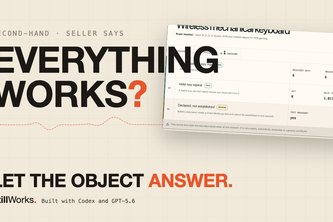
StillWorks is a browser-based tool designed to test specific, observable aspects of electronic devices in second-hand transactions. It allows sellers to make claims about device functionality and buyers to verify those claims through real-time browser signals (e.g., Gamepad API for controllers, WebAudio for microphones). The system produces a condition card with PASS, FAIL, or UNKNOWN outcomes based on these tests.
What changed
The project was built during the OpenAI 2026 hackathon using Codex and GPT-5.6 Sol. It is described as a static, local-first PWA that avoids backend dependencies, AI runtime assessments, and external data collection.
Single most important open question
Is there any evidence of traction, revenue, or adoption beyond the author’s own submission? The description does not indicate any real-world usage or customer base.
What The Product Actually Is
The description states that StillWorks:
- Turns a seller claim into a short, agreed test plan.
- Uses browser APIs to observe device behavior (e.g., Gamepad API for controllers, MediaDevices for webcams).
- Produces a bounded condition card with PASS, FAIL, or UNKNOWN results.
- Operates entirely locally in the browser without backend services or account requirements.
- Includes a recorded fixture for judges without matching hardware.
- Exports evidence as JSON if desired.
Inference StillWorks is a browser-based tool that enables trust in second-hand electronics by testing specific device functions using web APIs. It avoids AI-generated assessments and does not collect user data or require an account.
Positioning & Claim Evolution
The description states:
- StillWorks aims to make trust a shared action at the moment of exchange, before money changes hands.
- It addresses uncertainty in second-hand electronics as a source of e-waste.
- The tool does not claim to certify devices; it records what one bounded handoff established.
Inference StillWorks positions itself as a lightweight, local-first solution for verifying device functionality during peer-to-peer transactions. Its core value is reducing uncertainty and increasing honesty in second-hand exchanges.
Target Customer & ICP
The description states:
- The tool targets buyers and sellers in second-hand electronics markets.
- It supports users who want to verify specific device functions before purchasing.
- It includes a judge path for those without matching hardware.
Inference StillWorks appears aimed at individuals or small groups involved in peer-to-peer electronics sales, particularly where trust is a concern. The ICP likely includes tech-savvy users comfortable with browser-based testing and minimal setup.
Business Model & Pricing Evidence
The description states:
- There is no mention of pricing.
- No business model is described beyond the tool’s functionality.
- It is built as a static PWA with no backend or monetization layer.
Inference There is no evidence of a business model or pricing strategy. The product appears to be a prototype or proof-of-concept, not a commercial offering.
Technical & Delivery Signals
The description states:
- Built with Next.js, React, and TypeScript.
- Fully static production export.
- Uses browser APIs for testing (Gamepad API, WebAudio, MediaDevices).
- Implements deterministic test planning.
- Includes a PWA shell, export flow, tests, and documentation.
- No backend, analytics, or runtime model assessments.
Inference StillWorks is technically a local-first, static web application with no external dependencies. It uses browser APIs to perform device-specific tests and avoids AI-generated outcomes in favor of deterministic code-based results.
Traction & Maturity Signals
The description states:
- The project was built during a hackathon.
- No revenue, customers, or adoption data are provided.
- The tool is described as a complete prototype with 12 deterministic and integration tests.
- It includes clean-build, browser, security, and accessibility checks.
Inference There is no evidence of traction, revenue, or customer adoption. The project appears to be an experimental prototype, not a mature product in use.
Competitive Context
The description states:
- No mention of competitors.
- The tool focuses on local testing and avoiding AI-based assessments.
- It emphasizes honesty in reporting uncertainty (UNKNOWN) over false positives.
Inference No competitive landscape is described. StillWorks appears to be a unique approach to device verification, but its positioning against existing tools or platforms is not evident from the description.
Open Questions & Risks
The description states:
- The tool does not claim to certify devices.
- It avoids backend services and AI runtime decisions.
- It includes a recorded fixture for judges without matching hardware.
Inference
Key risks include:
- Lack of real-world usage or adoption.
- No clear path to monetization or scaling.
- Dependence on browser APIs, which may vary across platforms or devices.
- The tool is described as a prototype, not a production-ready product.
Questions the description leaves open
- Has StillWorks been tested in real-world second-hand transactions?
- Are there any plans to monetize the tool or integrate it into existing marketplaces?
- How does StillWorks handle edge cases like browser permission failures or hardware unavailability?
- What is the long-term vision for expanding device categories and test types?
- Is there a plan to move beyond the static PWA model, or is this intentional?
Overall Assessment
The description states:
- StillWorks was built during a hackathon.
- It is described as a prototype with no revenue or customer data.
- The tool avoids backend services and AI-based assessments.
Inference There is no evidence of commercial traction, revenue, or customer adoption. The project appears to be an experimental idea with potential for further development but lacks the maturity or market validation to warrant investment or partnership at this stage.
User Stories BotA demo video on every pull request
Get a demo video on every new feature
GitHub App that watches your pull requests and records a narrated, captioned demo.
Save time on demo prep and make informed decisions faster with a video walkthrough of every new feature.
Source
Submitted to the OpenAI 2026 hackathon on Devpost. Project home on Devpost. Back to the full gallery on Devpost.
This competitive analysis was produced by top-founders.com (opens in a new tab)
Generated by a language model from this project's public Devpost page — its tagline, the author's own write-up and any built-with tags listed there — as captured in August 2026. Short quotations are the author's words. It is an opinion on the idea as a business, not on the people behind it, and it reflects the description as published then. If the project has moved on, request a correction below. The analysis is not independent research and contains no verified traction, revenue or customer data.
An independent guide by KFG International LLC — not affiliated with, endorsed by, or connected to Devpost or OpenAI.