

Archive position — measured, not model output
0 likes on Devpost
2,263 of the 7,850 archived projects have more likes, and 5,587 share exactly 0 — so this project's #6,949 place in the like-ranked listing is a tie-break inside that group, not a ranking.
Projects (log scale)
Likes on Devpost. ▲ marks this project's group.
Show the figures
| Likes | Projects | Share of archive |
|---|---|---|
| 0 | 5,587 | 71.2% |
| 1 | 1,758 | 22.4% |
| 2 | 284 | 3.6% |
| 3–4 | 132 | 1.7% |
| 5–9 | 75 | 1.0% |
| 10+ | 14 | 0.2% |
 User Stories BotA demo video on every pull request
Get a demo video on every new feature
GitHub App that watches your pull requests and records a narrated, captioned demo.
Save time on demo prep and make informed decisions faster with a video walkthrough of every new feature.
Executive Summary
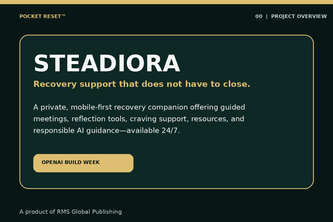
Project: Steadiora
Self-reported basis: The entire analysis is based on the author’s own description of the project, submitted to the OpenAI 2026 hackathon on Devpost. No external verification or historical data are available.
Commercial due-diligence read: Steadiora appears to be a self-contained, AI-powered mobile application designed as a 24/7 peer support companion for people in addiction recovery. The author states it uses OpenAI models and aims to provide empathetic, non-clinical support between professional care and community resources. There is no evidence of revenue, customers, or traction. The project is in early development, likely post-hackathon prototype stage.
Single most important open question: Is there a viable path to user adoption and retention without clinical validation or integration with existing recovery services?
What The Product Actually Is
The description states that Steadiora is an AI-powered recovery companion designed for people navigating addiction recovery and mental wellness. It offers:
- 24/7 AI conversations
- Guided recovery check-ins
- Personalized encouragement
- Coping exercises and grounding techniques
- Goal and milestone tracking
- Journaling prompts
- Daily motivation
- Recovery education
- Meeting and community resources
- Wellness-focused activities
The platform is described as mobile-first, built with Next.js, React, Supabase, PostgreSQL, OpenAI models (including GPT-5), and deployed on Vercel. It uses conversational AI to guide users through structured recovery exercises and healthy decision-making.
Inference: The product appears to be a prototype or MVP, likely developed for a hackathon, with no evidence of production deployment or user base.
Positioning & Claim Evolution
The author states that Steadiora was built to place compassionate, judgment-free support in someone's pocket at any hour of the day, aiming to bridge gaps between professional treatment and peer support. The vision is described as: “no one should have to face recovery alone.”
Key claims:
- It is not meant to replace professional treatment or recovery communities.
- It aims to provide consistent, accessible support during low-points in recovery.
- It uses AI to make recovery resources more accessible.
Inference: The positioning is centered on accessibility and emotional support rather than clinical efficacy. It reflects a shift from traditional recovery tools toward digital companionship.
Target Customer & ICP
The author states that Steadiora is for people overcoming addiction, particularly those who struggle during moments when support isn’t immediately available—such as during “crisis points” or between therapy sessions.
Inference: The target customer is likely individuals in early to mid-stage recovery, possibly with limited access to professional care or peer groups. No specific demographics or segmentation are mentioned.
Business Model & Pricing Evidence
The description does not contain any information about pricing, monetization, or business model. There is no mention of subscriptions, freemium tiers, partnerships, or revenue streams.
Not evidenced: No evidence of a defined business model or pricing strategy.
Technical & Delivery Signals
Steadiora is built with:
- Frontend: React, Next.js
- Backend/Infrastructure: Supabase, PostgreSQL, Vercel
- AI Models: OpenAI (including GPT-5)
- Other Tech: TypeScript, CSS, REST APIs
The application is described as mobile-first and designed to feel supportive rather than clinical.
Inference: The tech stack suggests a modern, lightweight, web-based prototype. It is not clear if the product has been deployed or scaled beyond a hackathon-level build.
Traction & Maturity Signals
There is no evidence of traction, including:
- No user base
- No revenue
- No customer data
- No production deployment
- No metrics on usage, retention, or engagement
The project is described as a hackathon submission and has no indication of further development beyond that.
Not evidenced: No signs of product-market fit, adoption, or growth.
Competitive Context
The description does not mention any direct competitors. It is unclear whether similar AI-powered recovery tools exist in the market.
Inference: The space likely includes mental health apps, AI chatbots for wellness, and peer support platforms, but no competitive analysis is provided.
Open Questions & Risks
- Ethical concerns: The product aims to provide emotional support without clinical oversight. Risk of dependency or inappropriate responses.
- Lack of validation: No evidence of clinical testing, user feedback, or safety protocols.
- Unproven market demand: No data on user interest or willingness to pay.
- Limited scope: The project is described as a prototype with a roadmap for future features—no indication of current functionality or adoption.
- AI risks: Use of OpenAI models raises concerns about hallucination, bias, and lack of control over responses in sensitive contexts.
Questions the description leaves open
- What are the specific ethical guidelines and safety checks implemented in AI conversations?
- How is the product being tested with real users or in clinical settings?
- Is there any plan to partner with recovery centers, therapists, or mental health organizations?
- What is the roadmap for monetization and scaling beyond a prototype?
- How will the product handle crisis situations or high-risk scenarios?
- Are there plans to integrate with existing support systems (e.g., AA meetings, therapy apps)?
- Has the team considered regulatory compliance in health tech?
Overall Assessment
Not evidenced: No evidence of traction, revenue, or customer validation exists. The project is described as a hackathon submission and lacks any indication of commercial viability or product-market fit.
Confidence level: Low — based entirely on self-reported claims with no external corroboration.
Assessment: Early-stage prototype with potential in a high-need space but not yet ready for investment or partnership. A follow-up evaluation would require evidence of user testing, clinical validation, and a clear path to monetization.
User Stories BotA demo video on every pull request
Get a demo video on every new feature
GitHub App that watches your pull requests and records a narrated, captioned demo.
Save time on demo prep and make informed decisions faster with a video walkthrough of every new feature.
Source
Submitted to the OpenAI 2026 hackathon on Devpost. Project home on Devpost. Back to the full gallery on Devpost.
This competitive analysis was produced by top-founders.com (opens in a new tab)
Generated by a language model from this project's public Devpost page — its tagline, the author's own write-up and any built-with tags listed there — as captured in August 2026. Short quotations are the author's words. It is an opinion on the idea as a business, not on the people behind it, and it reflects the description as published then. If the project has moved on, request a correction below. The analysis is not independent research and contains no verified traction, revenue or customer data.
An independent guide by KFG International LLC — not affiliated with, endorsed by, or connected to Devpost or OpenAI.