

Archive position — measured, not model output
0 likes on Devpost
2,263 of the 7,850 archived projects have more likes, and 5,587 share exactly 0 — so this project's #6,942 place in the like-ranked listing is a tie-break inside that group, not a ranking.
Projects (log scale)
Likes on Devpost. ▲ marks this project's group.
Show the figures
| Likes | Projects | Share of archive |
|---|---|---|
| 0 | 5,587 | 71.2% |
| 1 | 1,758 | 22.4% |
| 2 | 284 | 3.6% |
| 3–4 | 132 | 1.7% |
| 5–9 | 75 | 1.0% |
| 10+ | 14 | 0.2% |
 User Stories BotA demo video on every pull request
Get a demo video on every new feature
GitHub App that watches your pull requests and records a narrated, captioned demo.
Save time on demo prep and make informed decisions faster with a video walkthrough of every new feature.
Executive Summary
What the company appears to be: StartOne is a self-reported learning tool built as a hackathon project that uses GPT-5.6 to help users turn their own learning materials into a structured, visual path for focused study. It claims to support a “learning loop” from start to completion without requiring upfront planning or goal-setting.
What changed: The author states this is a hackathon submission with no prior traction or commercial activity. It was built in one sprint and deployed using AI tools like Codex and GPT-5.6, with no evidence of prior development or user base.
Single most important open question: Is there any evidence that the product works as described, or whether users actually adopt it for learning? The description is self-reported, unverified, and lacks any demonstration of real-world usage or impact.
What The Product Actually Is
The description states that StartOne:
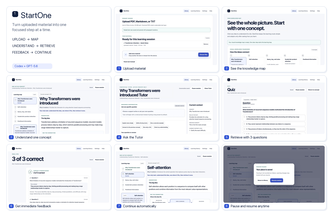
- Turns uploaded or pasted learning material into a visual knowledge map using GPT-5.6.
- Provides explanations, relationships, examples, and memory anchors for each concept.
- Includes an AI Tutor that guides the learner without changing the learning route.
- Implements a “Guided Mastery Loop” with quizzes, recall exercises, and feedback.
- Uses a bounded Adaptive Planning Agent to select the next action automatically.
- Stores learning performance as factual "LearningEvidence" rather than recommendations.
- Operates only on material provided by the user; no web search or external data.
- Supports autosave, restart points, and mobile responsiveness.
Inference: The product appears to be a prototype for an AI-powered personal learning assistant that aims to reduce friction in beginning and continuing study tasks. It is not described as a marketplace, SaaS platform, or tool for educators or teams.
Positioning & Claim Evolution
The author states:
- StartOne was created to close the gap between intending to learn and completing a meaningful task.
- It is ADHD-informed but makes no medical claims.
- The product aims to make learning easier by removing planning steps and offering structured, visual guidance.
- It emphasizes simplicity, focus, and momentum in learning.
Inference: Positioning is centered on reducing cognitive load for learners who struggle with starting or continuing study. The evolution of the claim appears to be from a general problem (starting learning) to a specific solution (structured AI-assisted path).
Target Customer & ICP
The description states:
- StartOne targets individuals who want to learn but find it hard to begin or stay focused.
- It is designed for learners who provide their own material, not for educators or institutions.
- The interface is English-only and minimalistic.
Inference: The ICP appears to be self-directed learners—particularly those with attention challenges—who prefer structured, low-friction learning paths. No evidence of targeting specific demographics, industries, or use cases beyond personal learning.
Business Model & Pricing Evidence
The description states:
- StartOne is a hackathon project.
- It uses anonymous workspaces and SQLite storage.
- Future versions may include opt-in accounts, long-term storage, spaced review scheduling, and privacy-preserving analytics.
- No pricing model or monetization strategy is described.
Inference: There is no evidence of a business model or pricing structure. The product is presented as a prototype with no indication of commercial viability or revenue streams.
Technical & Delivery Signals
The description states:
- Built with Python, FastAPI, Uvicorn, SQLite, HTML/CSS/JS.
- Deployed on Render.
- Uses GPT-5.6 via OpenAI API for all AI functions.
- Structured outputs validated using Pydantic schemas.
- Source references are validated against the learner’s workspace.
- Planning Agent uses strict function calls and disables parallel processing or web search.
- Codex was used to accelerate development.
Inference: The technical stack is minimal and server-side, with a focus on AI grounding and validation. The use of Codex suggests rapid prototyping, but no evidence of scalability or production-grade infrastructure beyond the hackathon version.
Traction & Maturity Signals
The description states:
- This is a hackathon submission.
- No prior users, customers, or revenue are mentioned.
- The product has automated regression tests and a live GPT-5.6 smoke test.
- It supports pause/resume, autosave, and mobile behavior.
Inference: There is no evidence of traction, adoption, or user engagement beyond the hackathon. The maturity level is that of an early prototype with basic functionality.
Competitive Context
The description does not mention any competitors or market positioning relative to existing tools.
Inference: No competitive analysis or differentiation from other learning platforms is provided. The author does not reference similar products, tools, or services in the space.
Open Questions & Risks
- Unverified claims: All features and outcomes are self-reported without independent validation.
- No traction or adoption: No evidence of users, customers, or real-world usage.
- Prototype-only: The product is described as a hackathon project with no indication of further development or commercialization.
- Limited scope: The system only works on user-provided material and does not support external content or collaboration.
- No monetization strategy: No evidence of how the product would generate revenue.
Questions the description leaves open
- What specific learning outcomes have users reported after using StartOne?
- How is the AI grounding validated in practice? Are there examples of failed validations?
- Has the system been tested with real learners or only internally?
- What are the plans for long-term storage, user accounts, and data privacy?
- Is there any evidence that users actually complete learning paths or return to continue?
- How does the product handle edge cases where uploaded material is incomplete or unclear?
Overall Assessment
The description states that StartOne is a hackathon project with no prior traction, revenue, or commercial activity. It is described as a prototype built using AI tools like Codex and GPT-5.6.
Inference: There is no evidence to support investment or partnership interest at this time. The product lacks demonstrated traction, business model, or user validation. Any potential value lies in the concept and prototype, but not in its current state as a self-reported hackathon submission.
User Stories BotA demo video on every pull request
Get a demo video on every new feature
GitHub App that watches your pull requests and records a narrated, captioned demo.
Save time on demo prep and make informed decisions faster with a video walkthrough of every new feature.
Source
Submitted to the OpenAI 2026 hackathon on Devpost. Project home on Devpost. Back to the full gallery on Devpost.
This competitive analysis was produced by top-founders.com (opens in a new tab)
Generated by a language model from this project's public Devpost page — its tagline, the author's own write-up and any built-with tags listed there — as captured in August 2026. Short quotations are the author's words. It is an opinion on the idea as a business, not on the people behind it, and it reflects the description as published then. If the project has moved on, request a correction below. The analysis is not independent research and contains no verified traction, revenue or customer data.
An independent guide by KFG International LLC — not affiliated with, endorsed by, or connected to Devpost or OpenAI.