

Archive position — measured, not model output
0 likes on Devpost
2,263 of the 7,850 archived projects have more likes, and 5,587 share exactly 0 — so this project's #6,941 place in the like-ranked listing is a tie-break inside that group, not a ranking.
Projects (log scale)
Likes on Devpost. ▲ marks this project's group.
Show the figures
| Likes | Projects | Share of archive |
|---|---|---|
| 0 | 5,587 | 71.2% |
| 1 | 1,758 | 22.4% |
| 2 | 284 | 3.6% |
| 3–4 | 132 | 1.7% |
| 5–9 | 75 | 1.0% |
| 10+ | 14 | 0.2% |
 User Stories BotA demo video on every pull request
Get a demo video on every new feature
GitHub App that watches your pull requests and records a narrated, captioned demo.
Save time on demo prep and make informed decisions faster with a video walkthrough of every new feature.
Executive Summary
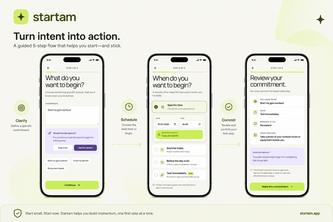
Startam is an AI accountability app that helps users begin difficult tasks by turning them into smaller actions, setting commitments, and recording proof of starting. The author states it was built as a hackathon project using Codex and GPT-5.6 for development. It supports creating commitments, rescheduling, asking for help when stuck (with AI-generated action suggestions), submitting proof, and viewing history. The app is described as focused on the "space between intention and action" rather than task completion. No revenue, customers or traction data are evidenced.
Key commercial due-diligence read
The description states a product concept but provides no evidence of market traction, user adoption, revenue, or business model validation. The author's own write-up indicates this is a hackathon project with no commercial deployment or monetization strategy described. The single most important open question is whether there is any evidence of real-world usage or demand beyond the author’s self-reported development.
What The Product Actually Is
The description states that Startam is an AI accountability app focused on helping people move from hesitation to action. It allows users to:
- Create a commitment
- Choose when to begin
- Decide what proof of starting will look like
- Receive in-app due states
- Ask for help when stuck (with AI-generated action suggestions)
- Submit text or image proof after starting
- View results in History
The app is described as built as a responsive web application using Codex and GPT-5.6 throughout the development process, with server-side OpenAI API integration to avoid exposing API keys in the browser.
Positioning & Claim Evolution
The author states that Startam was inspired by the insight that "the hardest part is not finishing. It is starting." The app positions itself around the idea of helping users begin difficult tasks rather than complete them, with a tagline: "Don’t finish. Begin."
The description claims it focuses on one specific moment: when someone knows what they need to do but cannot make themselves begin. It also states that the AI is intentionally constrained to produce one useful action rather than long motivational advice or an overwhelming productivity plan.
Target Customer & ICP
The description does not explicitly identify a target customer or ideal customer profile (ICP). The author states that "a lot of productivity tools are designed around finishing tasks" and that "for many people, the hardest part is not finishing. It is starting." This suggests a broad audience of individuals who struggle with initiating tasks, but no specific segment or persona is defined.
Business Model & Pricing Evidence
The description does not provide any evidence of a business model or pricing strategy. The author describes the app as a hackathon project and mentions future features like authenticated user accounts, cloud synchronization, and browser notifications, but no commercialization approach or monetization mechanism is detailed.
Technical & Delivery Signals
The description states that Startam was built as a responsive web application using Codex and GPT-5.6 throughout the development process. It uses the OpenAI Responses API server-side to generate smaller actions, and the author mentions using Codex for:
- Application structure
- Interface implementation
- State management
- Local persistence
- Multiple commitment support
- Scheduling and reminder states
- AI-generated task reduction
- Proof submission
- History records
- Responsive design
The project is stored in a public GitHub repository and deployed on Vercel. The author notes challenges with state boundaries, proof persistence, and ensuring AI responses are tied to correct commitments.
Traction & Maturity Signals
The description states that this was a hackathon project submitted to the OpenAI 2026 hackathon on Devpost. No evidence of user traction, adoption, or market validation is provided beyond the author's own account. The author mentions accomplishments such as creating a complete working product and focusing on one specific moment (beginning tasks), but no metrics or usage data are presented.
Competitive Context
The description does not provide any information about competitive landscape or existing alternatives. It only states that "a lot of productivity tools are designed around finishing tasks" and that Startam is focused on helping people begin rather than complete them, without identifying specific competitors or market positioning relative to existing solutions.
Open Questions & Risks
- The project is described as a hackathon submission with no evidence of commercial deployment or traction
- No revenue, customers or business model are evidenced
- The author states that the app does not yet support background notifications when the browser is closed, indicating incomplete functionality
- The single developer team size (1) raises questions about scalability and long-term development capacity
- The product appears to be focused on a very specific use case without clear evidence of market demand beyond the author's own experience
Questions the description leaves open
- What is your evidence that people struggle with beginning tasks rather than finishing them?
- How do you plan to validate demand for this specific solution?
- What are your plans for monetization and revenue generation?
- Can you demonstrate any user testing or feedback from potential customers?
- How will you scale beyond a single developer team?
- What is the competitive advantage of your approach compared to existing productivity tools?
- Have you identified any specific market segments or personas that would use this tool?
- What are your plans for user acquisition and retention?
Overall Assessment
Not evidenced.
The description provides no evidence of revenue, customers, traction, or validated market demand. The project is described as a hackathon submission with no commercial deployment or monetization strategy. There is insufficient evidence to assess whether this represents a viable business opportunity or if there is sufficient market validation for investment or partnership consideration. The single developer team and lack of any commercial metrics raise significant concerns about scalability and viability.
User Stories BotA demo video on every pull request
Get a demo video on every new feature
GitHub App that watches your pull requests and records a narrated, captioned demo.
Save time on demo prep and make informed decisions faster with a video walkthrough of every new feature.
Source
Submitted to the OpenAI 2026 hackathon on Devpost. Project home on Devpost. Back to the full gallery on Devpost.
This competitive analysis was produced by top-founders.com (opens in a new tab)
Generated by a language model from this project's public Devpost page — its tagline, the author's own write-up and any built-with tags listed there — as captured in August 2026. Short quotations are the author's words. It is an opinion on the idea as a business, not on the people behind it, and it reflects the description as published then. If the project has moved on, request a correction below. The analysis is not independent research and contains no verified traction, revenue or customer data.
An independent guide by KFG International LLC — not affiliated with, endorsed by, or connected to Devpost or OpenAI.