

Archive position — measured, not model output
0 likes on Devpost
2,263 of the 7,850 archived projects have more likes, and 5,587 share exactly 0 — so this project's #6,931 place in the like-ranked listing is a tie-break inside that group, not a ranking.
Projects (log scale)
Likes on Devpost. ▲ marks this project's group.
Show the figures
| Likes | Projects | Share of archive |
|---|---|---|
| 0 | 5,587 | 71.2% |
| 1 | 1,758 | 22.4% |
| 2 | 284 | 3.6% |
| 3–4 | 132 | 1.7% |
| 5–9 | 75 | 1.0% |
| 10+ | 14 | 0.2% |
 User Stories BotA demo video on every pull request
Get a demo video on every new feature
GitHub App that watches your pull requests and records a narrated, captioned demo.
Save time on demo prep and make informed decisions faster with a video walkthrough of every new feature.
Executive Summary
What the company appears to be
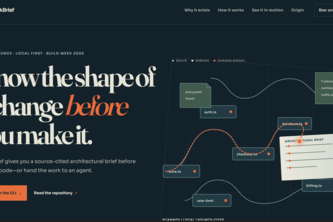
StackBrief is a self-reported open-source, offline-first CLI tool that generates architectural briefs from code repositories. The author states it helps developers understand software architecture before changing code by analyzing file paths and line-level evidence.
What changed
The project evolved from an initial idea called stack.md, which aimed to summarize unfamiliar repositories. It shifted toward helping developers answer questions like “what happens if I change this file?” or “which services does this route depend on?”, leading to a focus on pre-code-change understanding rather than documentation generation.
Single most important open question
Is there any evidence of real-world usage, adoption, or traction beyond the author’s own development and submission to an AI hackathon?
What The Product Actually Is
The description states that StackBrief is:
- An open-source, offline-first CLI
- That generates an architectural brief directly from a repository
- It detects:
- Repository languages
- Frameworks
- Routes
- Services
- Databases
- Dependencies
- External APIs
- Local imports
- Architectural boundaries
- Every result is backed by file paths and line-level evidence
- Everything runs locally, with no hosted service, vector database, embeddings, or repository code leaving the machine
Inference The tool appears to be a developer-facing utility for understanding code structure before making changes.
Positioning & Claim Evolution
The author claims:
- StackBrief started as stack.md, a simpler idea focused on summarizing repositories.
- It evolved into something more strategic: helping developers understand what happens when they change code, not just what the code is.
- The philosophy is: “Understand the architecture before you change the code.”
- It was built using AI (GPT-5.6 and Codex) as a product design and engineering partner, not as a replacement for engineering judgment.
Inference The positioning shifted from documentation generation to pre-change architectural insight, with an emphasis on local execution and AI-assisted thinking over automation.
Target Customer & ICP
The description states:
- StackBrief is intended for developers
- It helps them understand software architecture before making code changes
- It supports use cases like:
- Making code changes
- Reviewing pull requests
- Onboarding into unfamiliar projects
- Integrating with future workflows
Inference The primary customer is a developer or engineering team working in complex codebases where understanding dependencies and impact is critical.
Business Model & Pricing Evidence
The description states:
- StackBrief is open-source
- It is available on GitHub and npm
- No pricing information, monetization strategy, or business model is mentioned
Not evidenced There is no evidence of any revenue model, paid features, or commercial use cases beyond the author’s own development.
Technical & Delivery Signals
The description states:
- Built with:
- GPT-5.6
- Codex
- JavaScript, Next.js, Node.js, React, TypeScript
- Uses AI as an engineering collaborator for architecture and planning
- Implemented using a milestone-based workflow with Codex accelerating implementation
- No API keys, hosted services, embeddings, or vector databases required
- Runs entirely offline
Inference The tool is built with modern developer stack and integrates AI into its development process, but not in runtime.
Traction & Maturity Signals
The description states:
- Submitted to the OpenAI Build Week 2026 hackathon
- Created by a single person (Mojeeb Titilayo)
- No mention of users, customers, downloads, or adoption metrics
- No evidence of revenue, funding rounds, or growth data
Not evidenced There is no evidence of traction, user base, or market validation beyond the author’s own development.
Competitive Context
The description states:
- The original idea was inspired by existing documentation tools (READMEs, architecture diagrams)
- AI can summarize repositories
- StackBrief aims to go beyond documentation to help developers understand impact before changing code
Not evidenced No mention of competitors or competitive landscape. No evidence of how it differentiates from other tools in the space.
Open Questions & Risks
The description states:
- The tool is built by a single developer
- It’s open-source and submitted to a hackathon
- No commercial traction, revenue, or user base is reported
- AI was used for planning and implementation but not as a runtime service
- No evidence of monetization or scalability plans
Inference Risk factors include lack of market validation, limited team size, no proven business model, and potential difficulty in scaling beyond the author’s own use case.
Questions the description leaves open
- What specific problems are developers facing that StackBrief solves?
- How many developers have tried or used this tool outside of the author’s development process?
- Are there any early adopters or feedback from users?
- Has the author considered how to scale beyond a single-person project?
- Is there any plan for monetization or commercial use beyond open-source?
- What are the technical limitations of running entirely offline, especially in large repositories?
Overall Assessment
The description states:
- StackBrief is an open-source CLI tool built by one developer
- It was created during a hackathon and submitted to OpenAI Build Week 2026
- No evidence of traction, revenue, or commercial viability beyond the author’s own work
Not evidenced There is no evidence of any investment interest, partnership opportunities, or market readiness.
Confidence level Low. The project is self-reported and lacks any external validation, user data, or business model evidence.
User Stories BotA demo video on every pull request
Get a demo video on every new feature
GitHub App that watches your pull requests and records a narrated, captioned demo.
Save time on demo prep and make informed decisions faster with a video walkthrough of every new feature.
Source
Submitted to the OpenAI 2026 hackathon on Devpost. Project home on Devpost. Back to the full gallery on Devpost.
This competitive analysis was produced by top-founders.com (opens in a new tab)
Generated by a language model from this project's public Devpost page — its tagline, the author's own write-up and any built-with tags listed there — as captured in August 2026. Short quotations are the author's words. It is an opinion on the idea as a business, not on the people behind it, and it reflects the description as published then. If the project has moved on, request a correction below. The analysis is not independent research and contains no verified traction, revenue or customer data.
An independent guide by KFG International LLC — not affiliated with, endorsed by, or connected to Devpost or OpenAI.