

Archive position — measured, not model output
0 likes on Devpost
2,263 of the 7,850 archived projects have more likes, and 5,587 share exactly 0 — so this project's #3,007 place in the like-ranked listing is a tie-break inside that group, not a ranking.
Projects (log scale)
Likes on Devpost. ▲ marks this project's group.
Show the figures
| Likes | Projects | Share of archive |
|---|---|---|
| 0 | 5,587 | 71.2% |
| 1 | 1,758 | 22.4% |
| 2 | 284 | 3.6% |
| 3–4 | 132 | 1.7% |
| 5–9 | 75 | 1.0% |
| 10+ | 14 | 0.2% |
 User Stories BotA demo video on every pull request
Get a demo video on every new feature
GitHub App that watches your pull requests and records a narrated, captioned demo.
Save time on demo prep and make informed decisions faster with a video walkthrough of every new feature.
Executive Summary
Project: Braincon
Source: Self-reported author description from Devpost submission for OpenAI 2026 hackathon
Analysis basis: Only the project description supplied by the caller — no external verification, no archived history, no third-party data
Braincon is described as a personal AI context bank that visualizes connections between topics in a 3D brain-like interface. The author states it reduces input cost for large context projects by 98.8%, and is built using Codex GPT 5.5 with Electron and TypeScript. It is positioned as an agent-first tool, intended to help personal AI agents understand user context more efficiently.
Key open question: Is there any evidence of actual usage, customer feedback or product-market fit beyond the author's own claims?
What The Product Actually Is
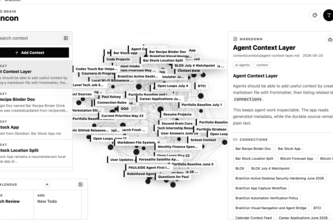
The description states that Braincon is a personal AI context bank, allowing a personal agent to search topics about a user’s life and visualize corresponding connections. It uses a 3D rotating brain model with visual connectors to show how topics relate to one another.
It is described as an agent-first tool, intended to reduce the input cost for AI agents when processing large context projects by 98.8%.
The author also notes that it was built using Codex GPT 5.5, and that it supports semantic search for newly added content.
Inference: The product appears to be a prototype or proof-of-concept, likely built as part of a hackathon project. It is not described as a commercial product or platform with users.
Positioning & Claim Evolution
The author states that Braincon was inspired by Obsidian banks, suggesting a conceptual alignment with knowledge management tools.
It positions itself as:
- A context bank for AI use
- A tool that visualizes connections between topics
- An agent-first system to help personal AI agents understand user context
- A solution to reduce input cost for large context projects by 98.8%
The claim evolution shows a progression from inspiration (Obsidian) to functionality (context bank with visualizations) to performance metrics (input cost reduction).
Inference: The positioning is aspirational, but lacks evidence of real-world adoption or validation.
Target Customer & ICP
The description states that Braincon is built for personal AI agents, and aims to help them understand a user’s life and projects more efficiently. It is described as an agent-first tool.
It also mentions that it helps reduce input cost when working on large context projects, suggesting it targets users who are working with complex or long-running AI tasks.
Inference: The target customer appears to be AI developers or power users of personal AI agents, though no specific persona or use case is detailed.
Business Model & Pricing Evidence
There is no evidence in the description of a business model, pricing strategy, monetization approach, or any indication of how the product would generate revenue.
The author does not mention subscriptions, licensing, usage fees, or any commercial structure.
Inference: The project is described as a hackathon prototype with no commercialization plan evident.
Technical & Delivery Signals
The project was built using:
- Codex GPT 5.5
- Electron
- TypeScript
It includes features such as:
- A 3D rotating brain model
- Visual connectors between topics
- Semantic search for newly added content
- Ability to spin the 3D model cleanly, with increasing node size
The author notes challenges in shaping nodes into a natural-looking brain and ensuring smooth 3D rotation.
Inference: The technical stack suggests it is a desktop application or prototype, likely built quickly as part of a hackathon. No evidence of scalability, performance metrics, or production-grade delivery.
Traction & Maturity Signals
There is no evidence of traction, customers, usage data, or product maturity beyond the author's own description.
The project is described as a hackathon submission, and no mention is made of:
- User feedback
- Adoption rates
- Product iterations
- Market testing
- Revenue or monetization
Inference: The project is at an early stage, likely a prototype or proof-of-concept with no demonstrated traction.
Competitive Context
The author states that Braincon was inspired by Obsidian banks, suggesting it competes in the knowledge management and AI context tools space.
However, there is no evidence of:
- Competitor analysis
- Market positioning relative to existing tools
- Differentiation from similar products
Inference: The competitive landscape is not described or analyzed. It is unclear how Braincon would differentiate itself from Obsidian or other tools in the space.
Open Questions & Risks
- No commercialization plan or business model is evident.
- No traction, customers or usage data provided.
- The project is a hackathon submission, suggesting it may be a prototype or proof-of-concept.
- The claim of 98.8% input cost reduction is not independently verified and lacks context or methodology.
- No evidence of scalability, performance, or production readiness.
Inference: The project appears to be early-stage with no demonstrated commercial viability or market traction.
Questions the description leaves open
- What is the actual use case for this tool? Who will use it and how?
- How was the 98.8% input cost reduction measured? What methodology was used?
- Is there any user feedback or testing beyond the author’s own experience?
- What are the technical limitations of the current prototype, and how would they be addressed in a production version?
- Are there plans to monetize this tool, and if so, what is the business model?
- How does Braincon compare to existing tools like Obsidian or Notion in terms of functionality and value?
Overall Assessment
The description provides no evidence of revenue, traction, customers, or a clear path to commercialization.
It is described as a hackathon submission, with no indication of product-market fit, scalability, or business model.
Assessment: Not evidenced. This project appears to be an early-stage prototype with no demonstrated commercial viability or market traction. It does not meet the criteria for investment or partnership at this stage.
User Stories BotA demo video on every pull request
Get a demo video on every new feature
GitHub App that watches your pull requests and records a narrated, captioned demo.
Save time on demo prep and make informed decisions faster with a video walkthrough of every new feature.
Source
Submitted to the OpenAI 2026 hackathon on Devpost. Project home on Devpost. Back to the full gallery on Devpost.
This competitive analysis was produced by top-founders.com (opens in a new tab)
Generated by a language model from this project's public Devpost page — its tagline, the author's own write-up and any built-with tags listed there — as captured in August 2026. Short quotations are the author's words. It is an opinion on the idea as a business, not on the people behind it, and it reflects the description as published then. If the project has moved on, request a correction below. The analysis is not independent research and contains no verified traction, revenue or customer data.
An independent guide by KFG International LLC — not affiliated with, endorsed by, or connected to Devpost or OpenAI.