

Archive position — measured, not model output
0 likes on Devpost
2,263 of the 7,850 archived projects have more likes, and 5,587 share exactly 0 — so this project's #6,917 place in the like-ranked listing is a tie-break inside that group, not a ranking.
Projects (log scale)
Likes on Devpost. ▲ marks this project's group.
Show the figures
| Likes | Projects | Share of archive |
|---|---|---|
| 0 | 5,587 | 71.2% |
| 1 | 1,758 | 22.4% |
| 2 | 284 | 3.6% |
| 3–4 | 132 | 1.7% |
| 5–9 | 75 | 1.0% |
| 10+ | 14 | 0.2% |
 User Stories BotA demo video on every pull request
Get a demo video on every new feature
GitHub App that watches your pull requests and records a narrated, captioned demo.
Save time on demo prep and make informed decisions faster with a video walkthrough of every new feature.
Executive Summary
What the company appears to be: SproutQuest is a self-reported family-oriented app that uses AI to interpret natural-language meal inputs and display corresponding plant-based foods in a virtual garden. The app aims to encourage varied dietary intake through gamification, with distinct "parent" and "kid" modes.
What changed: This is a hackathon submission from an indie developer who describes building the app using AI tools like GPT-5.6 and Codex, along with SvelteKit and TypeScript. It was built over a short timeframe (presumably a hackathon) and includes basic functionality for meal input, plant tracking, and kid-friendly educational content.
Single most important open question: Is there any evidence of user adoption, revenue, or traction beyond the author's own description? The project is described as a prototype with no team, no funding, and no customers — all self-reported claims without independent verification.
What The Product Actually Is
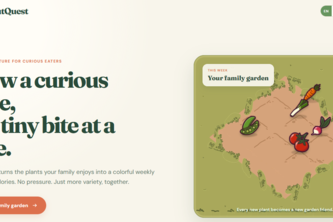
The description states that SproutQuest allows users to type meals into a textbox. AI identifies vegetables, herbs, and legumes in the meal and displays them. Users can accept or edit the AI's output. Accepted items are added to a virtual garden at the bottom of the screen. There is also a panel showing how many different vegetables have been eaten weekly, and soft weekly quests about color variety.
The app includes two modes: "parent" mode for adults and "kid" mode where children can click on crops to learn facts or water plants. The author notes that this was built during a hackathon and has not yet been fully developed.
- Claimed functionality: Meal input → AI parsing → plant display in virtual garden
- Mode switching: Parent mode ↔ Kid mode
- Gamification elements: Virtual garden, weekly quests, educational facts
Evidence strength: Self-reported. No independent verification of product features or performance.
Positioning & Claim Evolution
The author positions SproutQuest as a playful, family-oriented tool for tracking plant diversity in meals. It is described as a way to encourage varied nutrition intake by making it fun for toddlers and parents alike.
Key claims:
- Inspired by the American Gut Project's findings about eating 30 different plant types per week
- Designed to be lightly gamified so that toddlers can enjoy it while learning
- Not a calorie tracker, but an encouragement tool
The positioning evolved from a personal idea (kitchen wall iPad app) to a hackathon prototype with AI integration and visual elements.
Inference: The author’s background as a system administrator and indie game designer suggests they may have approached development using documentation-heavy methods and AI-assisted coding. However, this is not directly stated in the product description.
Target Customer & ICP
The description states that SproutQuest targets families with young children, particularly those interested in encouraging varied diets through playfulness. The app includes a "kid mode" designed for toddlers, suggesting a family-oriented audience.
- Primary user: Parents or caregivers of young children
- Secondary user: Toddlers (via kid mode)
- Use case: Tracking plant diversity in meals to support health goals
Evidence strength: Self-reported. No data on actual users or market segmentation.
Business Model & Pricing Evidence
There is no evidence provided about pricing, monetization strategy, or business model. The author mentions “make a monetized app out of it!” as part of the next steps, but does not describe how this would be done.
- Monetization intent: Future plan to monetize
- Pricing structure: Not evidenced
Inference: If monetized, likely via freemium or subscription models, given the educational and gamified nature of the app. But no concrete evidence supports this.
Technical & Delivery Signals
The author built SproutQuest using:
- AI tools: GPT-5.6 Terra, Sol (for logic/backend), Codex
- Frameworks: SvelteKit, TypeScript
- Hosting/Infrastructure: Cloudflare, D1, durable objects
- UI Components: Svelte components with graphics from itch.io asset packs
The author reports using a "human-in-the-loop" method, relying on documentation and agent-based workflows. They also mention issues with Codex freezing on Windows.
Evidence strength: Self-reported. No independent validation of technical architecture or delivery process.
Traction & Maturity Signals
There is no evidence of traction, revenue, customers, or user engagement beyond the author’s own description. The project was submitted to a hackathon and has no team listed (0 members). It is described as a prototype with many features still in development.
- Team size: 0
- Funding status: Not evidenced
- Customers/users: Not evidenced
- Maturity level: Prototype, post-hackathon
Inference: The app appears to be early-stage and unproven. No evidence of real-world usage or product-market fit.
Competitive Context
No competitive analysis is provided in the description. The author does not reference existing apps or platforms that do similar things (e.g., meal tracking, nutrition apps, gardening apps). There is no mention of competitors or market positioning relative to others.
Evidence strength: Not evidenced.
Open Questions & Risks
- No team or funding: The project has no team listed and no evidence of investment.
- Prototype only: Built as a hackathon submission with many features still in development.
- Unverified claims: All descriptions are self-reported without external corroboration.
- Technical limitations: Issues with AI tools (Codex freezing), graphics asset compatibility, and lack of polish.
- Unclear monetization path: No business model or pricing strategy described.
Inference: The app lacks commercial viability indicators. It is not yet a product in any meaningful sense, but rather an idea being explored by one person.
Questions the description leaves open
- What specific problem are you solving for families? Is there any user research or feedback?
- How do you plan to monetize the app beyond "make a monetized app out of it"?
- Have you tested the AI parsing accuracy with real-world meals?
- What is your roadmap for development beyond the hackathon prototype?
- Are there any existing users or beta testers?
- How will you scale beyond one developer’s capacity?
Overall Assessment
Not evidenced.
The project is described as a hackathon submission with no team, no funding, no customers, and no traction. It is not yet a viable business or product. The author states intentions to develop further but provides no evidence of progress or validation.
Confidence level: Very low — based entirely on self-reported claims without any external verification or data.
User Stories BotA demo video on every pull request
Get a demo video on every new feature
GitHub App that watches your pull requests and records a narrated, captioned demo.
Save time on demo prep and make informed decisions faster with a video walkthrough of every new feature.
Source
Submitted to the OpenAI 2026 hackathon on Devpost. Project home on Devpost. Back to the full gallery on Devpost.
This competitive analysis was produced by top-founders.com (opens in a new tab)
Generated by a language model from this project's public Devpost page — its tagline, the author's own write-up and any built-with tags listed there — as captured in August 2026. Short quotations are the author's words. It is an opinion on the idea as a business, not on the people behind it, and it reflects the description as published then. If the project has moved on, request a correction below. The analysis is not independent research and contains no verified traction, revenue or customer data.
An independent guide by KFG International LLC — not affiliated with, endorsed by, or connected to Devpost or OpenAI.