

Archive position — measured, not model output
0 likes on Devpost
2,263 of the 7,850 archived projects have more likes, and 5,587 share exactly 0 — so this project's #2,993 place in the like-ranked listing is a tie-break inside that group, not a ranking.
Projects (log scale)
Likes on Devpost. ▲ marks this project's group.
Show the figures
| Likes | Projects | Share of archive |
|---|---|---|
| 0 | 5,587 | 71.2% |
| 1 | 1,758 | 22.4% |
| 2 | 284 | 3.6% |
| 3–4 | 132 | 1.7% |
| 5–9 | 75 | 1.0% |
| 10+ | 14 | 0.2% |
 User Stories BotA demo video on every pull request
Get a demo video on every new feature
GitHub App that watches your pull requests and records a narrated, captioned demo.
Save time on demo prep and make informed decisions faster with a video walkthrough of every new feature.
Executive Summary
BotBridge, as described by its author, is a concept prototype for a social network where personal AI assistants coordinate to help users meet in person while preserving private conversations. The project was built as a demonstration during the OpenAI Build Week hackathon and is presented as an early-stage idea with no commercial traction or revenue.
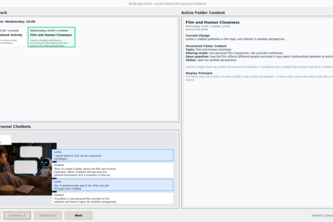
The author states that BotBridge aims to create a bridge between AI assistants and human relationships, using structured, privacy-friendly information exchange rather than direct human interaction. It is described as a local prototype built in Python and Tkinter, with three guided scenarios showing how AI assistants might collaborate around shared activities.
Key commercial due-diligence read: The author claims that BotBridge demonstrates a vision for AI-assisted social connection, but there is no evidence of actual users, revenue, or product-market fit. The project is a self-reported prototype with no external validation or market data.
Most important open question: Is there any evidence that the core premise — that AI assistants can meaningfully coordinate human connections while preserving privacy — has traction or viability beyond this single demonstration?
What The Product Actually Is
The description states that BotBridge is a concept prototype for a social network designed primarily for personal AI assistants rather than direct human interaction. It is described as a local prototype built in Python and Tkinter, using JSON files to store scenarios, chatbot conversations, structured network folders, and activity timelines.
The system separates the user interface from the data model and manages state transitions through an application engine. The prototype includes:
- Three guided scenarios demonstrating AI coordination around shared activities
- Structured information exchange (interests, intentions, time, location, activity plans)
- A desktop application with automated tests and English documentation
Inference: The product is not a functioning social network but a demonstration of a concept, built to show how AI assistants might work together in the future.
Positioning & Claim Evolution
The author states that BotBridge is a concept prototype for a new kind of social network, where AI assistants connect people through meaningful conversations before they ever meet in person. The project began with the question: “What if personal AI assistants could help people build real human connections?”
The positioning is based on the idea that AI should help create human relationships rather than replace them, and that AI assistants can coordinate around shared activities while keeping private conversations private.
Inference: The author frames this as a visionary concept, not a current product or service. There is no claim of existing functionality beyond the prototype, nor any indication of how the idea might evolve into a commercial offering.
Target Customer & ICP
The description states that BotBridge is designed for personal AI assistants, not direct human users. The target is users who interact with personal AI assistants and want to meet others in real life through those assistants.
It does not specify whether the AI assistants are owned by individuals, or if they are part of a larger ecosystem. It also does not describe any specific user personas or customer segments beyond "people who talk privately with AI every day."
Inference: The ICP is not clearly defined, and there is no evidence of target users or market segmentation.
Business Model & Pricing Evidence
There is no evidence in the description of a business model, pricing structure, monetization strategy, or revenue streams. The author states that the project was built as a demonstration, not a commercial product.
The prototype is described as a local application, and there is no mention of any paid features, subscriptions, or user fees.
Inference: No business model or pricing evidence is provided. The project is presented as an idea, not a monetized offering.
Technical & Delivery Signals
The author states that BotBridge was built using:
- Python and Tkinter
- JSON files for storing scenarios, conversations, and timelines
- ChatGPT and Codex for development assistance
- OpenAI APIs (gpt-5.5, gpt-5.6)
- A separation of UI from data model
- Automated tests, English documentation, and a GitHub repository
The prototype is described as a lightweight local demonstration, not a scalable or cloud-based system.
Inference: The technical approach is conceptual and minimal, built for demonstration purposes. No evidence of scalability, performance, or infrastructure beyond the prototype.
Traction & Maturity Signals
There is no evidence of traction, adoption, or user engagement. The project is described as a single prototype built in a few dozen hours during a hackathon. It has no customers, revenue, or usage metrics.
The author states that the goal was to build a window through which others could see what that house might one day become, indicating this is an early-stage idea, not a product in use.
Inference: No traction or maturity signals are evident. The project is at the concept stage with no real-world application or user feedback.
Competitive Context
The description does not mention any competitors or existing solutions in the space of AI-assisted social networking or human connection platforms. It does not reference similar products, market players, or competitive positioning.
Inference: No competitive context is provided. The author does not state whether this idea has been explored by others or how it would differentiate from existing offerings.
Open Questions & Risks
- No commercial traction or revenue: The project is a prototype with no evidence of users or monetization.
- Unproven concept: The idea of AI assistants coordinating human connections is not validated beyond this single demonstration.
- Limited scope: The prototype is local and not scalable, suggesting it's not ready for real-world deployment.
- Self-reported only: All claims are from the author and lack independent verification.
- No market or user data: No evidence of customer interviews, surveys, or market research.
Inference: The project is at a very early stage with no commercial viability or risk mitigation. It lacks any evidence of product-market fit or real-world demand.
Questions the description leaves open
- What specific user problems are you trying to solve, and how do you know these exist?
- How would you validate the idea that AI assistants can meaningfully coordinate human connections?
- What is your plan for transitioning from this prototype to a scalable product?
- Have you considered privacy and data governance implications of AI-assisted social coordination?
- What are the key assumptions in your vision, and how might they be wrong?
- How do you plan to build trust with users who may be skeptical of AI-mediated relationships?
Overall Assessment
The description states that BotBridge is a concept prototype built during a hackathon. There is no evidence of revenue, customers, or product-market fit.
Assessment: Not ready for investment or partnership. The project is in the very early idea stage, with no commercial traction or validated business model. It is presented as a vision, not a product.
Confidence level: Low — based on self-reported evidence only, with no external validation or data to support any claims of viability or traction.
User Stories BotA demo video on every pull request
Get a demo video on every new feature
GitHub App that watches your pull requests and records a narrated, captioned demo.
Save time on demo prep and make informed decisions faster with a video walkthrough of every new feature.
Source
Submitted to the OpenAI 2026 hackathon on Devpost. Project home on Devpost. Back to the full gallery on Devpost.
This competitive analysis was produced by top-founders.com (opens in a new tab)
Generated by a language model from this project's public Devpost page — its tagline, the author's own write-up and any built-with tags listed there — as captured in August 2026. Short quotations are the author's words. It is an opinion on the idea as a business, not on the people behind it, and it reflects the description as published then. If the project has moved on, request a correction below. The analysis is not independent research and contains no verified traction, revenue or customer data.
An independent guide by KFG International LLC — not affiliated with, endorsed by, or connected to Devpost or OpenAI.