

Archive position — measured, not model output
0 likes on Devpost
2,263 of the 7,850 archived projects have more likes, and 5,587 share exactly 0 — so this project's #2,994 place in the like-ranked listing is a tie-break inside that group, not a ranking.
Projects (log scale)
Likes on Devpost. ▲ marks this project's group.
Show the figures
| Likes | Projects | Share of archive |
|---|---|---|
| 0 | 5,587 | 71.2% |
| 1 | 1,758 | 22.4% |
| 2 | 284 | 3.6% |
| 3–4 | 132 | 1.7% |
| 5–9 | 75 | 1.0% |
| 10+ | 14 | 0.2% |
 User Stories BotA demo video on every pull request
Get a demo video on every new feature
GitHub App that watches your pull requests and records a narrated, captioned demo.
Save time on demo prep and make informed decisions faster with a video walkthrough of every new feature.
Executive Summary
What the company appears to be
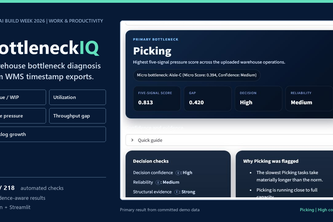
BottleneckIQ is a Python-based tool for analyzing warehouse operation data from WMS timestamp exports. The author describes it as a "conservative Theory of Constraints screening workflow" that turns task-level timestamps into bottleneck diagnoses using five operational signals.
What changed
The project was built during OpenAI Build Week, with the author stating they used Codex and GPT-5.6 for engineering assistance. It is presented as a prototype tool with a six-operation analysis workflow and automated testing framework.
Single most important open question
Does BottleneckIQ demonstrate sufficient commercial viability to warrant further due-diligence attention, or does it remain a research/prototype-level tool without evidence of traction, customers, or revenue?
What The Product Actually Is
The description states that BottleneckIQ is a Python and Streamlit application built with pandas, NumPy, Altair, Matplotlib, OpenPyXL, and pdfkit. It processes one Excel or CSV file per warehouse operation containing task-level timestamps.
It uses timestamp-based flow balances, reflected cumulative Queue/WIP, observed-capacity occupancy, robust cycle-time pressure, flow-equivalent throughput, backlog growth, and a conservative lead-lag tie-break for close candidates to score operations with five operational signals:
- Queue and WIP accumulation
- Observed utilization
- Cycle pressure
- Throughput gap
- Backlog growth
The tool returns a primary bottleneck diagnosis along with decision confidence, report reliability, structural evidence, top-two score gap, and plain-language reasons. It also provides supporting views showing inbound/outbound pressure, overlapping bottlenecks, local hotspots, and guarded ROI scenarios.
Not evidenced: No information on whether the tool is deployed in production or used by any organization beyond the author's own testing.
Positioning & Claim Evolution
The author positions BottleneckIQ as a way to "turn existing WMS exports into a conservative Theory of Constraints screening workflow." It is described as addressing a gap where warehouse teams have timestamp data but lack affordable tools to identify actual bottlenecks.
It claims to be explainable and conservative in its approach, explicitly stating that weak or ambiguous evidence is reported as "Low" or "Weak" rather than being presented as certain diagnoses. The tool aims to avoid false signals caused by planned buffers, release waves, missing labor data, and small samples.
Inferred: The positioning suggests a niche B2B SaaS or consulting tool aimed at warehouse operations teams or industrial engineers who work with WMS systems. However, no explicit commercial claims about pricing, partnerships, or go-to-market strategy are made.
Target Customer & ICP
The author states that the tool was built after working in e-commerce warehouse operations and studying industrial engineering. The target audience appears to be warehouse teams or industrial engineers who have access to WMS timestamp data but lack tools to analyze it for bottleneck identification.
Not evidenced: No specific customer segments, personas, or use cases beyond general warehouse operations are detailed. There is no mention of whether the tool targets large enterprises, small businesses, or third-party logistics providers.
Business Model & Pricing Evidence
The description does not contain any information about pricing models, monetization strategies, or business model assumptions. The author mentions that the next milestone is a live field pilot using anonymized task logs and before-and-after throughput measures, but no commercial structure is described.
Inferred: If this becomes a product, it may be sold as a SaaS tool or consulting service, but there is no evidence to support this assumption.
Technical & Delivery Signals
The tool is built with Python, Streamlit, pandas, NumPy, Altair, Matplotlib, OpenPyXL, and pdfkit. It uses Codex and GPT-5.6 during development, indicating some AI-assisted engineering.
Key technical features include:
- Timestamp-based flow balances
- Five-signal scoring engine
- Automated testing framework (218/218 non-overlapping checks)
- Independent implementation validation (correlation 1.000)
- PDF reporting with guarded financial scenarios
Not evidenced: No information on scalability, deployment architecture, API access, or integration capabilities.
Traction & Maturity Signals
The author claims to have run tests on a public outbound warehouse log containing 767,723 selected events and 130,835 traces. They also mention:
- 218/218 automated checks including 112 broad warehouse scenarios and 33 adversarial scenarios
- An independently written Queue/WIP implementation that matched engine rank ordering with correlation 1.000 and maximum metric delta 0
However, the description makes clear that the public log has no intervention-confirmed true bottleneck — so these results establish consistency and coverage rather than field accuracy.
Not evidenced: No revenue, customer adoption, or usage metrics beyond internal testing are provided.
Competitive Context
The author does not reference any competitors directly. The tool appears to address a gap in warehouse bottleneck analysis tools that rely on WMS timestamp data. It is positioned as a conservative approach compared to other methods that might overstate certainty or ignore uncertainty.
Inferred: Potential competitors may include enterprise WMS vendors with built-in analytics, industrial engineering software, or specialized operations research platforms — but no such references are made in the description.
Open Questions & Risks
- Prototype status: The tool is described as a prototype built during a hackathon and is not yet deployed in production.
- No commercial traction: No evidence of revenue, customers, or market validation beyond internal testing.
- Unclear monetization path: No information on how the product would be sold or priced.
- Limited scope: The tool supports only six-operation analysis workflows; no indication of scalability or broader applicability.
- Dependence on timestamp quality: The tool's effectiveness depends heavily on accurate and complete timestamp data, which may not always be available in real-world settings.
Questions the description leaves open
- What is the current stage of development? Is it being used internally or tested with any partners?
- How does the tool handle missing or inconsistent timestamp data from WMS systems?
- Are there plans to integrate with specific WMS platforms or APIs?
- Has the author considered how to scale this analysis across multiple warehouses or large datasets?
- What are the key assumptions made in the bottleneck identification process, and how do they impact reliability?
- How does the tool differentiate between planned buffers and actual bottlenecks in practice?
- What is the expected timeline for moving from prototype to commercial product?
Overall Assessment
The description indicates that BottleneckIQ is a prototype built during a hackathon, with no evidence of revenue, customers, or commercial traction. While it shows technical sophistication and a clear understanding of operational constraints in warehouse environments, there is insufficient evidence to conclude that this represents a viable business opportunity at this stage.
Assessment Not evidenced as a commercial-ready product or investment target without further validation of market demand, user adoption, or monetization strategy. The tool remains a research/prototype-level effort with strong technical execution but no demonstrated path to scale or profitability.
User Stories BotA demo video on every pull request
Get a demo video on every new feature
GitHub App that watches your pull requests and records a narrated, captioned demo.
Save time on demo prep and make informed decisions faster with a video walkthrough of every new feature.
Source
Submitted to the OpenAI 2026 hackathon on Devpost. Project home on Devpost. Back to the full gallery on Devpost.
This competitive analysis was produced by top-founders.com (opens in a new tab)
Generated by a language model from this project's public Devpost page — its tagline, the author's own write-up and any built-with tags listed there — as captured in August 2026. Short quotations are the author's words. It is an opinion on the idea as a business, not on the people behind it, and it reflects the description as published then. If the project has moved on, request a correction below. The analysis is not independent research and contains no verified traction, revenue or customer data.
An independent guide by KFG International LLC — not affiliated with, endorsed by, or connected to Devpost or OpenAI.