

Archive position — measured, not model output
1 like on Devpost
505 of the 7,850 archived projects have more likes, and 1,758 share exactly 1 — so this project's #1,979 place in the like-ranked listing is a tie-break inside that group, not a ranking.
Projects (log scale)
Likes on Devpost. ▲ marks this project's group.
Show the figures
| Likes | Projects | Share of archive |
|---|---|---|
| 0 | 5,587 | 71.2% |
| 1 | 1,758 | 22.4% |
| 2 | 284 | 3.6% |
| 3–4 | 132 | 1.7% |
| 5–9 | 75 | 1.0% |
| 10+ | 14 | 0.2% |
 User Stories BotA demo video on every pull request
Get a demo video on every new feature
GitHub App that watches your pull requests and records a narrated, captioned demo.
Save time on demo prep and make informed decisions faster with a video walkthrough of every new feature.
Executive Summary
What the company appears to be
Spotted.ai is a project that claims to transform social videos into shoppable moments using OpenAI Vision models. It was submitted to the OpenAI 2026 hackathon and is described as identifying products in videos, verifying matches, and linking users to what they see.
What changed
The description does not indicate any prior version or evolution of the project — it is presented as a single submission with no history or prior development mentioned.
The single most important open question
Is there evidence of product-market fit, customer traction, or commercial viability beyond a hackathon submission?
What The Product Actually Is
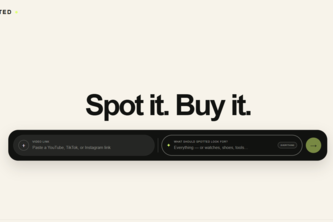
The description states: “Spot it. Buy it. Spotted.ai transforms social videos into shoppable moments, using OpenAI Vision to identify products, verify matches, and link you to exactly what you saw.”
- Inferred The product appears to be a tool that processes social media video content to extract product information.
- Inferred It uses OpenAI Vision models (gpt-5.6-luna, gpt-5.6-sol, gpt-5.6-terra) for visual recognition and matching.
- Inferred The output is intended to enable users to purchase the identified products directly from the video context.
Not evidenced No details on how the product works beyond model usage, nor any demonstration or prototype shown.
Positioning & Claim Evolution
The tagline: “Spot it. Buy it.” suggests a focus on visual discovery and immediate commerce.
- Claimed positioning: A platform that bridges social media consumption with direct purchasing.
- Inferred evolution: The project is positioned as a tool for turning casual video viewing into transactional moments, likely targeting influencer or consumer-generated content.
Not evidenced No indication of prior positioning, branding, or evolution in messaging. This is the only claim made about the product’s purpose.
Target Customer & ICP
The description does not state who the target customer is or what constitutes an ideal customer profile (ICP).
- Claimed audience: Likely social media users, influencers, or brands looking to monetize visual content.
- Inferred The tool may be aimed at creators or platforms that want to add shoppable elements to video content.
Not evidenced No explicit customer segmentation, user personas, or buyer profiles are provided.
Business Model & Pricing Evidence
There is no evidence of a business model or pricing structure in the description.
- Inferred If this were a commercial product, it might be monetized through usage fees, affiliate commissions, or platform partnerships.
- Not evidenced No mention of revenue streams, pricing tiers, or monetization strategy.
Technical & Delivery Signals
The author-declared tech stack includes:
- ffmpeg, ffprobe
- gpt-5.6-luna, gpt-5.6-sol, gpt-5.6-terra
- node.js, python
- serp-ai
- Inferred The project uses video processing tools and OpenAI’s vision models for product identification.
- Inferred It likely integrates with search or commerce APIs (via serp-ai).
- Not evidenced No information on architecture, scalability, or delivery mechanism.
Traction & Maturity Signals
The description states that the project was submitted to the OpenAI 2026 hackathon and is built by a team of three members.
- Inferred This is a prototype or proof-of-concept, not a mature product.
- Not evidenced No evidence of user adoption, revenue, or customer feedback. No mention of prior versions or iterations.
Competitive Context
The description does not provide any information about competitors or the competitive landscape.
- Inferred The space may include tools for visual search, social commerce, or AI-powered product identification.
- Not evidenced No mention of existing solutions, market size, or differentiation strategy.
Open Questions & Risks
- Risk: The project is a hackathon submission with no evidence of traction or commercial viability.
- Open question: Lack of any business model, pricing, or customer data.
- Open question: No demonstration or prototype provided; only a tagline and tech stack.
Questions the description leaves open
- What is the intended user journey from video viewing to purchase?
- How does the product verify product matches in real-world videos?
- Are there any existing partnerships or integrations with social platforms or e-commerce sites?
- What are the key assumptions about user behavior and monetization?
- Has the team validated demand for this solution with potential users?
Overall Assessment
Not evidenced No basis to assess investment or partnership viability.
- Inferred This is a very early-stage idea, likely a hackathon prototype.
- Inferred It lacks commercial evidence, traction, or clear monetization strategy.
- Confidence level: Low — the description provides no evidence of product-market fit or business traction.
User Stories BotA demo video on every pull request
Get a demo video on every new feature
GitHub App that watches your pull requests and records a narrated, captioned demo.
Save time on demo prep and make informed decisions faster with a video walkthrough of every new feature.
Source
Submitted to the OpenAI 2026 hackathon on Devpost. Project home on Devpost. Back to the full gallery on Devpost.
This competitive analysis was produced by top-founders.com (opens in a new tab)
Generated by a language model from this project's public Devpost page — its tagline and any built-with tags listed there, since the author published no write-up — as captured in August 2026. Short quotations are the author's words. It is an opinion on the idea as a business, not on the people behind it, and it reflects the description as published then. If the project has moved on, request a correction below. The analysis is not independent research and contains no verified traction, revenue or customer data.
An independent guide by KFG International LLC — not affiliated with, endorsed by, or connected to Devpost or OpenAI.