

Archive position — measured, not model output
0 likes on Devpost
2,263 of the 7,850 archived projects have more likes, and 5,587 share exactly 0 — so this project's #6,235 place in the like-ranked listing is a tie-break inside that group, not a ranking.
Projects (log scale)
Likes on Devpost. ▲ marks this project's group.
Show the figures
| Likes | Projects | Share of archive |
|---|---|---|
| 0 | 5,587 | 71.2% |
| 1 | 1,758 | 22.4% |
| 2 | 284 | 3.6% |
| 3–4 | 132 | 1.7% |
| 5–9 | 75 | 1.0% |
| 10+ | 14 | 0.2% |
 User Stories BotA demo video on every pull request
Get a demo video on every new feature
GitHub App that watches your pull requests and records a narrated, captioned demo.
Save time on demo prep and make informed decisions faster with a video walkthrough of every new feature.
Executive Summary
What the company appears to be
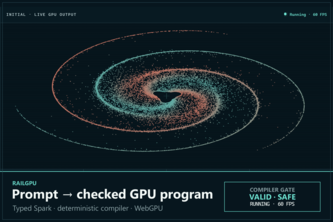
RailGPU is a self-reported project by one developer (Laurin Feulner) that aims to make GPU programming more accessible through an abstraction layer for AI agents. It introduces a "tiny typed language" called Spark, which compiles into WebGPU code using a deterministic compiler. The goal is to reduce token usage and improve safety when AI models generate GPU programs.
What changed
The project was submitted as part of the OpenAI 2026 hackathon. It represents an experimental approach to integrating LLMs with structured, compiler-checked intermediate languages for constrained domains like GPU computing.
Single most important open question
Is there evidence that the proposed compiler-based abstraction improves correctness or efficiency in real-world use cases beyond exploratory benchmarks?
What The Product Actually Is
The description states:
- RailGPU is a system that allows AI agents to generate GPU programs via a small typed language called Spark.
- These Spark programs are validated by a deterministic compiler before execution in the browser.
- It targets WebGPU-accelerated simulations and aims to reduce boilerplate and hallucinations common in raw GPU code generation.
- The system includes a generic viewer that supports particle systems, cellular automata, stencil simulations, and small N-body systems without custom host code.
Inference The product appears to be an experimental prototype built during a hackathon. It uses Codex tools (GPT-5.6) for implementation and focuses on reducing LLM token consumption while increasing safety in GPU programming.
Positioning & Claim Evolution
The description states:
- The project aims to make GPU programming more accessible by abstracting away boilerplate.
- It seeks to improve AI agent performance by limiting the scope of code generation through a deterministic compiler.
- The author claims that this approach can lead to safer, more token-efficient outputs compared to direct WGSL generation.
Inference The positioning evolves from a hackathon experiment into a broader hypothesis: using compiler-checked DSLs could enhance LLM reliability in constrained domains such as databases or robotics. However, no evidence of traction or adoption exists beyond the author's own claims.
Target Customer & ICP
The description states:
- The primary audience is AI agents tasked with generating GPU code.
- It targets developers who work with WebGPU and want to reduce errors and token usage in their workflows.
- The system supports simulations that can be visualized via a browser-based viewer.
Inference There is no clear indication of a defined customer base beyond the author’s own use case. No named customers, partnerships or user segments are mentioned.
Business Model & Pricing Evidence
The description states:
- No explicit business model or pricing information is provided.
- The project is presented as a hackathon submission with no commercialization strategy described.
Inference There is no evidence of any monetization plan or pricing structure. This remains unaddressed in the self-reported materials.
Technical & Delivery Signals
The description states:
- Built using TypeScript, WGSL, and Codex tools.
- The compiler is described as deterministic and validates constraints.
- GPT-5.6 was used for implementation within a Codex harness or Claude Code.
- Supports particle systems, cellular automata, stencil simulations, and small N-body systems.
Inference The technical stack suggests a prototype built in a constrained environment (hackathon). There is no evidence of production-grade infrastructure or delivery mechanisms beyond the author’s own development setup.
Traction & Maturity Signals
The description states:
- The project was submitted to the OpenAI 2026 hackathon.
- Early benchmark results show ~2–3× fewer tokens emitted while maintaining validity.
- Every prompt, source, repair, and token count is retained in the repository.
- The author notes that current methodology lacks statistical significance.
Inference There is no evidence of customer adoption, revenue, or product-market fit. Traction is limited to internal experiments and exploratory benchmarks.
Competitive Context
The description states:
- No mention of competitors or existing solutions in the space.
- The author references wgpu/WGSL and headless simulation platforms but does not compare RailGPU to other tools or frameworks.
Inference No competitive analysis is provided. The project appears to be a novel idea within a niche area, but its positioning relative to existing GPU programming tools or LLM integration systems is unclear.
Open Questions & Risks
The description states:
- The author is the sole team member.
- The project is experimental and based on exploratory benchmarks.
- No clear path to product-market fit or scalability.
- The methodology for benchmarking effectiveness is noted as lacking statistical significance.
Inference Key risks include lack of validation, limited team capacity, unproven commercial viability, and absence of real-world use cases. The project may be too early-stage to assess its potential impact.
Questions the description leaves open
- What specific problems are you trying to solve in the current GPU programming workflow?
- How do you plan to validate the effectiveness of the compiler-based approach beyond exploratory benchmarks?
- Are there any plans for expanding beyond WebGPU or targeting other domains like robotics or databases?
- What is your roadmap for scaling this beyond a hackathon prototype?
- Do you have any early adopters or users who are interested in testing or using RailGPU?
Overall Assessment
The description states:
- The project is an experimental hackathon submission with no revenue, customers, or traction data.
- It introduces a novel concept but lacks evidence of commercial viability or product-market fit.
Inference At this stage, there is insufficient evidence to support investment or partnership interest. The idea shows promise in theory but has not demonstrated measurable impact or scalability. Further validation through real-world usage and robust benchmarking would be required before considering deeper engagement.
User Stories BotA demo video on every pull request
Get a demo video on every new feature
GitHub App that watches your pull requests and records a narrated, captioned demo.
Save time on demo prep and make informed decisions faster with a video walkthrough of every new feature.
Source
Submitted to the OpenAI 2026 hackathon on Devpost. Project home on Devpost. Back to the full gallery on Devpost.
This competitive analysis was produced by top-founders.com (opens in a new tab)
Generated by a language model from this project's public Devpost page — its tagline, the author's own write-up and any built-with tags listed there — as captured in August 2026. Short quotations are the author's words. It is an opinion on the idea as a business, not on the people behind it, and it reflects the description as published then. If the project has moved on, request a correction below. The analysis is not independent research and contains no verified traction, revenue or customer data.
An independent guide by KFG International LLC — not affiliated with, endorsed by, or connected to Devpost or OpenAI.