

Archive position — measured, not model output
1 like on Devpost
505 of the 7,850 archived projects have more likes, and 1,758 share exactly 1 — so this project's #1,964 place in the like-ranked listing is a tie-break inside that group, not a ranking.
Projects (log scale)
Likes on Devpost. ▲ marks this project's group.
Show the figures
| Likes | Projects | Share of archive |
|---|---|---|
| 0 | 5,587 | 71.2% |
| 1 | 1,758 | 22.4% |
| 2 | 284 | 3.6% |
| 3–4 | 132 | 1.7% |
| 5–9 | 75 | 1.0% |
| 10+ | 14 | 0.2% |
 User Stories BotA demo video on every pull request
Get a demo video on every new feature
GitHub App that watches your pull requests and records a narrated, captioned demo.
Save time on demo prep and make informed decisions faster with a video walkthrough of every new feature.
Executive Summary
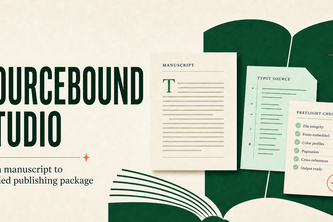
What the company appears to be: Sourcebound Studio is a self-reported AI-assisted publishing workflow tool designed for independent creators who want to move manuscripts toward print-ready packages with deterministic checks and creator-approved fixes. It claims to offer a source-first approach where outputs remain traceable to their original material.
What changed: The author states that this project emerged from personal need during a self-publishing journey, and was shaped through an OpenAI Build Week hackathon. It evolved from a side project into a potential product with a defined architecture involving GPT-5.6, Typst, and deterministic validation layers.
Single most important open question: Is there evidence of traction or early adoption by independent creators? The description does not state whether any users exist beyond the founder, nor whether the tool has been used in real-world publishing workflows.
Note: This analysis is based solely on the self-reported project description provided. No external verification, revenue data, customer names, or traction metrics are available.
What The Product Actually Is
The description states that Sourcebound Studio is a source-first, AI-assisted self-publishing workflow aimed at helping creators move manuscripts toward print-ready packages. It includes two main surfaces:
- Creator Studio: A human-facing workspace where users can upload documents (Word, PDF, Markdown), interact with GPT-5.6 for editorial decisions, choose book specifications, and generate a PDF proof.
- Workflow Evidence Lab: An interface showing the publishing process in six stages—manuscript, book description, editorial plan, build, review, export—and presenting how deterministic checks ensure reproducibility.
The system uses:
- GPT-5.6 for interpretation and planning
- Typst for deterministic PDF composition
- Codex (presumably an AI assistant) for development support
- OpenAI Responses API for interaction with GPT
It is described as a local-first or hybrid publishing studio, where creators benefit from cloud-based AI services without losing ownership of their files.
Inference: The product appears to be a prototype built during a hackathon, not yet commercialized. It has no stated revenue or customer base.
Positioning & Claim Evolution
The author claims that Sourcebound Studio helps creators avoid repetitive coordination and negotiation in publishing by automating parts of the workflow while maintaining control over final output.
Key positioning elements:
- AI planning with deterministic checks
- Creator-approved fixes
- Reproducible publishing packages
- Source traceability
It positions itself as a tool that allows creators to explore formats, revise titles, or rebuild editions without restarting the entire production process.
Inference: The evolution of the idea seems to have started from personal frustration with traditional publishing tools and evolved into a structured workflow during a hackathon. There is no evidence of prior market positioning or branding beyond this narrative.
Target Customer & ICP
The description identifies the primary user as an independent creator who also acts as editor, production coordinator, layout operator, proofreader, file manager, and publisher.
These users are characterized by:
- Juggling multiple roles
- Limited time
- Need for control over their work
- Desire to avoid starting from scratch when revising or changing formats
They may be self-published authors, content creators, or small-scale publishers working independently.
Inference: The ICP is defined more by behavior and role than by demographic or firmographics. No specific segments or personas are named.
Business Model & Pricing Evidence
There is no mention of pricing models, monetization strategies, or business model in the description.
The author states that the goal is to let creators understand what changed, approve it, and reproduce the result — but does not describe how this will be sold or whether there are paid tiers or subscriptions.
Not evidenced: No evidence of any commercial structure, pricing plans, or monetization strategy.
Technical & Delivery Signals
The prototype was built using:
- Framework: Next.js
- AI: GPT-5.6 via OpenAI Responses API
- Composition engine: Typst and typst.ts
- Other tech stack: React, TypeScript, Tailwind CSS, Node.js, Cloudflare Workers, PDF.js, WebAssembly
Key technical features:
- Deterministic checks before applying changes
- Human approval required for meaningful repairs
- Local storage of manuscripts until intentional sharing
- Support for multiple input formats (Word, PDF, Markdown)
- Separation between human-facing UI and underlying engine visibility (Evidence Lab)
Inference: The architecture suggests a hybrid approach combining agentic AI with deterministic validation. However, no evidence exists about scalability or deployment in production environments.
Traction & Maturity Signals
The description states:
- Team size: 0
- No named members
- Built during OpenAI Build Week (a hackathon)
- Prototype exists but is not yet commercialized
- No mention of early users, customers, or adoption
Not evidenced: No evidence of traction, revenue, customer base, or product maturity beyond prototype stage.
Competitive Context
No direct competitors are named in the description. However, the author references traditional publishing software that creators often use, such as Affinity Publisher, which is noted as optional for highly visual editions.
The space includes:
- Self-publishing platforms (e.g., Amazon KDP, IngramSpark)
- AI writing tools (e.g., Jasper, Copy.ai)
- Document composition tools (e.g., LaTeX, Typst itself)
Inference: The competitive landscape likely includes general-purpose publishing and document management tools. No evidence of existing direct competitors or market positioning.
Open Questions & Risks
- No traction or user base: The project is described as a prototype built during a hackathon with no known users.
- Unproven AI integration: While GPT-5.6 is used, there's no evidence of how well it integrates into the workflow or handles real-world editing tasks.
- Lack of commercial viability: No pricing, monetization, or business model described.
- Unclear scalability: The tool is built for local-first use; unclear if it scales to larger teams or enterprise needs.
- Founder-only team: No evidence of a team beyond the individual founder.
Inference: The risk of failure is high due to lack of product-market fit, user feedback, and commercialization strategy.
Questions the description leaves open
- What specific problems do you observe in current self-publishing workflows that your tool addresses?
- Have you tested the workflow with actual independent creators? If so, what were their reactions?
- How does the system handle edge cases like complex formatting or multi-language manuscripts?
- Are there any known limitations of GPT-5.6 in this context that affect reliability?
- What is your plan for monetization and scaling beyond the prototype?
- Do you have a roadmap for expanding support for cover design, OCR, or version control?
Overall Assessment
There is no evidence of traction, revenue, or customer adoption. The project is described as a prototype built during a hackathon with no team beyond the founder.
It is positioned as a solution to inefficiencies in self-publishing workflows but lacks any demonstration of real-world usage or commercial viability.
Confidence level: Low — based entirely on self-reported narrative without external validation or data.
Assessment: Not ready for investment or partnership at this stage. Further due diligence would require evidence of early users, product-market fit, and a clear go-to-market strategy.
User Stories BotA demo video on every pull request
Get a demo video on every new feature
GitHub App that watches your pull requests and records a narrated, captioned demo.
Save time on demo prep and make informed decisions faster with a video walkthrough of every new feature.
Source
Submitted to the OpenAI 2026 hackathon on Devpost. Project home on Devpost. Back to the full gallery on Devpost.
This competitive analysis was produced by top-founders.com (opens in a new tab)
Generated by a language model from this project's public Devpost page — its tagline, the author's own write-up and any built-with tags listed there — as captured in August 2026. Short quotations are the author's words. It is an opinion on the idea as a business, not on the people behind it, and it reflects the description as published then. If the project has moved on, request a correction below. The analysis is not independent research and contains no verified traction, revenue or customer data.
An independent guide by KFG International LLC — not affiliated with, endorsed by, or connected to Devpost or OpenAI.