

Archive position — measured, not model output
0 likes on Devpost
2,263 of the 7,850 archived projects have more likes, and 5,587 share exactly 0 — so this project's #6,781 place in the like-ranked listing is a tie-break inside that group, not a ranking.
Projects (log scale)
Likes on Devpost. ▲ marks this project's group.
Show the figures
| Likes | Projects | Share of archive |
|---|---|---|
| 0 | 5,587 | 71.2% |
| 1 | 1,758 | 22.4% |
| 2 | 284 | 3.6% |
| 3–4 | 132 | 1.7% |
| 5–9 | 75 | 1.0% |
| 10+ | 14 | 0.2% |
 User Stories BotA demo video on every pull request
Get a demo video on every new feature
GitHub App that watches your pull requests and records a narrated, captioned demo.
Save time on demo prep and make informed decisions faster with a video walkthrough of every new feature.
Executive Summary
What the company appears to be
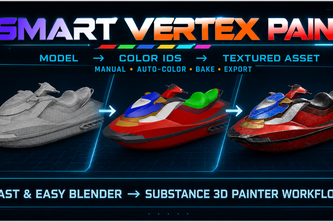
Smart Vertex Paint (SVP) is a Blender extension developed by one person — Przemyslaw Rodewald — that automates parts of the 3D artist workflow for assigning Color IDs to models, primarily for use in Substance 3D Painter and game engines like Unity, Unreal Engine, and Godot. It uses Blender’s native Color Attributes system and integrates AI tools (OpenAI Codex and GPT-5.6) into its development process.
What changed
The author states that SVP emerged from a personal need to reduce repetitive work in preparing 3D assets for XR game projects. The tool was built iteratively with AI assistance, focusing on manual control while speeding up tasks like geometry-based or UV-based color assignment.
Single most important open question
Is there evidence of adoption or usage beyond the creator's own workflow? There is no indication of external users, revenue, or traction — only a self-reported development process and use case.
What The Product Actually Is
The description states that Smart Vertex Paint (SVP) is a Blender extension. It uses Blender’s native Color Attributes system to assign numbered colors to different parts of a 3D model.
Key features include:
- Manual selection and assignment of numbered colors.
- Automatic generators for:
- By Geometry (3D)
- By UV Map (2D)
- By Geometry Size (3D)
- By UV Size (2D)
- Ability to bake Color IDs into a PNG image.
- Export selected meshes to FBX while preserving vertex colors.
- Integration with Substance 3D Painter and game engines such as Unity, Unreal Engine, Godot.
The tool is described as being built using Blender’s API, with support for:
- Mesh editing
- Multi-object workflows
- Interface behavior
- Packaging
- Documentation
Inference The product is a plugin or add-on for Blender, not a standalone application. It integrates into an existing 3D artist workflow.
Positioning & Claim Evolution
The author states that SVP was created to remove repetitive technical work in preparing 3D assets for game development, especially in XR projects. The goal was not to automate artistic decisions but to speed up the process of assigning Color IDs.
It positions itself as a tool that:
- Begins in Blender
- Continues into Substance 3D Painter and game engines
- Helps artists focus on creativity rather than repetitive tasks
The positioning is framed around workflow efficiency, artist control, and AI-assisted development. It does not claim to be a full pipeline solution or a commercial product.
Inference The tool is positioned as a productivity helper for 3D artists, not a commercial offering with a defined market or pricing model.
Target Customer & ICP
The description states that the author’s target audience includes:
- Artists working on XR game projects
- Users of Blender, Substance 3D Painter, and game engines like Unity, Unreal Engine, and Godot
- Professionals who need to assign Color IDs to complex 3D models
There is no explicit segmentation beyond the general category of 3D artists or developers working in XR.
Inference The ICP appears to be 3D artists or developers in XR game development, with a focus on workflow optimization and time-saving tools.
Business Model & Pricing Evidence
The description does not contain any information about:
- Revenue streams
- Pricing models
- Monetization strategy
- Paid features or subscriptions
It only describes the tool as being built by one person for personal use, then potentially shared with others.
Inference No business model or pricing evidence is provided. The tool may be free, open-source, or intended for personal use only — but this is not stated.
Technical & Delivery Signals
The author states that SVP was built using:
- Blender API
- OpenAI Codex and GPT-5.6
- Iterative human-AI collaboration
It supports:
- Blender’s Color Attributes system
- Mesh editing
- Multi-object workflows
- Exporting to FBX with preserved vertex colors
- Baking to PNG for texture-based workflows
The author tested every feature using real production assets and refined the tool through feedback loops.
Inference The tool is technically grounded in Blender’s native capabilities, and AI was used to accelerate development. However, there is no evidence of scalability or deployment infrastructure beyond a single developer's workflow.
Traction & Maturity Signals
The description states:
- The project was submitted to the OpenAI 2026 hackathon
- It was built by one person (Przemyslaw Rodewald)
- It uses real production assets for testing
- It is a Blender extension, not a web or SaaS product
There is no mention of:
- Users or customers
- Revenue or monetization
- Downloads or usage statistics
- Product maturity beyond the initial version
Inference The tool is in an early stage, likely a prototype or MVP. No traction or adoption data is provided.
Competitive Context
The description does not provide any information about:
- Competitors
- Market positioning relative to other tools
- Similar products in the 3D artist workflow space
It only describes SVP as a Blender extension that helps with Color ID assignment and integrates with Substance 3D Painter.
Inference No competitive context is evident. The tool may be unique or niche, but there is no evidence of existing alternatives or market dynamics.
Open Questions & Risks
- Single-person development: The entire project was built by one person — this raises questions about scalability, long-term maintenance, and support.
- No monetization strategy: No indication of how the tool will be sold or funded.
- Unverified AI claims: The use of GPT-5.6 is self-reported; no evidence of actual implementation or performance metrics.
- No external validation or adoption: There is no mention of users, feedback, or community engagement.
- Limited scope: The tool is focused on a narrow workflow within 3D art and game development.
Inference Risks include lack of product-market fit, limited commercial viability, and potential technical limitations due to single-person ownership.
Questions the description leaves open
- What is the actual usage or adoption rate beyond personal use?
- Is there a plan for monetization or distribution (e.g., open-source, paid plugin)?
- How does SVP handle compatibility across different versions of Blender?
- Are there any plans to expand beyond the current set of automatic generators?
- What are the long-term goals for the tool — is it intended as a commercial product or a personal utility?
Overall Assessment
The description states that Smart Vertex Paint (SVP) is a Blender extension built by one developer to solve a personal workflow problem. It is not described as a commercial product, nor does it show evidence of traction, revenue, or external adoption.
There is no indication of:
- Revenue
- Customers
- Market demand
- Product maturity beyond prototype stage
Inference This is likely an early-stage, personal project, possibly with potential for future development. It is not currently a viable investment or partnership opportunity based on the provided information.
User Stories BotA demo video on every pull request
Get a demo video on every new feature
GitHub App that watches your pull requests and records a narrated, captioned demo.
Save time on demo prep and make informed decisions faster with a video walkthrough of every new feature.
Source
Submitted to the OpenAI 2026 hackathon on Devpost. Project home on Devpost. Back to the full gallery on Devpost.
This competitive analysis was produced by top-founders.com (opens in a new tab)
Generated by a language model from this project's public Devpost page — its tagline, the author's own write-up and any built-with tags listed there — as captured in August 2026. Short quotations are the author's words. It is an opinion on the idea as a business, not on the people behind it, and it reflects the description as published then. If the project has moved on, request a correction below. The analysis is not independent research and contains no verified traction, revenue or customer data.
An independent guide by KFG International LLC — not affiliated with, endorsed by, or connected to Devpost or OpenAI.