

Archive position — measured, not model output
0 likes on Devpost
2,263 of the 7,850 archived projects have more likes, and 5,587 share exactly 0 — so this project's #6,754 place in the like-ranked listing is a tie-break inside that group, not a ranking.
Projects (log scale)
Likes on Devpost. ▲ marks this project's group.
Show the figures
| Likes | Projects | Share of archive |
|---|---|---|
| 0 | 5,587 | 71.2% |
| 1 | 1,758 | 22.4% |
| 2 | 284 | 3.6% |
| 3–4 | 132 | 1.7% |
| 5–9 | 75 | 1.0% |
| 10+ | 14 | 0.2% |
 User Stories BotA demo video on every pull request
Get a demo video on every new feature
GitHub App that watches your pull requests and records a narrated, captioned demo.
Save time on demo prep and make informed decisions faster with a video walkthrough of every new feature.
Executive Summary
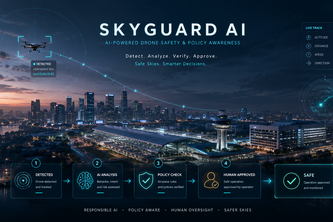
SkyGuard AI is a self-reported simulation, evaluation and training platform for AI decision-making models in drone incident scenarios. The author states it evaluates sequential decision policies using simulated multi-step incidents, supports multiple model types (GRU, Decision Transformer, CQL, LLMs), and enforces strict safety rules through a deterministic policy gate and verifier. It does not control hardware or perform physical actions; its purpose is to make model limitations visible before trust is placed in consequential decisions.
The platform currently supports external frontier LLMs via an OpenAI-compatible interface while maintaining internal model checkpoints with canonical digests for provenance. It includes features like dataset generation, side-by-side model comparison, episode replay, and safety metrics. The system records failed evaluations honestly and treats invalid outputs as abstentions rather than silent fallbacks.
The most important open question is whether the platform has been used in any real-world evaluation or training context beyond this single developer's project, which would indicate commercial viability or traction.
What The Product Actually Is
The description states that SkyGuard AI is:
- An AI simulation, evaluation and training platform for sequential decision models
- Designed to evaluate AI agents making drone incident decisions
- A platform that creates simulated multi-step drone incidents for training and evaluation
- Capable of supporting multiple model types including GRU-based behavioural modelling, Decision Transformer policies, Conservative Offline Reinforcement Learning using Discrete CQL, deterministic scripted baselines, and external frontier LLMs through an OpenAI-compatible provider interface
- Used to evaluate models thoroughly before they are considered for use in downstream products such as TALON
The platform is described as not controlling hardware or performing physical actions; it evaluates models and makes their limitations visible.
Positioning & Claim Evolution
The description states that SkyGuard AI was inspired by the author's earlier work on Frontier, a long-horizon evaluation environment for tool-using AI agents. The positioning evolved from:
- A focus on detection (traditional drone safety systems) to
- Evaluation of decision-making processes in incomplete evidence scenarios
- From judging models only by final answers to understanding decisions made, evidence used, safety rules followed, and failure points
The platform is positioned as an evaluation system designed to explain why a candidate model should or should not be trusted, rather than just a demo.
Target Customer & ICP
Not evidenced. The description does not state who the target customers are or what their specific needs are beyond the author's own use case.
Business Model & Pricing Evidence
Not evidenced. The description does not contain any information about pricing, revenue streams, or business model.
Technical & Delivery Signals
The platform is built with:
- Backend in Python
- Dashboard in Next.js, React and TypeScript
- SQLite for local evaluation records and provenance
- Supports temporal datasets, checkpoint creation, model evaluation and replay
- Uses canonical digests to bind datasets, configurations and model artefacts so that evaluation results cannot silently refer to different models or datasets
- External frontier LLMs supported through OpenAI-compatible provider interface
- Deliberately restricted public projection containing only:
- Public observation history
- Public evidence references
- Current action mask
- Approval availability
- Simulation time and bounded incident history
- Malformed JSON, unsupported actions, masked actions, invalid evidence references, timeouts or provider failures safely fall back to ABSTAIN_INSUFFICIENT_EVIDENCE
Traction & Maturity Signals
Not evidenced. The description does not contain any information about revenue, customers, adoption, or traction beyond the author's own development work.
Competitive Context
Not evidenced. The description does not mention competitors or the competitive landscape.
Open Questions & Risks
- The platform is described as a single-developer project with no evidence of commercial use or traction
- It is explicitly stated that it does not control hardware, perform physical responses or provide production-safety certification
- The system is described as a simulation and evaluation platform for training purposes only
- No information about scalability, performance, or integration capabilities beyond the author's own development environment
- The project appears to be a hackathon submission with no indication of ongoing development or commercialization plans
Questions the description leaves open
- What is the intended use case for SkyGuard AI beyond this single developer's project?
- Has the platform been used in any real-world evaluation or training contexts?
- Are there any customers or partners interested in using this platform?
- What are the plans for commercialization or monetization?
- How does the platform handle data privacy and security concerns when evaluating external models?
- What is the roadmap for expanding support to additional provider adapters and domains?
- How does the platform ensure reproducibility across different environments and dependencies?
Overall Assessment
Not evidenced. The description does not contain any information about investment or partnership opportunities, nor does it indicate whether the project has moved beyond the prototype stage or has any commercial traction.
User Stories BotA demo video on every pull request
Get a demo video on every new feature
GitHub App that watches your pull requests and records a narrated, captioned demo.
Save time on demo prep and make informed decisions faster with a video walkthrough of every new feature.
Source
Submitted to the OpenAI 2026 hackathon on Devpost. Project home on Devpost. Back to the full gallery on Devpost.
This competitive analysis was produced by top-founders.com (opens in a new tab)
Generated by a language model from this project's public Devpost page — its tagline, the author's own write-up and any built-with tags listed there — as captured in August 2026. Short quotations are the author's words. It is an opinion on the idea as a business, not on the people behind it, and it reflects the description as published then. If the project has moved on, request a correction below. The analysis is not independent research and contains no verified traction, revenue or customer data.
An independent guide by KFG International LLC — not affiliated with, endorsed by, or connected to Devpost or OpenAI.