

Archive position — measured, not model output
0 likes on Devpost
2,263 of the 7,850 archived projects have more likes, and 5,587 share exactly 0 — so this project's #2,830 place in the like-ranked listing is a tie-break inside that group, not a ranking.
Projects (log scale)
Likes on Devpost. ▲ marks this project's group.
Show the figures
| Likes | Projects | Share of archive |
|---|---|---|
| 0 | 5,587 | 71.2% |
| 1 | 1,758 | 22.4% |
| 2 | 284 | 3.6% |
| 3–4 | 132 | 1.7% |
| 5–9 | 75 | 1.0% |
| 10+ | 14 | 0.2% |
 User Stories BotA demo video on every pull request
Get a demo video on every new feature
GitHub App that watches your pull requests and records a narrated, captioned demo.
Save time on demo prep and make informed decisions faster with a video walkthrough of every new feature.
Executive Summary
What the company appears to be
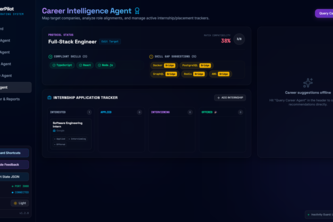
The project described by the author is a self-contained, full-stack AI-powered career coaching platform named "Autonomous AI Career Co-Pilot & Mock Training OS". It is built as a personal assistant-style tool that orchestrates 7 specialized micro-agents around persistent memory, adaptive mock interviews, and human-in-the-loop safety. The system is described as an autonomous operating system for career development.
What changed
The author states this is a hackathon submission (OpenAI 2026) with no prior commercial traction or product history. It represents a single developer’s prototype built in a short timeframe using AI code generation tools like OpenAI Codex and GPT-5.6, with no evidence of prior revenue, customers, or market adoption.
Single most important open question
Is there any evidence that this platform has been used by real users beyond the author's own development experience? The description contains no data on user engagement, retention, or commercial viability — only claims about functionality and architecture.
What The Product Actually Is
The description states:
- CareerPilot AI OS is an autonomous, state-aware AI career co-pilot coordinating 7 specialized micro-agents.
- It maintains a persistent cross-session memory store.
- It includes agents for resume optimization, mock interviews, learning sprints, cover letters, scheduling, and progress logging.
- It uses Human-in-the-Loop (HITL) safety to require user consent before AI actions.
- The system integrates voice input via Web Speech API and supports real-time dictation during interviews.
Inference This is a personal productivity tool for job seekers that attempts to automate career development through AI orchestration. It is not a SaaS product or marketplace, but rather an internal agent-based OS designed for individual use.
Positioning & Claim Evolution
The author claims:
- The platform is inspired by autonomous operating systems and human-agent co-pilots.
- It aims to solve fragmentation in job-seeking tools (e.g., ChatGPT, Notion, YouTube).
- It provides a unified experience that remembers user progress across sessions.
- It offers adaptive learning and interview simulation based on memory.
Inference The positioning is aspirational — the author positions this as an AI-powered career OS that can coordinate multiple functions without requiring users to switch between apps. However, no evidence exists of actual market demand or competitive differentiation from existing tools like Notion, LinkedIn Learning, or InterviewBuddy.
Target Customer & ICP
The description states:
- The target is job seekers preparing for technical interviews.
- It supports software engineers and professionals seeking career advancement.
- It is designed to be used by individuals in their personal development journey.
Inference The ICP appears to be early-career or mid-career software engineers who are actively job hunting. However, there is no evidence of actual user segmentation, personas, or feedback from target users beyond the author’s own experience.
Business Model & Pricing Evidence
The description does not mention:
- Any pricing model.
- Revenue streams.
- Monetization strategy.
- Subscription plans or usage-based billing.
Inference There is no evidence of a business model. The project is presented as a hackathon prototype, with no indication of monetization or commercial intent beyond the author’s own use case.
Technical & Delivery Signals
The description states:
- Built with React 18, TypeScript, Tailwind CSS, Express.js, D3.js, Framer Motion.
- Uses OpenAI Codex and GPT-5.6 for code generation and agent orchestration.
- Implements a local JSON-based persistence layer.
- Features voice recognition via Web Speech API.
- Includes custom memory pruning algorithm using exponential decay.
Inference The technical stack is modern and full-stack, with AI integration at the core. The use of Codex suggests rapid prototyping, but lacks evidence of scalability or production-grade infrastructure. The system appears to be a proof-of-concept rather than a scalable product.
Traction & Maturity Signals
The description states:
- This is a hackathon submission.
- It was built in a short timeframe (presumably during the hackathon).
- No mention of user adoption, retention, or usage metrics.
- The author claims full functionality and zero UI mockups.
Inference There are no signs of traction or maturity. The project is described as a prototype with no evidence of real-world deployment or user feedback. It has not been tested in production or scaled beyond one developer’s environment.
Competitive Context
The description does not mention:
- Competitors.
- Market analysis.
- Existing tools in the career development space (e.g., LinkedIn, Coursera, InterviewBuddy).
Inference No competitive positioning or market context is provided. The author does not reference existing solutions or explain how this differs from them.
Open Questions & Risks
The description states:
- The system uses GPT-5.6 and OpenAI Codex — both of which are proprietary and may not be available for commercial use.
- It relies on a single developer (team size = 1).
- No evidence of user testing or feedback loops.
- The HITL safety mechanism is described but not demonstrated in practice.
Inference
Key risks include:
- Dependency on unreleased or non-commercial AI models.
- Lack of team or development support beyond one person.
- No real-world validation or user data to confirm utility.
- Potential for over-engineering without proven demand.
Questions the description leaves open
- What is the actual user base? Has anyone besides you used this tool?
- How do you plan to monetize it? Is there a business model beyond personal use?
- Can you demonstrate real-world performance or usage data?
- What are the limitations of GPT-5.6 and Codex in a commercial setting?
- How would you scale this system beyond one developer’s prototype?
- Are there any legal or ethical concerns with using HITL safety in a product context?
Overall Assessment
Not evidenced.
There is no evidence of revenue, customers, traction, or commercial viability. The project is described as a hackathon submission by a single developer and lacks any indication of market readiness or scalability.
The author claims the system works in full functionality but provides no data to support that assertion beyond self-reporting. The product appears to be a prototype with no evidence of real-world application or user engagement.
Confidence Level: Low.
This analysis is based entirely on the author's own description, which is unverified and self-reported. No third-party validation, customer data, or financials are available.
User Stories BotA demo video on every pull request
Get a demo video on every new feature
GitHub App that watches your pull requests and records a narrated, captioned demo.
Save time on demo prep and make informed decisions faster with a video walkthrough of every new feature.
Source
Submitted to the OpenAI 2026 hackathon on Devpost. Project home on Devpost. Back to the full gallery on Devpost.
This competitive analysis was produced by top-founders.com (opens in a new tab)
Generated by a language model from this project's public Devpost page — its tagline, the author's own write-up and any built-with tags listed there — as captured in August 2026. Short quotations are the author's words. It is an opinion on the idea as a business, not on the people behind it, and it reflects the description as published then. If the project has moved on, request a correction below. The analysis is not independent research and contains no verified traction, revenue or customer data.
An independent guide by KFG International LLC — not affiliated with, endorsed by, or connected to Devpost or OpenAI.