

Archive position — measured, not model output
0 likes on Devpost
2,263 of the 7,850 archived projects have more likes, and 5,587 share exactly 0 — so this project's #6,725 place in the like-ranked listing is a tie-break inside that group, not a ranking.
Projects (log scale)
Likes on Devpost. ▲ marks this project's group.
Show the figures
| Likes | Projects | Share of archive |
|---|---|---|
| 0 | 5,587 | 71.2% |
| 1 | 1,758 | 22.4% |
| 2 | 284 | 3.6% |
| 3–4 | 132 | 1.7% |
| 5–9 | 75 | 1.0% |
| 10+ | 14 | 0.2% |
 User Stories BotA demo video on every pull request
Get a demo video on every new feature
GitHub App that watches your pull requests and records a narrated, captioned demo.
Save time on demo prep and make informed decisions faster with a video walkthrough of every new feature.
Executive Summary
What the company appears to be
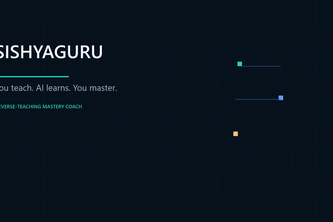
SishyaGuru is a self-reported educational tool built for a curated Water Cycle lesson, using reverse-teaching to assess mastery. The product allows learners to teach concepts and receive feedback from an AI that acts as a curious novice. It uses GPT-5.6 for structured assessments and integrates voice input via gpt-4o-mini-transcribe.
What changed
The project is described as a hackathon submission, built in a short timeframe with a minimal team (1 member). It includes a public demo and repository but no evidence of revenue, customers or adoption beyond the author's own claims.
Single most important open question
Is there any independent validation that the reverse-teaching model actually improves learning outcomes for real students?
What The Product Actually Is
The description states that SishyaGuru is a reverse-teaching mastery coach for a curated Water Cycle lesson. Learners teach by text or optional voice, and the AI responds with follow-up questions based on their explanations.
- The learner submits teaching turns.
- The system uses gpt-4o-mini-transcribe for optional voice input, which is editable before submission.
- After submission, an AI (using gpt-5.6) evaluates mastery and misconceptions using structured outputs.
- The evaluation is bound by exact-quote validation: only learner-submitted text can be cited as evidence.
- A mastery map updates only when the learner's words provide sufficient evidence.
- There are no accounts, databases, or external actions; progress stays in the browser.
This is a strictly client-side application, built with Next.js 16, TypeScript, and various OpenAI APIs. It includes a deterministic Replay path for public demo purposes and a separate Live GPT-5.6 path behind an owner key.
Inference: The product is a prototype or proof-of-concept, not a production-grade SaaS offering.
Positioning & Claim Evolution
The author positions SishyaGuru as a tool that reverses the traditional learning model — instead of AI explaining concepts, learners explain them to an AI that acts like a curious novice.
- The tagline: “You teach. AI learns. You master.” reflects this positioning.
- The inspiration behind it is that reading explanations can create an illusion of understanding, but teaching forces deeper comprehension.
- The system aims to provide formative feedback, not grades or certifications.
- It emphasizes evidence-bound mastery claims and fail-closed validation to avoid unsupported AI output.
Claim: This approach improves learning by requiring learners to articulate concepts clearly.
Target Customer & ICP
The description does not name specific customers or personas. However, it implies a focus on:
- Learners in educational settings (e.g., K–12, higher education).
- Educators who may want tools for formative assessment.
- Developers or educators interested in AI-assisted learning tools.
There is no evidence of segmentation, targeting, or customer interviews.
Not evidenced: No explicit ICP or target persona defined.
Business Model & Pricing Evidence
The description does not mention any pricing model, monetization strategy, or business model. It only describes a credential-free public demo and a private Live mode behind an owner key.
- The public path is free to use.
- The Live path requires an owner key.
- No mention of subscriptions, usage fees, or enterprise licensing.
Not evidenced: No pricing, revenue model, or monetization strategy.
Technical & Delivery Signals
The system is built as a strictly client-side Next.js 16 application using:
- gpt-4o-mini-transcribe, gpt-4o-mini-tts, and gpt-5.6
- Playwright, React 19, TypeScript, Vitest
- No database or RAG pipeline
- Voice input uses browser MediaRecorder with validation
- Structured outputs from GPT-5.6 are validated against learner-submitted text
The architecture is described as small and bounded to ensure reproducibility and transparency.
Inference: The system is designed for reproducibility, not scalability or enterprise use.
Traction & Maturity Signals
There is no evidence of traction, revenue, or customer adoption. The product is described as a hackathon submission, with:
- A public GitHub repository
- A demo hosted on GitHub Pages
- A 2:25 video and captions
- Zero Axe WCAG violations in the Replay shell
- 43 unit/domain tests, linting, and build verification
Not evidenced: No user data, customer base, or usage metrics.
Competitive Context
The description does not mention competitors or market positioning. It is unclear whether SishyaGuru is intended to compete with existing AI tutoring platforms like Duolingo, Khan Academy, or Coursera.
Not evidenced: No competitive analysis or market context provided.
Open Questions & Risks
- No independent validation of learning effectiveness.
- Single-person team, which may limit scalability and product development.
- Prototype nature: Built for a hackathon, not production use.
- No monetization strategy or customer feedback loop.
- Limited scope: Only one curated lesson (Water Cycle).
- No database or persistent storage, which limits long-term learning tracking.
Inference: The project is experimental and lacks commercial viability indicators.
Questions the description leaves open
- What evidence supports the claim that reverse-teaching improves learning outcomes?
- How would you scale this beyond a single lesson (Water Cycle)?
- Are there plans to integrate with existing LMS or educational platforms?
- What is your roadmap for monetization and customer acquisition?
- How do you plan to validate the effectiveness of the AI's structured outputs in real-world settings?
Overall Assessment
The project is described as a hackathon submission with no evidence of traction, revenue, or commercial viability.
- It is a proof-of-concept, not a product ready for market.
- The architecture is minimal and reproducible but not scalable.
- No clear business model or monetization strategy is evident.
- There is no indication of customer feedback or real-world testing.
Not evidenced: No commercial readiness, revenue, or customer data to support investment or partnership.
User Stories BotA demo video on every pull request
Get a demo video on every new feature
GitHub App that watches your pull requests and records a narrated, captioned demo.
Save time on demo prep and make informed decisions faster with a video walkthrough of every new feature.
Source
Submitted to the OpenAI 2026 hackathon on Devpost. Project home on Devpost. Back to the full gallery on Devpost.
This competitive analysis was produced by top-founders.com (opens in a new tab)
Generated by a language model from this project's public Devpost page — its tagline, the author's own write-up and any built-with tags listed there — as captured in August 2026. Short quotations are the author's words. It is an opinion on the idea as a business, not on the people behind it, and it reflects the description as published then. If the project has moved on, request a correction below. The analysis is not independent research and contains no verified traction, revenue or customer data.
An independent guide by KFG International LLC — not affiliated with, endorsed by, or connected to Devpost or OpenAI.