

Archive position — measured, not model output
1 like on Devpost
505 of the 7,850 archived projects have more likes, and 1,758 share exactly 1 — so this project's #838 place in the like-ranked listing is a tie-break inside that group, not a ranking.
Projects (log scale)
Likes on Devpost. ▲ marks this project's group.
Show the figures
| Likes | Projects | Share of archive |
|---|---|---|
| 0 | 5,587 | 71.2% |
| 1 | 1,758 | 22.4% |
| 2 | 284 | 3.6% |
| 3–4 | 132 | 1.7% |
| 5–9 | 75 | 1.0% |
| 10+ | 14 | 0.2% |
 User Stories BotA demo video on every pull request
Get a demo video on every new feature
GitHub App that watches your pull requests and records a narrated, captioned demo.
Save time on demo prep and make informed decisions faster with a video walkthrough of every new feature.
Executive Summary
What the company appears to be
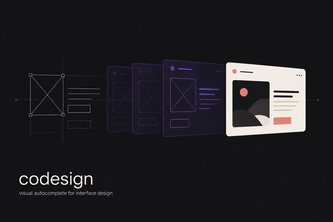
Codesign is a self-reported prototype tool that explores "visual autocomplete" for interface design, integrating AI into a familiar canvas-based workflow. It allows designers to continue working on a canvas while receiving AI-generated suggestions at varying fidelity levels (Base, AI Draft, AI HiFi). The tool stages AI suggestions separately from the original design and supports partial acceptance or rejection of these elements.
What changed
The project is described as a prototype built in one week using Codex and GPT-5.6 Sol, with no evidence of prior development, funding, or product-market fit beyond the author's own account.
Single most important open question
Is there any evidence that this concept has traction or demand from users beyond the author’s own use case? The description does not indicate whether anyone else is using it, nor whether there is a market for such a tool outside of experimental or academic contexts.
What The Product Actually Is
The description states that codesign is a visual autocomplete tool for interface design, operating within a canvas-based environment. It uses AI to suggest what the next step in a design could be, based on existing elements, layer names, and spatial relationships. Suggestions are staged separately from the original design, allowing designers to accept or reject them.
It supports three levels of fidelity:
- Base: Raw rectangles, text, layout
- AI Draft: Low-to-mid-fidelity interpretation
- AI HiFi: More detailed and polished direction
The tool is built using SvelteKit, with a canvas editor, scene graph, component registry, and a "design candidate" staging system. It integrates with Codex and GPT-5.6 Luna to operate on the canvas through an agent harness.
Inference: The product is described as a prototype, not a commercial offering. There is no evidence of revenue, pricing, or customer adoption.
Positioning & Claim Evolution
The author positions codesign as a hybrid between traditional UI design and prompt-driven AI tools, inspired by tab completion in code editors. It aims to reduce the friction of AI-generated interfaces by allowing designers to remain on the canvas and maintain control over their design process.
Key claims:
- "What could visual autocomplete look like for interface designers?"
- "Designers continue working on a familiar canvas while Codesign sequentially suggests what their design could become next."
- "The AI basically does a 'visual autocomplete' based on existing elements in the working frame, layer names, and the placement of the elements in relation to each other."
Inference: The positioning is experimental and conceptual. It does not indicate any commercial traction or market validation.
Target Customer & ICP
The description states that codesign is intended for interface designers, particularly those who are familiar with canvas-based design tools and want to integrate AI into their workflow without losing agency or control.
Inference: The target customer is likely a subset of UX/UI designers, possibly in creative or product teams. No evidence indicates whether this group has been validated through market research, interviews, or usage data.
Business Model & Pricing Evidence
There is no evidence of a business model or pricing structure in the description. The project is described as a prototype built by one person over a week, with no indication of monetization or revenue streams.
Technical & Delivery Signals
The tool is built using:
- Codex
- GPT-5.6 Sol and Luna
- SvelteKit
- A canvas editor, scene graph, component registry, and staging system
It uses a "design candidate" staging system to separate AI suggestions from the original design.
Inference: The technical approach is experimental and relies heavily on AI agents and Codex integration. No evidence of scalability, performance, or production-grade delivery.
Traction & Maturity Signals
The project is described as a prototype built in one week, with no evidence of:
- Revenue
- Customers
- User adoption
- Product-market fit
- Prior versions or iterations
Inference: The product is at an early stage, likely experimental or academic in nature. There is no indication of traction beyond the author’s own use.
Competitive Context
The description does not mention any competitors or direct market context. It references AI design tools that "start with a prompt and generate an entire interface at once", but does not name specific products or companies.
Inference: No competitive landscape is described, nor is there evidence of how this tool would differentiate from existing AI design tools in the market.
Open Questions & Risks
- Prototype-only: The product is described as a one-week prototype with no evidence of further development or traction.
- No commercialization path: There is no indication of a business model, pricing, or monetization strategy.
- Limited technical maturity: The author notes issues with visual bugs and generation quality, and that the tool is not yet production-ready.
- Self-reported only: All claims are from the author’s own account, with no independent verification.
Questions the description leaves open
- What specific user feedback or use cases drove the development of this prototype?
- Are there any early adopters or users beyond yourself?
- How do you plan to transition from a prototype to a scalable product?
- What are your thoughts on integrating with existing design tools (e.g., Figma, Sketch)?
- Have you considered how this tool would be monetized or priced?
Overall Assessment
Not evidenced — There is no evidence of revenue, customers, traction, or a clear path to commercialization. The project is described as a one-week prototype with no indication of market demand or business model.
Confidence: Low. The description is self-reported and unverified, and lacks any data on product-market fit, user adoption, or financials. This is an experimental concept, not a developed product or company.
User Stories BotA demo video on every pull request
Get a demo video on every new feature
GitHub App that watches your pull requests and records a narrated, captioned demo.
Save time on demo prep and make informed decisions faster with a video walkthrough of every new feature.
Source
Submitted to the OpenAI 2026 hackathon on Devpost. Project home on Devpost. Back to the full gallery on Devpost.
This competitive analysis was produced by top-founders.com (opens in a new tab)
Generated by a language model from this project's public Devpost page — its tagline, the author's own write-up and any built-with tags listed there — as captured in August 2026. Short quotations are the author's words. It is an opinion on the idea as a business, not on the people behind it, and it reflects the description as published then. If the project has moved on, request a correction below. The analysis is not independent research and contains no verified traction, revenue or customer data.
An independent guide by KFG International LLC — not affiliated with, endorsed by, or connected to Devpost or OpenAI.