

Archive position — measured, not model output
0 likes on Devpost
2,263 of the 7,850 archived projects have more likes, and 5,587 share exactly 0 — so this project's #6,704 place in the like-ranked listing is a tie-break inside that group, not a ranking.
Projects (log scale)
Likes on Devpost. ▲ marks this project's group.
Show the figures
| Likes | Projects | Share of archive |
|---|---|---|
| 0 | 5,587 | 71.2% |
| 1 | 1,758 | 22.4% |
| 2 | 284 | 3.6% |
| 3–4 | 132 | 1.7% |
| 5–9 | 75 | 1.0% |
| 10+ | 14 | 0.2% |
 User Stories BotA demo video on every pull request
Get a demo video on every new feature
GitHub App that watches your pull requests and records a narrated, captioned demo.
Save time on demo prep and make informed decisions faster with a video walkthrough of every new feature.
Executive Summary
What the company appears to be
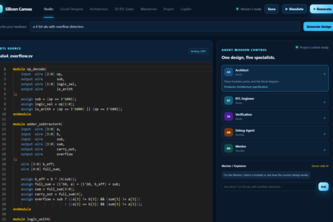
Silicon-Simulator is a browser-based hardware design platform that claims to enable users to describe or draw circuits in plain English or visually, then automatically generates synthesizable Verilog code and runs real simulations using an AI pipeline. The system includes an auto-fix loop that repairs failing testbenches and exports designs for FPGA implementation.
What changed
The project is a self-reported hackathon submission (Devpost entry) describing a prototype tool built for the OpenAI 2026 hackathon. It does not indicate any prior commercial traction, funding, or product release beyond its development phase.
Single most important open question
Is there evidence of actual user adoption, revenue, or customer engagement beyond the authors' own description?
Note: This analysis is based entirely on the self-reported, unverified project description provided by the caller. No external corroboration exists for any claims made in this document.
What The Product Actually Is
The description states that Silicon-Simulator is a browser-based HDL workspace with a closed AI loop:
- Users can describe or draw circuits using natural language ("8-bit synchronous counter with reset") or visual layout.
- A two-agent AI pipeline builds the circuit:
- An "Architect" model generates structured JSON specs including modules, ports, connections, and verification plans.
- An "RTL Engineer" model translates those specs into synthesizable Verilog and a self-checking testbench constrained to an Icarus-compatible subset.
- Generated RTL is executed against its testbench in an isolated Icarus Verilog worker, producing real pass/fail results and waveform traces rendered live in-browser.
- Auto-Fix closes the loop: if the testbench fails, one click packages logs, VCD tail, and source into a diagnosis-and-repair pass that produces a new version (originals are never overwritten) and re-simulates to confirm the fix.
- Projects maintain immutable version history — users can view, diff, or restore any past version without overwriting.
Inference: The system appears designed for rapid prototyping of digital hardware using AI-assisted design, with emphasis on simulation fidelity and reproducibility.
Positioning & Claim Evolution
The description states that the inspiration behind Silicon-Simulator was to reduce the high barrier to entry in hardware design by allowing users to describe circuits in plain English or visually, rather than requiring deep knowledge of Verilog or toolchain setup. It positions itself as a way to go from idea to FPGA-ready code in-browser, without needing EDA tools.
Claim: The product enables “from prompt to proven silicon” — an end-to-end workflow from concept to hardware implementation.
Inference: This is a positioning statement aimed at lowering the learning curve for hardware engineers and students. It implies a shift toward AI-assisted design, but no evidence of prior market validation or adoption.
Target Customer & ICP
The description does not explicitly name target customers or define an Ideal Customer Profile (ICP). However, it suggests use cases involving:
- Hardware designers who want to prototype quickly.
- Students learning digital logic and Verilog.
- Developers working on FPGA projects with limited access to EDA tools.
Inference: The likely audience includes educators, hobbyists, and early-stage hardware engineers looking for accessible design environments. No evidence of specific customer segments or personas is provided.
Business Model & Pricing Evidence
There is no mention of pricing, monetization strategy, or business model in the description.
Not evidenced — the authors do not state how they plan to charge users or whether this will be a paid service.
Technical & Delivery Signals
The project uses:
- Frontend: React 19 + TypeScript + Vite + Tailwind, with Zustand for state management.
- Backend: Node.js HTTP server (no framework), PostgreSQL for versioned projects and source files.
- AI pipeline: Structured chat completions via Azure OpenAI or public OpenAI credentials, constrained to schema and Icarus-safe subset of Verilog/SystemVerilog.
- Simulation: Isolated Icarus Verilog worker for executing RTL and testbenches.
- Version control: Immutable history with checkpointing on restore/repair.
- VCD parsing: Dedicated vcd-core package for waveform visualization.
Inference: The architecture shows deliberate engineering around sandboxing, modularity, and safety — particularly in handling untrusted AI-generated code. These are strong technical signals indicating a thoughtful approach to building a secure, scalable platform.
Traction & Maturity Signals
There is no evidence of traction, revenue, or customer adoption beyond the authors’ own account.
Not evidenced — no data on active users, usage metrics, or product deployment outside the hackathon context.
Competitive Context
The description does not reference competitors or existing solutions in the space. It does not compare Silicon-Simulator to other tools for hardware design or AI-assisted circuit generation.
Not evidenced — no competitive landscape or differentiation analysis is provided.
Open Questions & Risks
Several potential risks and open questions emerge from the description:
- AI reliability: The system relies heavily on AI-generated code that must be validated at runtime. While it enforces constraints, there is no guarantee of correctness beyond simulation.
- Scalability concerns: The backend runs in a dependency-light Node.js server; this may not scale well for large-scale or concurrent usage.
- Toolchain limitations: The system only supports Icarus Verilog and Yosys/NextPNR — limiting compatibility with other FPGA ecosystems.
- No commercial viability: As a hackathon project, there is no indication of long-term product strategy or monetization.
Inference: The tool appears experimental and not yet ready for production use. It lacks clear evidence of market demand or sustainable business model.
Questions the description leaves open
- What is the current status of the project? Is it still under active development?
- Have you tested the system with real users beyond the hackathon environment?
- How do you plan to handle edge cases in AI-generated code that might not be caught by constraints?
- Are there plans for monetization or commercial licensing?
- What are your long-term goals for expanding support for different FPGA platforms or EDA tools?
- How do you ensure the integrity of the auto-fix loop — especially when repairs fail repeatedly?
Overall Assessment
There is no evidence of a functioning product, revenue, or customer base beyond the authors’ own description.
Not evidenced — no data supports commercial viability, traction, or investment readiness. The project appears to be an experimental prototype submitted for a hackathon.
Confidence level: Low. This analysis is based solely on self-reported information and lacks any external validation or performance metrics.
User Stories BotA demo video on every pull request
Get a demo video on every new feature
GitHub App that watches your pull requests and records a narrated, captioned demo.
Save time on demo prep and make informed decisions faster with a video walkthrough of every new feature.
Source
Submitted to the OpenAI 2026 hackathon on Devpost. Project home on Devpost. Back to the full gallery on Devpost.
This competitive analysis was produced by top-founders.com (opens in a new tab)
Generated by a language model from this project's public Devpost page — its tagline, the author's own write-up and any built-with tags listed there — as captured in August 2026. Short quotations are the author's words. It is an opinion on the idea as a business, not on the people behind it, and it reflects the description as published then. If the project has moved on, request a correction below. The analysis is not independent research and contains no verified traction, revenue or customer data.
An independent guide by KFG International LLC — not affiliated with, endorsed by, or connected to Devpost or OpenAI.