

Archive position — measured, not model output
1 like on Devpost
505 of the 7,850 archived projects have more likes, and 1,758 share exactly 1 — so this project's #1,918 place in the like-ranked listing is a tie-break inside that group, not a ranking.
Projects (log scale)
Likes on Devpost. ▲ marks this project's group.
Show the figures
| Likes | Projects | Share of archive |
|---|---|---|
| 0 | 5,587 | 71.2% |
| 1 | 1,758 | 22.4% |
| 2 | 284 | 3.6% |
| 3–4 | 132 | 1.7% |
| 5–9 | 75 | 1.0% |
| 10+ | 14 | 0.2% |
 User Stories BotA demo video on every pull request
Get a demo video on every new feature
GitHub App that watches your pull requests and records a narrated, captioned demo.
Save time on demo prep and make informed decisions faster with a video walkthrough of every new feature.
Executive Summary
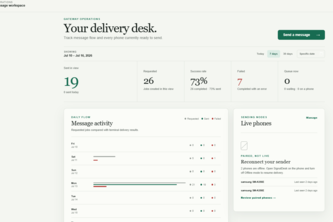
SignalDesk, as described by its author, is a self-hosted SMS gateway built around an Android phone acting as a message sender. The system allows developers to send SMS messages through their own SIM card using a simple API, bypassing traditional vendors like Twilio or Vonage. It consists of three components: a backend API (Express + Prisma + PostgreSQL), an Android app that sends messages via its SIM, and a React-based dashboard for managing devices and API keys.
The author states the project was built during OpenAI Build Week using Codex 5.4 and later refined with GPT-5.6. It is presented as a solution to the limitations of existing SMS APIs — such as per-message fees, number verification requirements, and limited free tiers — by enabling users to leverage their own hardware.
Key commercial due-diligence question: Is there evidence that SignalDesk has traction or adoption beyond its single developer creator? The description contains no data on revenue, customers, usage volume, or market response. It is entirely self-reported and unverified.
What The Product Actually Is
The description states:
- SignalDesk turns an Android phone into a private, self-hosted SMS gateway.
- Users can queue messages through a simple API, send them via their own SIM, and track delivery from one dashboard.
- The system includes:
- A backend (Express + Prisma + PostgreSQL) that handles the API and message status tracking.
- An Android app (built with Kotlin) that acts as a dumb polling worker to send messages through its SIM.
- A frontend dashboard (React + Vite) for device pairing, monitoring, and managing API keys.
The author notes that the project was originally built with Codex 5.4 and later improved using GPT-5.6 during OpenAI Build Week.
Inference: The system is designed to avoid vendor dependencies by leveraging personal hardware (an Android phone with a SIM) for sending SMS, rather than relying on cloud-based or third-party infrastructure.
Positioning & Claim Evolution
The author claims:
- SignalDesk offers an alternative to traditional SMS APIs like Twilio or Vonage.
- It allows developers to send OTPs and notifications without paying per-message fees or dealing with number verification requirements.
- The system is presented as a way to "skip the vendor entirely" by using existing hardware.
There is no evidence of prior positioning or evolution in claims beyond this single project submission. The author does not reference any previous versions, product iterations, or market feedback that might inform how the idea evolved.
Inference: This appears to be a one-off hackathon project with no indication of prior commercialization or strategic development.
Target Customer & ICP
The description states:
- SignalDesk is intended for developers who need to send OTPs and notifications.
- It targets users who want to avoid vendor-based SMS APIs due to cost, complexity, or limitations.
There is no evidence of a defined customer persona beyond the single developer creator. No segmentation by industry, company size, or use case is provided.
Inference: The target customer is likely a small-scale developer or startup with limited budget or technical constraints around SMS delivery.
Business Model & Pricing Evidence
The description states:
- Users can send messages through their own SIMs via an API.
- There are no mentions of pricing tiers, subscription models, or monetization strategies.
- The system is presented as self-hosted and not sold as a SaaS product.
Inference: No business model or pricing structure is evident. The project appears to be a proof-of-concept or prototype with no indication of how it would generate revenue.
Technical & Delivery Signals
The description states:
- Backend: Express.js + Prisma + PostgreSQL.
- Android app: Kotlin-based, designed as a polling worker without UI.
- Frontend: React + Vite dashboard for management and monitoring.
- The system uses a round-robin assignment of messages to phones.
- Delivery logic is designed to handle edge cases like late reports or failures.
There is no evidence of scalability, performance metrics, or production deployment details. The author mentions that the system avoids push infrastructure (e.g., FCM) by using polling, which simplifies reachability but may limit real-time responsiveness.
Inference: The technical architecture is minimal and focused on simplicity and self-containment, but lacks evidence of robustness or scalability for enterprise use.
Traction & Maturity Signals
The description states:
- The project was built during a hackathon (OpenAI Build Week 2026).
- It has one team member: NATNAEL FIKRE.
- No mention of users, customers, or adoption beyond the creator’s own use case.
There is no evidence of traction, revenue, or user engagement. The project is described as a prototype with no indication of prior market testing or product-market fit.
Inference: There is no evidence of maturity or traction beyond the single developer's personal project.
Competitive Context
The description states:
- SignalDesk aims to replace vendors like Twilio and Vonage.
- It addresses issues such as per-message fees, number verification, and free tier limitations.
No mention of competitors, market size, or competitive positioning beyond this comparison. The author does not reference any existing solutions in the SMS gateway space beyond the big players.
Inference: The competitive landscape is implied to include major SMS API providers, but no evidence of market analysis or differentiation strategy is provided.
Open Questions & Risks
- Single developer project: No team, no traction, no product-market fit validation.
- No monetization model: No pricing, subscriptions, or revenue streams are evident.
- Limited scalability: The system relies on physical Android devices, which may not scale well for enterprise use.
- Self-reported only: All claims are unverified and lack independent corroboration.
- No customer data: No evidence of users, feedback, or adoption beyond the author.
Inference: This is a prototype with no commercial viability or market traction. It lacks any signs of being a viable business or product.
Questions the description leaves open
- What is your plan for monetization and scaling beyond a single developer?
- Have you tested SignalDesk in real-world conditions or with other users?
- How do you intend to handle carrier-specific delivery receipts or opt-out handling?
- Are there any legal or regulatory concerns around using personal Android devices for SMS delivery?
- What are the limitations of relying on physical hardware for message delivery?
Overall Assessment
The description states that SignalDesk is a hackathon project built by one developer, with no evidence of traction, revenue, or adoption.
Assessment: Not evidenced as a viable commercial opportunity. The project lacks any signs of product-market fit, scalability, or monetization strategy. It is presented as a proof-of-concept and not as a business or product ready for investment or partnership.
User Stories BotA demo video on every pull request
Get a demo video on every new feature
GitHub App that watches your pull requests and records a narrated, captioned demo.
Save time on demo prep and make informed decisions faster with a video walkthrough of every new feature.
Source
Submitted to the OpenAI 2026 hackathon on Devpost. Project home on Devpost. Back to the full gallery on Devpost.
This competitive analysis was produced by top-founders.com (opens in a new tab)
Generated by a language model from this project's public Devpost page — its tagline, the author's own write-up and any built-with tags listed there — as captured in August 2026. Short quotations are the author's words. It is an opinion on the idea as a business, not on the people behind it, and it reflects the description as published then. If the project has moved on, request a correction below. The analysis is not independent research and contains no verified traction, revenue or customer data.
An independent guide by KFG International LLC — not affiliated with, endorsed by, or connected to Devpost or OpenAI.