

Archive position — measured, not model output
0 likes on Devpost
2,263 of the 7,850 archived projects have more likes, and 5,587 share exactly 0 — so this project's #6,618 place in the like-ranked listing is a tie-break inside that group, not a ranking.
Projects (log scale)
Likes on Devpost. ▲ marks this project's group.
Show the figures
| Likes | Projects | Share of archive |
|---|---|---|
| 0 | 5,587 | 71.2% |
| 1 | 1,758 | 22.4% |
| 2 | 284 | 3.6% |
| 3–4 | 132 | 1.7% |
| 5–9 | 75 | 1.0% |
| 10+ | 14 | 0.2% |
 User Stories BotA demo video on every pull request
Get a demo video on every new feature
GitHub App that watches your pull requests and records a narrated, captioned demo.
Save time on demo prep and make informed decisions faster with a video walkthrough of every new feature.
Executive Summary
What the company appears to be
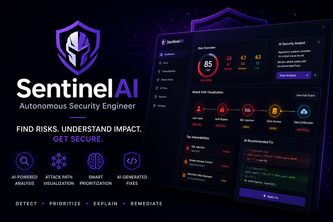
SentinelAI is an AI-powered autonomous security engineer that analyzes entire software repositories using a combination of traditional security tools (e.g., Bandit, Semgrep) and LLMs (GPT-5.6). It claims to reason about vulnerabilities, correlate findings into attack paths, prioritize risks, and generate secure code fixes.
What changed
The project is self-reported as a hackathon submission for the OpenAI 2026 hackathon. It was built by one person (Saravanan Grizz) over a short timeframe, with no evidence of prior traction or commercial deployment.
Single most important open question
Is there any evidence that SentinelAI has been used in real-world development environments or integrated into actual workflows? The description states the product is “built” but does not indicate whether it has been deployed, tested, or adopted beyond the hackathon context.
What The Product Actually Is
The description states that SentinelAI is an AI-powered Autonomous Security Engineer. It claims to:
- Analyze entire software repositories (not just isolated files)
- Combine traditional security analysis tools (Bandit, Semgrep, etc.) with GPT-5.6
- Understand repository architecture before performing security analysis
- Correlate vulnerabilities into realistic attack paths
- Prioritize findings based on technical severity and business impact
- Generate secure code fixes using Codex
- Produce reports for both developers and executives
It also includes a dashboard with features like:
- Security score
- Attack graph
- Risk heatmap
- Recommendations
Inference The product appears to be a developer tool that integrates AI into the security workflow, aiming to reduce manual effort in vulnerability triage and remediation.
Positioning & Claim Evolution
The author states that modern scanners are good at detecting vulnerabilities but leave developers with a difficult problem: understanding what matters. SentinelAI aims to be an AI teammate that doesn’t just detect vulnerabilities—but reasons about them.
This positioning evolved from the idea of “AI explaining scanner results” to a system where GPT-5.6 reasons across the entire repository, understands relationships between vulnerabilities, and prioritizes remediation like a security engineer.
The author also notes that they redesigned the system to move beyond static scanning, aiming for an end-to-end AI security workflow.
Claim
The product is positioned as a tool that bridges traditional AppSec tools with LLM reasoning to improve developer experience and decision-making in security.
Target Customer & ICP
The description states that SentinelAI produces reports for both:
- Developers (technical reports)
- Executives (business summaries)
It also mentions that the system is designed to be suitable for both teams, suggesting a dual audience.
Inference The target customer includes security engineers, developers, and executives who are involved in software security decisions. The ICP likely centers on organizations with codebases that require ongoing security monitoring and remediation.
Business Model & Pricing Evidence
There is no evidence of pricing, monetization strategy, or business model in the description. The project is described as a hackathon submission, and there is no mention of revenue streams, subscriptions, or customer acquisition.
Not evidenced
Technical & Delivery Signals
The author states that the product was built with:
- Frontend: React, TypeScript, Tailwind CSS, Framer Motion, Recharts
- Backend: Python, FastAPI, PostgreSQL
- Security Engine: Bandit, Semgrep, pip-audit, Safety
- AI Tools: GPT-5.6, Codex
The system is described as:
- An end-to-end workflow
- Using LLMs for reasoning and code generation
- Integrating with existing security tools
Inference The technical stack suggests a full-stack application built with modern web and backend technologies, with integration points to existing security tools. However, no evidence of deployment or production use is provided.
Traction & Maturity Signals
The project was submitted to the OpenAI 2026 hackathon on Devpost. It was built by one person (Saravanan Grizz) and has no evidence of:
- Revenue
- Customers
- Product-market fit
- Deployment in real environments
- Adoption or usage beyond the hackathon
Not evidenced
Competitive Context
The description does not mention any competitors or direct market positioning against other tools. However, it implies a role in AI-powered security, which may overlap with:
- Traditional vulnerability scanners (e.g., SonarQube, Snyk, Checkmarx)
- AI-assisted code analysis tools
- Security orchestration platforms
Inference SentinelAI appears to aim at the intersection of traditional AppSec and AI-driven automation. It is not clear how it differentiates from existing tools or whether it has a unique value proposition in that space.
Open Questions & Risks
- No traction or adoption evidence: The project is described as a hackathon submission with no commercial use.
- Unverified claims: The description states that GPT-5.6 and Codex are used, but there is no evidence of actual implementation or performance.
- Single-person team: The entire product was built by one individual, raising questions about scalability and long-term maintenance.
- No pricing or monetization model: No indication of how the product would be sold or funded.
- Unproven AI integration: While LLMs are mentioned, there is no demonstration of their actual use in the system.
Questions the description leaves open
- What specific vulnerabilities does SentinelAI detect, and how does it validate its findings?
- How does the system handle false positives or ambiguous results from security scanners?
- Has the AI been tested on real-world codebases or only synthetic examples?
- What is the current state of integration with CI/CD pipelines or IDEs?
- Are there any plans to support multi-language environments beyond what’s currently listed?
- How does SentinelAI prioritize vulnerabilities when multiple tools flag different issues?
- Has the product been tested in a real development workflow, and if so, how was it received?
Overall Assessment
Not evidenced
The description is entirely self-reported and unverified. There is no evidence of:
- Revenue
- Customers
- Product-market fit
- Commercial traction
- Deployment or usage beyond the hackathon context
This is a pre-product concept, not a product in the market. Any investment or partnership decision would require further validation, including proof of concept, user feedback, and demonstration of real-world utility.
The author states that the project was built as part of a hackathon, and no evidence exists to suggest it has moved beyond that stage. The claims are ambitious but unproven.
User Stories BotA demo video on every pull request
Get a demo video on every new feature
GitHub App that watches your pull requests and records a narrated, captioned demo.
Save time on demo prep and make informed decisions faster with a video walkthrough of every new feature.
Source
Submitted to the OpenAI 2026 hackathon on Devpost. Project home on Devpost. Back to the full gallery on Devpost.
This competitive analysis was produced by top-founders.com (opens in a new tab)
Generated by a language model from this project's public Devpost page — its tagline, the author's own write-up and any built-with tags listed there — as captured in August 2026. Short quotations are the author's words. It is an opinion on the idea as a business, not on the people behind it, and it reflects the description as published then. If the project has moved on, request a correction below. The analysis is not independent research and contains no verified traction, revenue or customer data.
An independent guide by KFG International LLC — not affiliated with, endorsed by, or connected to Devpost or OpenAI.