

Archive position — measured, not model output
0 likes on Devpost
2,263 of the 7,850 archived projects have more likes, and 5,587 share exactly 0 — so this project's #2,694 place in the like-ranked listing is a tie-break inside that group, not a ranking.
Projects (log scale)
Likes on Devpost. ▲ marks this project's group.
Show the figures
| Likes | Projects | Share of archive |
|---|---|---|
| 0 | 5,587 | 71.2% |
| 1 | 1,758 | 22.4% |
| 2 | 284 | 3.6% |
| 3–4 | 132 | 1.7% |
| 5–9 | 75 | 1.0% |
| 10+ | 14 | 0.2% |
 User Stories BotA demo video on every pull request
Get a demo video on every new feature
GitHub App that watches your pull requests and records a narrated, captioned demo.
Save time on demo prep and make informed decisions faster with a video walkthrough of every new feature.
Executive Summary
Project: Arbiter
Source: Self-reported by Saurabh Chauhan, submitted to OpenAI 2026 hackathon
Analysis basis: Author's own description only — no external verification, no revenue, customers or traction data
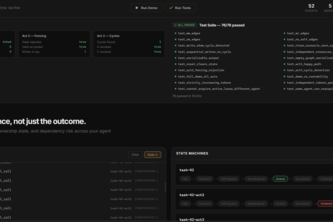
Arbiter is a causal runtime verifier for multi-agent AI systems, designed to detect and prevent coordination bugs across simulated transports (gRPC, queue, blackboard, webhook, stdout). The project implements four distributed-systems techniques: Hybrid Logical Clocks, fencing tokens, state-machine-based runtime verification, and cycle detection in dependency graphs. It is built as a weekend hackathon demo with no commercial traction or production use.
The single most important open question is: does this system have any real-world applicability beyond the simulated environment described?
What The Product Actually Is
The description states that Arbiter:
- Watches agent coordination events across multiple simulated transports.
- Uses a Hybrid Logical Clock (HLC) to timestamp events and enable causal ordering.
- Implements a state machine to specify coordination protocols with safety and liveness properties.
- Prevents hard invariant violations using fencing tokens.
- Detects soft anomalies via dependency graph cycle detection.
- Revokes agent capability tokens upon violation confirmation.
- Has a real-time dashboard built with FastAPI, WebSocket, and D3.js.
Inference: The system is a proof-of-concept runtime verification tool, not a production-ready product. It is built for demonstration purposes in a hackathon setting.
Positioning & Claim Evolution
The author claims Arbiter is:
- A "seatbelt for multi-agent systems".
- Grounded in distributed-systems theory, not hand-written checks.
- Capable of detecting and structurally preventing coordination bugs like duplicated work or stale writes.
Inference: The positioning is that of a verification layer for AI agent coordination, aiming to improve reliability in complex, multi-agent environments. It positions itself as a technical solution rather than a commercial product.
Target Customer & ICP
The description does not identify any target customer or ideal customer profile (ICP). It only describes the system's function and its use in a simulated environment.
Not evidenced: No indication of who would use this, what industry it targets, or whether there is a market need beyond demonstration.
Business Model & Pricing Evidence
The description does not mention any business model, pricing, monetization strategy, or commercial intent.
Not evidenced: No evidence of revenue streams, pricing tiers, or customer acquisition plans.
Technical & Delivery Signals
The project is built with:
- asyncio, d3.js, fastapi, networkx, pydantic, python, websockets
- Simulated transports: gRPC, queue, blackboard, webhook, stdout
- Implements HLC, fencing tokens, state machine engine (inspired by P/Coyote), cycle detection (Elle-style)
- Uses event bus with in-memory storage and capability token revocation
Inference: The system is a technical prototype, not a scalable or production-ready solution. It uses lightweight tools and simulated environments.
Traction & Maturity Signals
The description states that this was built as a hackathon project (OpenAI 2026) in a single weekend, with no mention of:
- Customers
- Revenue
- Production use
- Product-market fit
- Iteration or feedback loops
Not evidenced: No traction or maturity indicators beyond the demo.
Competitive Context
The description does not reference any competitors or existing solutions in the space of multi-agent AI coordination or runtime verification. It only mentions:
- Microsoft’s P/Coyote lineage
- Kyle Kingsbury’s Elle checker
- Cilium Tetragon / Pixie for eBPF tracing
Not evidenced: No competitive landscape, no comparison to existing tools or platforms.
Open Questions & Risks
- No production use: The system is a demo, not a product.
- Simulated environment only: Real-world applicability is unproven.
- Single founder: Limited team size implies limited development capacity.
- Unverified claims: No independent validation of performance or correctness.
- Technical debt: Built in a weekend; no indication of scalability or robustness.
Inference: The project is a technical exploration, not a commercial product. Risk of misalignment between technical capability and real-world applicability.
Questions the description leaves open
- What are the key assumptions about multi-agent AI coordination that this system is built on?
- How would you adapt this to real-world agent systems (e.g., those using LLMs, tool calling)?
- Is there a plan to move beyond simulated transports into real tracing (e.g., eBPF)?
- What are the performance implications of running this in production?
- Have you considered how this would integrate with existing orchestration or coordination frameworks?
Overall Assessment
Not evidenced: No data on commercial viability, traction, or market demand.
Inference: This is a technical proof-of-concept, not a viable investment or partnership opportunity at this stage. It may be of interest to researchers or developers working in distributed systems or AI coordination, but it does not yet demonstrate product-market fit or commercial potential.
User Stories BotA demo video on every pull request
Get a demo video on every new feature
GitHub App that watches your pull requests and records a narrated, captioned demo.
Save time on demo prep and make informed decisions faster with a video walkthrough of every new feature.
Source
Submitted to the OpenAI 2026 hackathon on Devpost. Project home on Devpost. Back to the full gallery on Devpost.
This competitive analysis was produced by top-founders.com (opens in a new tab)
Generated by a language model from this project's public Devpost page — its tagline, the author's own write-up and any built-with tags listed there — as captured in August 2026. Short quotations are the author's words. It is an opinion on the idea as a business, not on the people behind it, and it reflects the description as published then. If the project has moved on, request a correction below. The analysis is not independent research and contains no verified traction, revenue or customer data.
An independent guide by KFG International LLC — not affiliated with, endorsed by, or connected to Devpost or OpenAI.