

Archive position — measured, not model output
0 likes on Devpost
2,263 of the 7,850 archived projects have more likes, and 5,587 share exactly 0 — so this project's #6,616 place in the like-ranked listing is a tie-break inside that group, not a ranking.
Projects (log scale)
Likes on Devpost. ▲ marks this project's group.
Show the figures
| Likes | Projects | Share of archive |
|---|---|---|
| 0 | 5,587 | 71.2% |
| 1 | 1,758 | 22.4% |
| 2 | 284 | 3.6% |
| 3–4 | 132 | 1.7% |
| 5–9 | 75 | 1.0% |
| 10+ | 14 | 0.2% |
 User Stories BotA demo video on every pull request
Get a demo video on every new feature
GitHub App that watches your pull requests and records a narrated, captioned demo.
Save time on demo prep and make informed decisions faster with a video walkthrough of every new feature.
Executive Summary
What the company appears to be
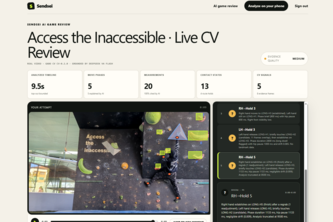
Sendsei is a phone-first bouldering review application that analyzes climbing attempts using computer vision and generative AI. The author states it reconstructs an attempt move-by-move, identifies the earliest evidence-backed turning point, and presents practical coaching cues.
What changed
The project was built as part of the OpenAI 2026 hackathon. It is described as an open-source project with a mobile-first interface, combining browser-based video capture, server-side computer vision (using MediaPipe, OpenCV, FFmpeg), and AI reasoning via GPT-5.6.
Single most important open question
Is there any evidence of user adoption, revenue generation or customer traction beyond the hackathon submission?
What The Product Actually Is
The description states that Sendsei is a phone-first bouldering review application. It allows climbers to record or upload an attempt, confirm holds in the route, and optionally add a successful reference attempt for comparison.
It analyzes:
- Body movement
- Hold contacts
- Pauses
- Transitions
To divide climbs into meaningful phases and find the earliest defensible key moment or divergence.
The output includes:
- Move-by-move breakdown of the attempt
- Pose and hold overlays on the original video
- Evidence-linked turning point
- Comparison with a successful attempt (when provided)
- One concise coaching cue
- One practical drill for the next attempt
Every conclusion references real frames, phases, holds, or measurements. If insufficient evidence exists, Sendsei abstains instead of inventing explanations.
Evidence The author's own write-up.
Confidence Low — this is a self-reported product description without independent verification.
Positioning & Claim Evolution
The author states that Sendsei was inspired by game reviews like Stockfish analyzing moves in chess, where the visible failure is only the final result of earlier breakdowns. The goal is to reconstruct an attempt move-by-move, identify the earliest turning point, and turn that insight into one practical correction.
It positions itself as:
- A tool for climbers who know where they fell but not what should change
- An application that finds the "move that changed the send"
- A system that provides evidence-backed coaching cues
Evidence The author's own write-up.
Confidence Low — this is a self-positioning statement, not validated by market feedback or adoption.
Target Customer & ICP
The description states that Sendsei targets climbers, particularly those who want to improve their performance through detailed analysis of failed attempts.
It supports:
- Standalone attempt analysis
- Failed-versus-successful comparison
There is no explicit mention of specific user segments beyond "climbers", nor any indication of a defined ICP (Ideal Customer Profile) beyond that.
Evidence The author's own write-up.
Confidence Low — no evidence of customer segmentation or targeting beyond general “climber” category.
Business Model & Pricing Evidence
The description does not contain any information about:
- Revenue model
- Pricing structure
- Monetization strategy
- Customer acquisition costs
- Unit economics
It is described as an open-source project.
Evidence The author's own write-up.
Confidence Very low — no commercial or financial details provided.
Technical & Delivery Signals
The mobile experience is built with:
- Next.js, React, TypeScript, Tailwind CSS
- Deployed on Vercel
Browser-side features include:
- Camera capture
- Video validation
- Route-color selection
- Lightweight motion analysis
- Adaptive pose-based framing feedback
Server-side pipeline uses:
- Python, MediaPipe, OpenCV, FFmpeg
- Running on Modal
- Normalizes videos, extracts body landmarks, matches hands/feet to confirmed holds, segments movement phases, calculates 2D movement metrics
AI layer:
- Uses OpenAI Responses API with GPT-5.6
- Produces structured reviews using only supplied measurements, IDs, and evidence frames
- Response validated against strict JSON schema
- Rejects references to nonexistent holds, phases, frames, or metrics
Storage:
- Videos and generated evidence stored privately in Cloudflare R2
- Supabase Auth and PostgreSQL for authentication and data durability
Data contracts:
- Shared, versioned data contracts allow independent development of frontend, CV pipeline, and AI service
- Modular AI layer allows community to add more model providers without rebuilding CV pipeline
Development tools:
- OpenAI Codex used throughout for architectural decisions, feature implementation, testing, code review, and system integration
Evidence The author's own write-up.
Confidence Medium — detailed technical architecture described, but no evidence of production use or scalability beyond hackathon.
Traction & Maturity Signals
The project is described as a hackathon submission (OpenAI 2026) and an open-source project.
There is no mention of:
- Revenue
- Customers
- Users
- Adoption metrics
- Product-market fit validation
- Growth indicators
It was built within a hackathon timeline, with accomplishments noted such as:
- Complete phone-to-review workflow without native app or desktop computer
- Resilient uploads and durable job recovery
- Honest abstention behavior
- Versioned data contracts
Evidence The author's own write-up.
Confidence Very low — no traction or maturity indicators beyond hackathon completion.
Competitive Context
The description does not mention:
- Direct competitors
- Market size
- Competitive positioning
- Industry trends
- Alternative solutions in the climbing analytics space
It references Stockfish-style analysis, suggesting a comparison to chess analysis tools, but does not elaborate on existing or potential competitors.
Evidence The author's own write-up.
Confidence Very low — no competitive landscape information provided.
Open Questions & Risks
- No commercial traction or revenue: The project is described as an open-source hackathon submission with no evidence of monetization or user base.
- Unverified claims about AI reasoning: While the system uses structured outputs and validation, there is no independent assessment of how well GPT-5.6 actually performs in this domain.
- Limited scalability assumptions: The system was built for a hackathon, not production scale; no evidence of performance or reliability beyond that context.
- Open-source nature implies lack of commercial focus: Open-source projects often lack dedicated monetization strategies or long-term business models.
- No clear path to market adoption: No mention of how users would discover or adopt the product.
Evidence The author's own write-up, combined with absence of any traction or commercial data.
Confidence Medium — risks are inferred from lack of evidence rather than stated facts.
Questions the description leaves open
- What is your plan for monetization and customer acquisition beyond the hackathon?
- How do you intend to validate that the coaching cues generated by GPT-5.6 are actually useful or actionable for climbers?
- Have you tested the system with real users, and if so, what feedback did you receive?
- What is your roadmap for scaling beyond a hackathon prototype?
- Are there any existing competitors in this space, and how do you differentiate from them?
- How do you plan to address privacy concerns related to storing video data of climbers?
- What kind of data or metrics would indicate product-market fit for this tool?
Evidence The author's own write-up.
Confidence Medium — these are reasonable questions based on the limited information provided.
Overall Assessment
There is no evidence of:
- Revenue
- Customers
- Traction
- Product-market fit
- Commercial viability
- Scalability beyond hackathon context
The project is described as an open-source hackathon submission, with no indication of any commercial or user adoption.
Assessment Not evidenced — this is a self-reported prototype with no demonstrated business case or market validation. It cannot be evaluated for investment or partnership potential without further evidence of traction, revenue, or customer engagement.
Confidence Very low — the description provides no basis for assessing commercial viability or strategic fit.
User Stories BotA demo video on every pull request
Get a demo video on every new feature
GitHub App that watches your pull requests and records a narrated, captioned demo.
Save time on demo prep and make informed decisions faster with a video walkthrough of every new feature.
Source
Submitted to the OpenAI 2026 hackathon on Devpost. Project home on Devpost. Back to the full gallery on Devpost.
This competitive analysis was produced by top-founders.com (opens in a new tab)
Generated by a language model from this project's public Devpost page — its tagline, the author's own write-up and any built-with tags listed there — as captured in August 2026. Short quotations are the author's words. It is an opinion on the idea as a business, not on the people behind it, and it reflects the description as published then. If the project has moved on, request a correction below. The analysis is not independent research and contains no verified traction, revenue or customer data.
An independent guide by KFG International LLC — not affiliated with, endorsed by, or connected to Devpost or OpenAI.