

Archive position — measured, not model output
0 likes on Devpost
2,263 of the 7,850 archived projects have more likes, and 5,587 share exactly 0 — so this project's #6,608 place in the like-ranked listing is a tie-break inside that group, not a ranking.
Projects (log scale)
Likes on Devpost. ▲ marks this project's group.
Show the figures
| Likes | Projects | Share of archive |
|---|---|---|
| 0 | 5,587 | 71.2% |
| 1 | 1,758 | 22.4% |
| 2 | 284 | 3.6% |
| 3–4 | 132 | 1.7% |
| 5–9 | 75 | 1.0% |
| 10+ | 14 | 0.2% |
 User Stories BotA demo video on every pull request
Get a demo video on every new feature
GitHub App that watches your pull requests and records a narrated, captioned demo.
Save time on demo prep and make informed decisions faster with a video walkthrough of every new feature.
Executive Summary
The description states that "Self-Healing Code Agent" is a CLI-based tool built using Python and Go, designed to autonomously debug and fix code issues in enterprise environments. It claims to operate like a Senior DevOps Engineer by identifying bugs, checking corporate constraints, empirically testing solutions, and reporting ROI. The author describes building it as a single-person project for the OpenAI 2026 hackathon.
The most important open question is whether this tool has any real-world adoption or usage beyond its author's demonstration — the description contains no evidence of customers, revenue, or product-market fit.
This analysis is based entirely on self-reported information from the project description and Devpost submission. No external verification or historical data are available.
What The Product Actually Is
The description states that the Self-Healing Code Agent is a CLI tool built with Python and Go, structured around the Model-View-Controller (MVC) architecture. It uses Codex for scaffolding and GPT-5.6 for reasoning through complex errors such as goroutine deadlocks in Go.
It includes:
- A "Business Rule RAG" system that reads local
architecture_rules.mdfiles to enforce corporate policies. - A secure Docker sandbox to test proposed fixes before applying them.
- Telemetry features that calculate ROI and generate executive Markdown reports.
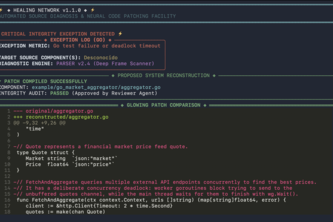
- A high-contrast, Stark-themed terminal UI with visual diffs.
The tool is described as operating like a Senior DevOps Engineer, identifying bugs, validating solutions, and reporting time saved to management.
Positioning & Claim Evolution
The description states the product is positioned as an enterprise-grade solution that goes beyond typical AI coding assistants. It claims to not just guess code but act like a Senior DevOps Engineer — identifying bugs, checking compliance, empirically testing fixes, and reporting financial impact.
It positions itself as:
- A tool for optimizing development and systems operation workflows.
- Not merely a technical convenience, but an enterprise-grade solution.
- Designed to reduce the financial drain of debugging complex systems by automating end-to-end fix processes.
The author frames this as a response to current AI tools that "only solve half the problem" — leaving testing, compliance, and documentation to developers. This suggests a shift from autocomplete to autonomous system operation.
Target Customer & ICP
The description states the tool is designed for enterprise environments and targets organizations with complex systems where debugging is costly. It claims to be built for companies that value:
- Corporate constraints (e.g., hardcoded timeout limits).
- Compliance and security.
- Financial accountability of development time.
It implies a customer base of:
- Developers working in large-scale, regulated tech environments.
- Teams seeking ROI measurement from their engineering efforts.
- Organizations that rely on DevOps practices and internal policy enforcement.
No specific industry or company size is mentioned. The ICP appears to be enterprise software teams with strict governance and performance tracking needs.
Business Model & Pricing Evidence
Not evidenced.
The description does not state anything about pricing, licensing, monetization strategy, or business model. It only describes the tool’s functionality and architecture.
Technical & Delivery Signals
The description states:
- Built using Python and Go.
- Uses Codex for scaffolding and GPT-5.6 for reasoning.
- Implements a dual-agent system with a "Reviewer Agent" to cross-reference constraints.
- Employs a Docker sandbox to prevent destructive hallucinations.
- Generates executive reports in Markdown format.
- Features a Stark-themed terminal UI with visual diffs.
It also mentions:
- A deep frame scanner to parse complex stack traces.
- Handling compiled languages like Go, particularly concurrency issues.
- Use of terminal escape sequences for UI design.
No evidence is provided regarding scalability, performance metrics, or deployment architecture beyond the author’s own claims.
Traction & Maturity Signals
Not evidenced.
There is no mention of users, customers, revenue, usage data, or product adoption. The project was submitted to a hackathon and described as a single-person effort. No evidence of traction, growth, or market validation exists in the description.
Competitive Context
Not evidenced.
The description does not name competitors or describe how this tool compares to existing AI coding assistants or debugging tools. It only positions itself as superior to current tools by solving more than just code generation.
Open Questions & Risks
- Single-person project: The tool was built by one person (Camila Ianni) for a hackathon — no evidence of team, product-market fit, or long-term viability.
- Unverified claims: The description states the use of GPT-5.6, which is not publicly confirmed as existing; this may be speculative or fictional.
- No traction or monetization: No evidence of revenue, customers, or usage beyond the author’s own demonstration.
- Hackathon origin: The project was submitted to a hackathon — not a commercial product or validated solution.
- Unproven ROI calculation: While it claims to calculate ROI, no details are given on how this is measured or verified.
Questions the description leaves open
- What specific corporate policies or constraints does the tool enforce? How are these rules encoded?
- Can you demonstrate a real-world example of a bug being identified and fixed by the agent?
- How does the dual-agent system (Reviewer Agent + Fixing Agent) work in practice?
- What is the accuracy rate of the fixes generated, and how do you validate them?
- Has the tool been tested in any actual enterprise environment or with real development teams?
- What are the limitations of the current implementation? Are there known edge cases where it fails?
- How does the sandboxing mechanism prevent false positives or security issues?
- Is this a prototype or a working product, and what is the roadmap for scaling?
Overall Assessment
Not evidenced.
There is no evidence to support any investment or partnership decision. The project is described as a hackathon submission by one individual with no traction, revenue, or customer data. It is unclear whether this represents a viable commercial product or an experimental idea.
User Stories BotA demo video on every pull request
Get a demo video on every new feature
GitHub App that watches your pull requests and records a narrated, captioned demo.
Save time on demo prep and make informed decisions faster with a video walkthrough of every new feature.
Source
Submitted to the OpenAI 2026 hackathon on Devpost. Project home on Devpost. Back to the full gallery on Devpost.
This competitive analysis was produced by top-founders.com (opens in a new tab)
Generated by a language model from this project's public Devpost page — its tagline, the author's own write-up and any built-with tags listed there — as captured in August 2026. Short quotations are the author's words. It is an opinion on the idea as a business, not on the people behind it, and it reflects the description as published then. If the project has moved on, request a correction below. The analysis is not independent research and contains no verified traction, revenue or customer data.
An independent guide by KFG International LLC — not affiliated with, endorsed by, or connected to Devpost or OpenAI.