

Archive position — measured, not model output
1 like on Devpost
505 of the 7,850 archived projects have more likes, and 1,758 share exactly 1 — so this project's #1,877 place in the like-ranked listing is a tie-break inside that group, not a ranking.
Projects (log scale)
Likes on Devpost. ▲ marks this project's group.
Show the figures
| Likes | Projects | Share of archive |
|---|---|---|
| 0 | 5,587 | 71.2% |
| 1 | 1,758 | 22.4% |
| 2 | 284 | 3.6% |
| 3–4 | 132 | 1.7% |
| 5–9 | 75 | 1.0% |
| 10+ | 14 | 0.2% |
 User Stories BotA demo video on every pull request
Get a demo video on every new feature
GitHub App that watches your pull requests and records a narrated, captioned demo.
Save time on demo prep and make informed decisions faster with a video walkthrough of every new feature.
Executive Summary
What the company appears to be
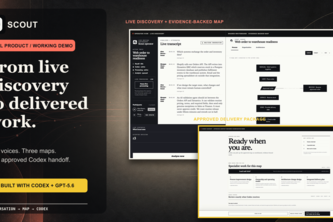
Scout is a self-reported tool that processes live customer conversations into structured business maps using AI (Codex), allowing humans to approve the output before it informs software development. It is described as a system for turning customer utterances into evidence-backed diagrams and software context, with an emphasis on separating operator influence from customer evidence.
What changed
The project evolved from a generic AI whiteboard into a more focused system that treats conversations as structured inputs, uses semantic diagram compilation, enforces validation rules, and integrates human approval as a trust boundary. It moved from text-heavy demos to a streamlined journey: listen, understand, inspect, approve, and build.
The single most important open question
Is there any evidence of real-world usage or customer feedback beyond the author’s own account? The description does not indicate whether Scout has been tested with actual customers or used in production environments.
What The Product Actually Is
The description states that Scout:
- Processes live customer conversations.
- Turns those conversations into evidence-backed business maps.
- Uses Codex (presumably OpenAI's language model) to interpret the conversation and generate structured outputs.
- Allows humans to approve the truth of the generated content before it is used for software development.
- Compiles semantic diagrams from conversation data, using deterministic projectors for different views (e.g., process, architecture).
- Operates with a focus on reliability over speed, avoiding partial updates and ensuring stable rendering.
It is not evidenced whether Scout is a SaaS product, an internal tool, or a prototype. The author describes it as a hackathon submission, suggesting it may be early-stage.
Positioning & Claim Evolution
The description states that Scout:
- Began as a "live AI whiteboard."
- Evolved into a system that bridges what customers say, what teams understand, and what Codex builds.
- Is positioned not just as an AI drawing tool but as a semantic diagram compiler.
- Emphasizes human approval as a trust boundary rather than friction to be removed.
- Prioritizes reliability and trustworthiness over apparent speed or streaming updates.
There is no evidence of prior positioning claims, product launches, or market feedback. The evolution described is self-reported and not independently verified.
Target Customer & ICP
The description states that Scout:
- Is designed for teams working with customer conversations to build software.
- Treats operator speech as conversational context while relying only on designated customer utterances for business facts.
- Is intended to help translate customer input into actionable software decisions.
It is not evidenced what specific industry or team type uses Scout, nor whether it targets enterprise customers, startups, or internal product teams. The ICP (Ideal Customer Profile) is not defined beyond the general use case described.
Business Model & Pricing Evidence
The description does not state:
- Whether Scout is a SaaS offering.
- How pricing would work.
- If there are any revenue streams or monetization plans.
- Whether it targets individual users, teams, or enterprises.
No evidence of business model or pricing exists in the provided text.
Technical & Delivery Signals
The description states that Scout:
- Uses technologies such as Codex (presumably OpenAI), Express.js, Node.js, TypeScript, Mermaid, Vitest, Zod, and Webhooks.
- Handles structured outputs with validation to prevent semantically incorrect relationships.
- Serializes rendering to avoid interference in Mermaid diagrams.
- Uses finalized utterances instead of partial transcriptions to maintain stability.
- Implements a journey-based interface: listen, understand, inspect, approve, and build.
It is not evidenced whether Scout has been deployed or tested beyond the author’s own account. No delivery timeline, versioning, or deployment details are provided.
Traction & Maturity Signals
The description does not provide evidence of:
- Customer adoption.
- Revenue or ARR.
- Product usage metrics.
- Any traction indicators such as user feedback, pilot programs, or market validation.
It is described as a hackathon submission, suggesting it may be in early development. No maturity signals beyond the author’s own account are evident.
Competitive Context
The description does not provide evidence of:
- Direct competitors.
- Market positioning relative to other tools for conversation analysis, diagramming, or AI-assisted software development.
- Whether Scout is part of a broader ecosystem or standalone tool.
No competitive landscape is described or implied.
Open Questions & Risks
Key risks and open questions based on the description:
- The project is self-reported and unverified. No third-party validation or traction data exists.
- It is described as a hackathon submission, suggesting it may not be production-ready or scalable.
- There is no evidence of customer feedback, usage, or real-world testing beyond the author’s own account.
- The focus on human approval and stability may slow adoption in fast-moving environments.
- The tool appears to be built for a specific use case (customer conversations → diagrams → software), but it's unclear how broadly applicable this is.
Questions the description leaves open
- What was the actual outcome of the hackathon submission? Was Scout selected or awarded?
- Has Scout been tested with real customers or teams beyond the authors’ own experience?
- How does Scout handle edge cases in conversation data (e.g., interruptions, overlapping speech)?
- Is there a plan to scale beyond the current two-person team?
- What are the technical limitations of the current implementation that would prevent production use?
- Are there any existing partnerships or early adopters?
- What is the roadmap for monetization or product development?
Overall Assessment
The description states that Scout:
- Is a self-reported hackathon project.
- Has no evidence of traction, revenue, or customer adoption.
- Was built by two individuals (Sergio Peschiera and Steve Parker).
- Is described as evolving from an AI whiteboard into a more structured system.
There is no evidence to support investment or partnership interest at this stage. The project appears to be in early development with no verified commercial activity. The lack of external validation, customer data, or product maturity makes it difficult to assess its viability for investment or strategic partnership.
User Stories BotA demo video on every pull request
Get a demo video on every new feature
GitHub App that watches your pull requests and records a narrated, captioned demo.
Save time on demo prep and make informed decisions faster with a video walkthrough of every new feature.
Source
Submitted to the OpenAI 2026 hackathon on Devpost. Project home on Devpost. Back to the full gallery on Devpost.
This competitive analysis was produced by top-founders.com (opens in a new tab)
Generated by a language model from this project's public Devpost page — its tagline, the author's own write-up and any built-with tags listed there — as captured in August 2026. Short quotations are the author's words. It is an opinion on the idea as a business, not on the people behind it, and it reflects the description as published then. If the project has moved on, request a correction below. The analysis is not independent research and contains no verified traction, revenue or customer data.
An independent guide by KFG International LLC — not affiliated with, endorsed by, or connected to Devpost or OpenAI.