

Archive position — measured, not model output
1 like on Devpost
505 of the 7,850 archived projects have more likes, and 1,758 share exactly 1 — so this project's #1,876 place in the like-ranked listing is a tie-break inside that group, not a ranking.
Projects (log scale)
Likes on Devpost. ▲ marks this project's group.
Show the figures
| Likes | Projects | Share of archive |
|---|---|---|
| 0 | 5,587 | 71.2% |
| 1 | 1,758 | 22.4% |
| 2 | 284 | 3.6% |
| 3–4 | 132 | 1.7% |
| 5–9 | 75 | 1.0% |
| 10+ | 14 | 0.2% |
 User Stories BotA demo video on every pull request
Get a demo video on every new feature
GitHub App that watches your pull requests and records a narrated, captioned demo.
Save time on demo prep and make informed decisions faster with a video walkthrough of every new feature.
Executive Summary
ScoreSync is a self-reported role-aware collaboration platform for school and community music ensembles. The author describes it as a tool that helps directors, section leaders, and musicians maintain consistent rehearsal feedback by assigning parts, coordinating sections, and enabling annotations on shared musical materials.
The project was built by one developer (Amelie Huang) over the course of a hackathon, using a full-stack tech stack including React, Node.js, Supabase, and PDF.js. It is deployed and functional, with features such as role-scoped access, annotation systems, and cross-part annotation placement.
The description states that ScoreSync supports three roles: directors, section leaders, and musicians. It includes functionality for uploading official files, assigning parts, managing rosters, and allowing musicians to suggest annotations that are reviewed by section leaders or directors before being shared.
There is no evidence of revenue, customers, traction, or funding. The author claims the system handles complex permission models and deployment challenges but does not provide data on usage, adoption, or performance.
The single most important open question
What is the actual demand for this tool among music ensembles? The description makes strong claims about solving real-world problems in ensemble rehearsal coordination, but there is no evidence of market validation, user feedback, or adoption metrics to confirm whether these claims reflect genuine need or just a technical solution.
What The Product Actually Is
The description states that ScoreSync is a "role-aware collaboration workspace for school and community music ensembles." It supports three roles:
- Directors who create ensembles, manage rosters, upload files, assign parts, and share rehearsal notes.
- Section leaders who view their section library, help with part assignment, review suggestions, and coordinate feedback.
- Musicians who request access to ensembles, see assigned concerts and parts, keep personal annotations, and suggest comments for review.
It allows users to upload private conductor scores and official instrument parts. Musicians only have access to the concerts and parts assigned to them, while directors retain a full-library view.
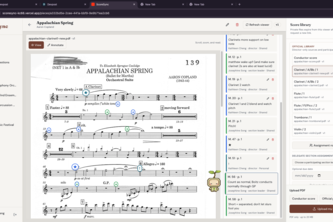
The system supports text and symbol notes placed by measure and location on rendered PDF pages. Notes can be personal reminders, shared section feedback, director notes sent from a conductor score to selected instrument parts or multiple sections, or musician suggestions waiting for review.
It includes an annotation system where musicians can suggest annotations on their assigned official part. These suggestions are visible only to the musician, relevant section leader, and director until reviewed. Review outcomes include:
- Approve: turning the suggestion into a shared annotation.
- Disregard: returning it as a personal note instead of deleting the work.
The system preserves measure context and allows intentional shared placement on the target part when conductor scores and individual parts have different layouts.
Inference The product appears to be a web-based application designed for collaborative music rehearsal environments, with specific attention paid to managing permissions and annotations across multiple roles and document types.
Positioning & Claim Evolution
The author states that ScoreSync addresses inconsistency in rehearsal feedback. They describe how directors work from full scores, musicians from individual parts, and section leaders coordinate sections — leading to fragmented communication and missed instructions.
The core positioning is: "ScoreSync keeps ensemble rehearsal feedback consistent."
It positions itself as a replacement for scattered PDFs, screenshots, messages, and verbal reminders. The author claims it gives each person the right materials and a structured way to communicate about them.
Inference This is a product built around solving a specific pain point in ensemble rehearsal workflows — not just a generic collaboration tool but one tailored to music education or community performance settings.
Target Customer & ICP
The description states that ScoreSync targets "school and community music ensembles." It mentions roles such as directors, section leaders, and musicians within these groups.
Membership details (instrument, grade, leadership role) are scoped to each ensemble rather than permanently attached to a user. A musician can play flute in one group, percussion in another, and have a different role in each.
Inference The ICP likely includes small-to-medium-sized music programs in educational institutions or community organizations that rely on collaborative rehearsal processes and need structured tools for managing shared musical materials and feedback.
Business Model & Pricing Evidence
Not evidenced.
The description does not mention any pricing model, monetization strategy, or business model. There is no indication of whether the tool will be offered free, paid, or through subscription.
Technical & Delivery Signals
The author reports that ScoreSync was built using:
- Frontend: React, TypeScript, Vite
- Backend: Node.js API with OpenAPI-generated clients
- Database: Supabase Auth, Postgres, Storage, Row Level Security
- Deployment: Vercel for frontend, Render for API
- PDF Handling: PDF.js for rendering and annotation overlays
- Storage: Private PDF storage with short-lived signed links
The author used Codex as a development collaborator throughout the process, including inspecting codebases, scoping milestones, implementing features, generating migrations, tracing production failures, and running type/build checks.
Deployment revealed bugs related to expired signed PDF links, nested-route refreshes, CORS configuration, and Row Level Security policies behaving differently in live app vs. local environments.
Inference The technical stack suggests a modern full-stack SaaS approach with cloud-native infrastructure (Supabase, Vercel, Render). The use of Codex indicates an AI-assisted development workflow, which may be relevant for understanding scalability or future tooling decisions.
Traction & Maturity Signals
Not evidenced.
There is no evidence of revenue, customers, user engagement, or adoption metrics. The author describes the tool as deployed and functional but does not provide data on usage, retention, or growth.
The project was submitted to a hackathon, suggesting it may be early-stage and experimental in nature.
Competitive Context
Not evidenced.
There is no mention of competitors, existing solutions, or market positioning relative to other tools for ensemble rehearsal management or collaborative music annotation.
Open Questions & Risks
- Single Developer: The project was built by one developer (Amelie Huang), raising questions about scalability, maintenance, and long-term support.
- No Revenue or Customers: No evidence of monetization, users, or traction. This raises concerns about market viability.
- Unverified Claims: All claims are self-reported and unverifiable; there is no independent validation of the stated benefits or technical capabilities.
- Deployment Challenges: The author notes that deployment surfaced several bugs not visible locally, indicating potential instability or lack of robust testing in production environments.
- Lack of Market Data: No evidence of demand, user feedback, or competitive analysis to support assumptions about product-market fit.
Questions the description leaves open
- What specific problems do you observe in current ensemble rehearsal workflows that ScoreSync aims to solve?
- How many ensembles are currently using ScoreSync, and what is their feedback?
- Are there any existing tools in this space? If so, how does ScoreSync differ from them?
- What is the plan for scaling beyond a single developer?
- How do you intend to monetize ScoreSync, if at all?
- Have you conducted any user research or interviews with directors, section leaders, or musicians?
- What are the biggest technical challenges you've faced in production and how were they resolved?
Overall Assessment
Not evidenced.
There is no evidence of funding, investment interest, or partnership discussions. The description does not indicate whether this is a commercial venture, a side project, or something intended for further development.
The author describes ScoreSync as a functional prototype built during a hackathon, with no indication of market traction or financial viability. Without data on users, revenue, or customer feedback, it's impossible to assess the potential for investment or partnership opportunities at this stage.
User Stories BotA demo video on every pull request
Get a demo video on every new feature
GitHub App that watches your pull requests and records a narrated, captioned demo.
Save time on demo prep and make informed decisions faster with a video walkthrough of every new feature.
Source
Submitted to the OpenAI 2026 hackathon on Devpost. Project home on Devpost. Back to the full gallery on Devpost.
This competitive analysis was produced by top-founders.com (opens in a new tab)
Generated by a language model from this project's public Devpost page — its tagline, the author's own write-up and any built-with tags listed there — as captured in August 2026. Short quotations are the author's words. It is an opinion on the idea as a business, not on the people behind it, and it reflects the description as published then. If the project has moved on, request a correction below. The analysis is not independent research and contains no verified traction, revenue or customer data.
An independent guide by KFG International LLC — not affiliated with, endorsed by, or connected to Devpost or OpenAI.