

Archive position — measured, not model output
0 likes on Devpost
2,263 of the 7,850 archived projects have more likes, and 5,587 share exactly 0 — so this project's #6,548 place in the like-ranked listing is a tie-break inside that group, not a ranking.
Projects (log scale)
Likes on Devpost. ▲ marks this project's group.
Show the figures
| Likes | Projects | Share of archive |
|---|---|---|
| 0 | 5,587 | 71.2% |
| 1 | 1,758 | 22.4% |
| 2 | 284 | 3.6% |
| 3–4 | 132 | 1.7% |
| 5–9 | 75 | 1.0% |
| 10+ | 14 | 0.2% |
 User Stories BotA demo video on every pull request
Get a demo video on every new feature
GitHub App that watches your pull requests and records a narrated, captioned demo.
Save time on demo prep and make informed decisions faster with a video walkthrough of every new feature.
Executive Summary
What the company appears to be
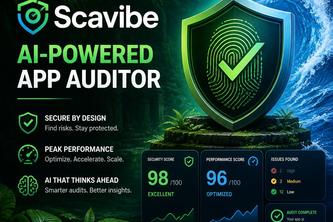
Scavibe is a self-reported pre-launch audit tool for vibe-coded apps (a term used by the author to describe applications built by non-technical founders). It claims to automate performance, security, and legal compliance checks using AI agents that scan GitHub repositories. The tool is described as running in a sandboxed environment, producing structured reports with verifiable findings.
What changed
The project description indicates this is a hackathon submission (submitted to the OpenAI 2026 hackathon), suggesting it was built rapidly and likely not yet deployed for commercial use. It has no evidence of revenue, customers, or traction beyond its own self-description.
Single most important open question
Is Scavibe’s AI agent pipeline capable of reliably detecting real issues in code without generating false positives or missing critical vulnerabilities? The author states that the system validates findings with exact file paths and line ranges, but there is no evidence of how often this validation succeeds or fails in practice.
What The Product Actually Is
The description states that Scavibe audits GitHub repositories through three stages:
- Performance: Load-tests a sandboxed deployment across fixed concurrency levels to identify breaking points.
- Security: Reviews the repository against an OWASP checklist, requiring exact file paths, line ranges, and source quotes for each finding.
- Legal & Data Handling: Traces data collection and consent flows, highlighting gaps in selected jurisdictions.
All outputs are exported as PDF reports. The system uses a pull request workflow to avoid direct pushes to repositories.
Evidence
- The author describes the three audit stages.
- It uses Next.js frontend and FastAPI backend.
- It pins audits to specific GitHub commits.
- It runs load tests in sandboxed environments.
- It generates structured findings with source evidence.
- Reports are downloadable as PDFs.
- Pull requests are used instead of direct pushes.
Inference The product is a developer tool designed for early-stage startups or solo founders who want to validate their app before launch.
Positioning & Claim Evolution
The author positions Scavibe as an alternative to vague AI advice, offering concrete findings with actionable remediation steps. It targets non-technical founders who may miss critical issues like unauthorized API routes or unverified security checks.
Key Claims
- Gives founders a practical pre-launch check.
- Avoids expensive and slow manual reviews.
- Provides verifiable findings (file path, line range, quote).
- Uses AI agents but enforces backend validation of results.
- Does not provide legal advice, only review aids.
Evidence
- The author explicitly states these claims in the write-up.
- The product is described as a “pre-launch check” for vibe-coded apps.
Inference The positioning reflects a niche market need: helping solo founders or small teams avoid common pitfalls without hiring expensive consultants. However, there is no evidence of how many such users exist or whether they would pay for this service.
Target Customer & ICP
The author defines the target user as non-technical founders who ship apps quickly but lack proper review processes.
Evidence
- The term “vibe-coded apps” refers to apps built by non-tech developers.
- Founders can ship in a weekend, then discover issues too late.
- The tool aims to replace expensive or slow manual reviews.
Inference The ideal customer profile is likely solo founders, small startups, or indie hackers who are not part of formal engineering teams and may lack internal security or compliance processes.
Business Model & Pricing Evidence
There is no evidence in the description of a business model or pricing structure. The author does not mention monetization, subscriptions, or any commercial offering beyond the hackathon submission.
Evidence
- No mention of pricing.
- No indication of revenue streams.
- No reference to paid features or tiers.
Inference If Scavibe is intended for commercial use, it has not yet defined how it will make money. The current version appears to be a proof-of-concept or prototype.
Technical & Delivery Signals
The system uses:
- Next.js frontend
- FastAPI backend
- AI agents powered by GPT-5.6 Terra (with fallback to NVIDIA)
- Sandboxed load testing
- Source validation via exact file, line, and quote matching
- Pull request workflow for changes
- Server-Sent Events for progress tracking
Evidence
- The author lists the tech stack.
- Describes sandboxed performance testing.
- Mentions deterministic scoring and backend validation.
- Notes use of pull requests and PDF exports.
Inference The architecture shows some sophistication in handling edge cases (e.g., malformed JSON, sandbox safety), but there is no evidence of scalability or production readiness.
Traction & Maturity Signals
There is no evidence of traction, revenue, customers, or adoption beyond the author’s own description. The project was submitted to a hackathon and has no archived history or external validation.
Evidence
- No mention of users, customers, or usage metrics.
- No revenue data or funding rounds.
- No product in production or marketplace presence.
Inference This is an early-stage prototype with no demonstrated market traction. It may be a proof-of-concept or MVP, but not yet a mature product.
Competitive Context
The author does not reference competitors or similar tools. There is no evidence of existing solutions in this space — whether they are AI-based, manual review platforms, or open-source scanning tools.
Evidence
- No mention of competitors.
- No comparison to other audit or scanning tools.
Inference It’s unclear if Scavibe fills a gap in the market or replicates an existing solution. The lack of competitive context makes it hard to assess its uniqueness or positioning.
Open Questions & Risks
- Unproven AI reliability: The system relies heavily on AI agents, but there is no evidence that these agents perform reliably or consistently.
- No validation data: No information about how often findings are accurate or false.
- Limited scope: Only three audit stages; no mention of expanding to other areas like accessibility, performance optimization, or scalability.
- Single-person team: The project is built by one person (Victor Kiprotich), which raises concerns about long-term maintenance and scaling.
- No commercialization plan: No evidence of monetization strategy or go-to-market approach.
Evidence
- No data on AI accuracy or validation.
- No mention of team size beyond one person.
- No indication of roadmap beyond hackathon submission.
Questions the description leaves open
- How often do your AI agents produce false positives or miss real issues?
- What is the expected time to complete a full audit for an average repository?
- Have you tested Scavibe on real-world repositories, and what were the results?
- Are there any known limitations in how well it handles large or complex codebases?
- How do you plan to scale beyond the current sandboxed approach?
- What is your roadmap for monetization and customer acquisition?
- Can you demonstrate a working prototype that can be used by others?
Overall Assessment
Not evidenced.
There is no evidence of revenue, customers, traction, or financial performance to support an investment or partnership decision. The project is described as a hackathon submission with no commercialization strategy or product-market fit demonstrated.
Confidence Level Low This analysis is based entirely on the self-reported description provided by the author. No external validation or historical data exists for this project.
User Stories BotA demo video on every pull request
Get a demo video on every new feature
GitHub App that watches your pull requests and records a narrated, captioned demo.
Save time on demo prep and make informed decisions faster with a video walkthrough of every new feature.
Source
Submitted to the OpenAI 2026 hackathon on Devpost. Project home on Devpost. Back to the full gallery on Devpost.
This competitive analysis was produced by top-founders.com (opens in a new tab)
Generated by a language model from this project's public Devpost page — its tagline, the author's own write-up and any built-with tags listed there — as captured in August 2026. Short quotations are the author's words. It is an opinion on the idea as a business, not on the people behind it, and it reflects the description as published then. If the project has moved on, request a correction below. The analysis is not independent research and contains no verified traction, revenue or customer data.
An independent guide by KFG International LLC — not affiliated with, endorsed by, or connected to Devpost or OpenAI.