

Archive position — measured, not model output
1 like on Devpost
505 of the 7,850 archived projects have more likes, and 1,758 share exactly 1 — so this project's #661 place in the like-ranked listing is a tie-break inside that group, not a ranking.
Projects (log scale)
Likes on Devpost. ▲ marks this project's group.
Show the figures
| Likes | Projects | Share of archive |
|---|---|---|
| 0 | 5,587 | 71.2% |
| 1 | 1,758 | 22.4% |
| 2 | 284 | 3.6% |
| 3–4 | 132 | 1.7% |
| 5–9 | 75 | 1.0% |
| 10+ | 14 | 0.2% |
 User Stories BotA demo video on every pull request
Get a demo video on every new feature
GitHub App that watches your pull requests and records a narrated, captioned demo.
Save time on demo prep and make informed decisions faster with a video walkthrough of every new feature.
Executive Summary
What the company appears to be
AutoSolve AI — Verified IT Remediation is a self-reported proof-of-concept tool built for developer and operations workflows. It claims to enable operators to enter incidents in natural language, use GPT-5.6 to generate structured remediation plans, validate those plans against policy and capability manifests, and execute only approved actions with independent verification of outcomes.
What changed
The project was submitted as a hackathon entry (OpenAI 2026) and is described as a clean-room sandbox implementation built in Python. It includes simulated integrations with alert providers like Datadog and Prometheus, ticketing systems like ServiceNow, and cloud platforms like AWS/EC2. The system is designed to avoid production credentials or data.
Single most important open question
Is there evidence of any real-world usage, traction, or commercial adoption beyond the demo? The description states no revenue, customers, or adoption data are available — only a self-reported demonstration.
Note: This analysis is based entirely on the author's own description. No external verification or historical data exists for this project.
What The Product Actually Is
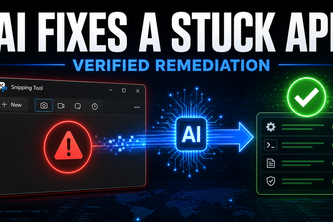
The description states that AutoSolve AI is a “verified incident-remediation command center” for developer and operations workflows. It accepts natural-language incidents such as “Snipping Tool on my local Windows machine will not close and is stuck open.”
It then:
- Normalizes the input into typed internal records.
- Searches historical verified resolutions.
- Inspects the target system (processes, logs, OS facts).
- Routes through provider-shaped adapters and a dynamic capability registry.
- Uses GPT-5.6 to generate structured plans when no reusable resolution exists.
- Validates these plans against typed contracts, policies, and allowlisted capabilities.
- Requires explicit approval before execution.
- Executes only in a sandboxed environment or local demo target.
- Independently verifies the outcome and records an audit trail.
The system is described as a standalone Python 3.10+ implementation with no production credentials or customer data involved. It includes simulators for various alerting, ticketing, and cloud systems but does not interact with real endpoints.
Inference: The product appears to be a prototype sandbox designed to demonstrate how AI could be used safely in IT incident response — not a deployed tool.
Positioning & Claim Evolution
The author states that AutoSolve AI was built around the question: “Can an operator give the system an incident in ordinary language, let it discover a safe remediation, and receive evidence that the target really recovered?”
It positions itself as:
- A stricter alternative to current incident response tools.
- Not focused on making suggestions but on creating controlled, reviewable actions.
- Designed to refuse labeling an issue resolved unless verification supports that claim.
The product is described as combining “the flexibility of an AI agent with the discipline expected from incident-response tooling.”
Claim: The system aims to turn ambiguous reports into reviewable plans and make verification a first-class outcome.
Inference: This reflects a shift toward more accountable automation in IT operations, but no evidence suggests this has been tested or adopted outside of a demo.
Target Customer & ICP
The description states that AutoSolve AI is intended for “developer and operations workflows.” It targets operators who manage incidents in environments where system health must be verified after remediation.
It includes integrations with:
- Alert providers (e.g., Datadog, Prometheus)
- Ticketing systems (e.g., ServiceNow)
- Cloud platforms (e.g., AWS/EC2)
However, the description makes clear that these are simulators, not live integrations. The system does not interact with production systems or require real credentials.
Claim: The tool is for IT teams managing incidents in dev and ops environments.
Not evidenced: No specific customer segments, personas, or use cases beyond the demo are provided.
Business Model & Pricing Evidence
The description does not contain any information about pricing, monetization, or business model. It describes a hackathon project with no indication of commercial intent or revenue streams.
Not evidenced: No evidence of pricing, subscriptions, licensing, or sales channels.
Technical & Delivery Signals
The system is implemented in Python 3.10+ using the standard library and avoids production credentials or data.
Key technical elements include:
- Typed contracts for validation
- Capability-based execution boundary
- Structured JSON output from GPT-5.6
- Simulated adapters for alerting, ticketing, and cloud platforms
- Audit trail with hash-chained evidence
- Deterministic offline planner (fallback without API key)
- Sandboxed execution environment
Claim: The architecture is modular and designed to prevent unsafe execution.
Inference: This suggests a strong focus on safety and control in automation.
Traction & Maturity Signals
The project is described as a hackathon submission, built during a single development sprint. It includes:
- Simulated integrations
- A public demo repository
- Automated tests
- Fault-injection scenarios
- Replay and rollback paths
There is no mention of any real-world deployment, customer feedback, or adoption metrics.
Not evidenced: No traction, usage data, or maturity indicators beyond the demo.
Competitive Context
The description does not reference existing tools in the market. However, based on its stated functionality — AI-powered incident remediation with verification and policy enforcement — it would likely compete with:
- Incident response platforms (e.g., PagerDuty, Splunk, ServiceNow)
- DevOps automation tools (e.g., Ansible, Puppet, Chef)
- Observability and monitoring systems (e.g., Datadog, Prometheus)
It is positioned as a safer, more accountable form of AI-driven remediation.
Inference: The product may address gaps in current tools that lack verification or policy enforcement.
Not evidenced: No competitive analysis or market positioning beyond self-description.
Open Questions & Risks
- No real-world usage: The system is described as a demo-only sandbox with no production use.
- Unproven scalability: The architecture is built for demonstration, not large-scale deployment.
- Limited integration depth: All integrations are simulated; no live connections to real systems.
- Unclear path to commercialization: No evidence of monetization or go-to-market strategy.
- Self-reported claims only: No third-party validation or performance data.
Inference: The project may be a promising concept but lacks any indication of traction or viability beyond the demo.
Questions the description leaves open
- What is the actual risk profile of the system in production environments?
- Has there been any testing with real operators or incident data?
- Are there plans to move beyond simulation into live integrations?
- How does the system handle edge cases or novel incidents not covered by its capability manifest?
- What are the key assumptions about how AI models behave in this context, and have they been validated?
- Is there any plan for enterprise-grade security, identity management, or secrets handling?
- What is the roadmap for moving from a demo to a production-ready tool?
Overall Assessment
The project is described as a hackathon submission with no evidence of traction, revenue, or commercial adoption.
Assessment: Not ready for investment or partnership at this stage.
Confidence level: Low — based on self-reported description only, with no external validation or usage data.
Next steps: If the founders have plans to scale beyond the demo, further due diligence would be needed to assess technical feasibility, scalability, and commercial viability.
User Stories BotA demo video on every pull request
Get a demo video on every new feature
GitHub App that watches your pull requests and records a narrated, captioned demo.
Save time on demo prep and make informed decisions faster with a video walkthrough of every new feature.
Source
Submitted to the OpenAI 2026 hackathon on Devpost. Project home on Devpost. Back to the full gallery on Devpost.
This competitive analysis was produced by top-founders.com (opens in a new tab)
Generated by a language model from this project's public Devpost page — its tagline, the author's own write-up and any built-with tags listed there — as captured in August 2026. Short quotations are the author's words. It is an opinion on the idea as a business, not on the people behind it, and it reflects the description as published then. If the project has moved on, request a correction below. The analysis is not independent research and contains no verified traction, revenue or customer data.
An independent guide by KFG International LLC — not affiliated with, endorsed by, or connected to Devpost or OpenAI.