

Archive position — measured, not model output
0 likes on Devpost
2,263 of the 7,850 archived projects have more likes, and 5,587 share exactly 0 — so this project's #6,547 place in the like-ranked listing is a tie-break inside that group, not a ranking.
Projects (log scale)
Likes on Devpost. ▲ marks this project's group.
Show the figures
| Likes | Projects | Share of archive |
|---|---|---|
| 0 | 5,587 | 71.2% |
| 1 | 1,758 | 22.4% |
| 2 | 284 | 3.6% |
| 3–4 | 132 | 1.7% |
| 5–9 | 75 | 1.0% |
| 10+ | 14 | 0.2% |
 User Stories BotA demo video on every pull request
Get a demo video on every new feature
GitHub App that watches your pull requests and records a narrated, captioned demo.
Save time on demo prep and make informed decisions faster with a video walkthrough of every new feature.
Executive Summary
What the company appears to be
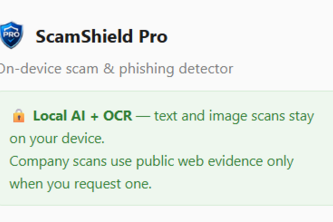
ScamShield Pro is a self-reported local-first Chrome extension designed to protect users from scams, phishing links, fake login pages, and fraudulent job offers. It combines machine learning (ML), explainable rules, OCR, and browser security inspection into a single tool that runs locally in the browser without requiring user data to leave their device.
What changed
The author states they built this as a solution to the increasing sophistication of scams, which now include professional-looking fake job offers and phishing pages. The project was developed using tools like DistilBERT, ONNX Runtime Web, Tesseract.js, and various APIs including Gemini and Tavily Search.
Single most important open question
Is there any evidence of user adoption or commercial traction beyond the author’s own development?
Note: All content is based on a self-reported project description. No external verification, revenue data, customer names, or independent sources are available.
What The Product Actually Is
The description states that ScamShield Pro is a local-first Chrome extension that performs multiple layers of scam detection:
- Text-based detection: Uses a fine-tuned DistilBERT model to classify text as Safe, Risky, or Scam.
- Image OCR support: Allows users to drag-select text from images on webpages and analyze it locally using Tesseract.js.
- Link inspection: Detects lookalike domains, URL shorteners, punycode, hidden redirects, and visible-link mismatches.
- Anti-phishing scan: Checks for fake login pages by inspecting claimed brand, current domain, password fields, and form destinations.
- Company research feature: Enables manual or selected company name input to return public evidence with source links (via Tavily API and Node.js backend).
It uses:
- Chrome Manifest V3
- ONNX Runtime Web with WASM
- Transformers.js
- Tesseract.js
- A Node.js backend hosted on Render for optional company research
Inference: The product is described as a browser extension, not a SaaS platform or API service. It is built to run locally and does not appear to be a commercial product yet.
Positioning & Claim Evolution
The author claims ScamShield Pro addresses the growing sophistication of scams, including:
- Fake job offers
- Phishing emails
- Fake login pages
- Shortened links
- Screenshot-based recruitment scams
They state that people should not need to copy content into a chatbot to assess risk — instead, they want a fast safety layer directly inside the browser.
The positioning is local-first security, emphasizing:
- Privacy (no data leaves the browser)
- Speed (real-time detection)
- Explainability (shows why something was flagged)
Claim vs Fact: The author positions this as a solution to modern scam trends, but no evidence of actual user feedback or market validation is provided.
Target Customer & ICP
The description states that ScamShield Pro targets:
- Students
- Job seekers
- Everyday internet users
These are described as individuals who are increasingly fooled by professional-looking scams.
Inference: The target audience appears to be general consumers rather than enterprise clients. No segmentation beyond “internet users” is evident.
Business Model & Pricing Evidence
There is no mention of pricing, monetization strategy, or business model in the project description.
Not evidenced
Technical & Delivery Signals
Key technical elements:
- Uses local inference via ONNX Runtime Web and Transformers.js
- Implements Tesseract OCR for image text extraction
- Runs on Chrome Manifest V3
- Includes an offscreen document for model execution
- Has a Node.js backend hosted on Render for optional company research
- Integrates with APIs like Gemini, Tavily Search, and Codex/GPT-5.6
Inference: The architecture shows a focus on privacy, performance, and integration complexity — but no evidence of deployment scale or production readiness.
Traction & Maturity Signals
The project is described as a hackathon submission (OpenAI 2026) and was built by one person (Rehan Raza). There is no evidence of:
- Users
- Revenue
- Customers
- Adoption metrics
- Product-market fit
- Commercial traction
Not evidenced
Competitive Context
No competitive analysis or mention of existing tools is included in the description.
Not evidenced
Open Questions & Risks
- Single-person development: The entire project was built by one individual, raising questions about scalability and long-term maintenance.
- No commercial traction: No evidence of users, revenue, or market validation.
- Local-first design may limit impact: While privacy-focused, local execution could reduce effectiveness if not widely adopted.
- Dependency on AI accuracy: The system relies heavily on ML models that may miss nuanced scams or generate false positives.
- Limited scope: The tool is focused on browser-based detection and lacks broader ecosystem integration.
Inference: The lack of any commercial or user-facing data makes it difficult to assess viability as a product or business.
Questions the description leaves open
- What is the current usage rate or adoption level among users?
- How do you plan to monetize this extension beyond its current open-source/hackathon state?
- Have you tested the model’s accuracy in real-world scenarios with actual scam content?
- Are there any plans for expanding beyond Chrome or adding mobile support?
- What are your long-term goals for product development and market positioning?
Overall Assessment
There is no evidence of commercial traction, revenue, or customer base.
Not evidenced
The project is described as a hackathon submission built by one developer. It demonstrates technical capability but lacks any sign of product-market fit, user adoption, or business model.
Confidence Level: Low — based entirely on self-reported claims with no external validation or data points.
User Stories BotA demo video on every pull request
Get a demo video on every new feature
GitHub App that watches your pull requests and records a narrated, captioned demo.
Save time on demo prep and make informed decisions faster with a video walkthrough of every new feature.
Source
Submitted to the OpenAI 2026 hackathon on Devpost. Project home on Devpost. Back to the full gallery on Devpost.
This competitive analysis was produced by top-founders.com (opens in a new tab)
Generated by a language model from this project's public Devpost page — its tagline, the author's own write-up and any built-with tags listed there — as captured in August 2026. Short quotations are the author's words. It is an opinion on the idea as a business, not on the people behind it, and it reflects the description as published then. If the project has moved on, request a correction below. The analysis is not independent research and contains no verified traction, revenue or customer data.
An independent guide by KFG International LLC — not affiliated with, endorsed by, or connected to Devpost or OpenAI.