

Archive position — measured, not model output
0 likes on Devpost
2,263 of the 7,850 archived projects have more likes, and 5,587 share exactly 0 — so this project's #6,531 place in the like-ranked listing is a tie-break inside that group, not a ranking.
Projects (log scale)
Likes on Devpost. ▲ marks this project's group.
Show the figures
| Likes | Projects | Share of archive |
|---|---|---|
| 0 | 5,587 | 71.2% |
| 1 | 1,758 | 22.4% |
| 2 | 284 | 3.6% |
| 3–4 | 132 | 1.7% |
| 5–9 | 75 | 1.0% |
| 10+ | 14 | 0.2% |
 User Stories BotA demo video on every pull request
Get a demo video on every new feature
GitHub App that watches your pull requests and records a narrated, captioned demo.
Save time on demo prep and make informed decisions faster with a video walkthrough of every new feature.
Executive Summary
What the company appears to be
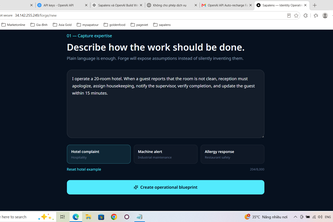
Sapalens Forge is a self-reported project that aims to transform human expertise into AI-structured standard operating procedures (SOPs), which are then converted into executable software modules for automation. The author describes it as an "Operational Intelligence Engine" that uses AI to structure knowledge, validate decisions through human review, and generate reusable operational assets.
What changed
The project was submitted to the OpenAI 2026 hackathon. It is described as a proof-of-concept or prototype built in a short timeframe using AI tools like GPT-5.6 and Codex, along with full-stack technologies such as React, Next.js, NestJS, and PostgreSQL.
Single most important open question
Is there evidence of real-world usage, customer feedback, or traction beyond the author’s own description? The project is presented as a concept, not a product in use.
What The Product Actually Is
The description states that Sapalens Forge enables domain experts—not only software engineers—to transform their professional knowledge into operational systems. It operates through five stages:
- Capture real-world expertise in natural language.
- AI structures the knowledge into standardized SOPs.
- Human experts review, validate, and approve critical decisions.
- Approved SOPs are transformed into executable software modules.
- Operational data continuously improves future versions.
The system is described as using GPT-5.6 for understanding instructions and structuring knowledge, and Codex to assist in building production-ready components. The application is built with a modern full-stack architecture including React, Next.js, TypeScript, NestJS, PostgreSQL, Docker, and the OpenAI API.
Inference The product appears to be an AI-powered workflow engine that bridges human expertise and software automation, but it is not evidenced as having been used in production or adopted by users beyond its creator.
Positioning & Claim Evolution
The author positions Sapalens Forge as a tool for turning human knowledge into reusable digital infrastructure. It is framed not merely as documentation, but as a way to make expertise scalable through automation and continuous improvement.
Key claims:
- AI acts as an "Operational Intelligence Engine"
- The workflow supports approval checkpoints, evidence verification, escalation rules, measurable execution, and continuous improvement
- Forge amplifies human expertise rather than replacing it
Inference The positioning reflects a shift from traditional AI chatbots toward operational systems that require governance and control by humans. However, the description lacks any indication of how this differs from existing tools or whether such workflows have been tested in practice.
Target Customer & ICP
The author states that Sapalens Forge targets domain experts—not only software engineers—who want to convert their professional knowledge into operational systems.
Inference The target customer segment likely includes professionals in industries where expertise is tacit and hard to codify, such as healthcare, engineering, consulting, or operations management. However, no specific industry or persona is named, nor is there evidence of market research or user interviews.
Business Model & Pricing Evidence
There is no mention of pricing models, monetization strategies, or business model assumptions in the description.
Not evidenced.
Technical & Delivery Signals
The project was built using:
- AI tools: GPT-5.6, Codex
- Frameworks and libraries: React, Next.js, NestJS, TypeScript, PostgreSQL, Docker, OpenAI API
- Development approach: AI-assisted with human oversight over system architecture, workflow design, and product decisions
Inference The technical stack suggests a modern full-stack SaaS-like architecture. However, the description does not indicate whether this is intended for deployment in enterprise environments or if it has been scaled beyond prototype status.
Traction & Maturity Signals
There is no evidence of revenue, customers, user adoption, or product maturity beyond the author’s own account.
Not evidenced.
Competitive Context
The description does not reference competitors or existing solutions in the space of AI-driven SOP generation or operational knowledge management.
Not evidenced.
Open Questions & Risks
- The project is described as a hackathon submission, suggesting it may be a prototype with limited functionality.
- No evidence of real-world usage or user feedback.
- Use of GPT-5.6 implies reliance on proprietary AI models that may not be available for long-term use.
- Lack of clarity around scalability and enterprise readiness.
- Absence of any mention of data privacy, governance, or compliance considerations.
Inference The lack of traction and commercial viability makes this a high-risk investment or partnership opportunity unless further development and validation occur post-hackathon.
Questions the description leaves open
- What specific industries or domains are you targeting with this tool?
- How do you plan to validate the accuracy and reliability of AI-generated SOPs before human approval?
- Are there any existing partnerships or early adopters who have tested the system?
- What is your roadmap for transitioning from prototype to scalable product?
- How will you ensure data security, privacy, and compliance in handling sensitive operational knowledge?
Overall Assessment
The project is presented as a concept or prototype built during a hackathon. There is no evidence of revenue, customers, or traction beyond the author’s own description.
Assessment Not ready for investment or partnership without further development and demonstration of real-world utility. The idea shows promise but lacks validation and commercial readiness.
User Stories BotA demo video on every pull request
Get a demo video on every new feature
GitHub App that watches your pull requests and records a narrated, captioned demo.
Save time on demo prep and make informed decisions faster with a video walkthrough of every new feature.
Source
Submitted to the OpenAI 2026 hackathon on Devpost. Project home on Devpost. Back to the full gallery on Devpost.
This competitive analysis was produced by top-founders.com (opens in a new tab)
Generated by a language model from this project's public Devpost page — its tagline, the author's own write-up and any built-with tags listed there — as captured in August 2026. Short quotations are the author's words. It is an opinion on the idea as a business, not on the people behind it, and it reflects the description as published then. If the project has moved on, request a correction below. The analysis is not independent research and contains no verified traction, revenue or customer data.
An independent guide by KFG International LLC — not affiliated with, endorsed by, or connected to Devpost or OpenAI.