

Archive position — measured, not model output
1 like on Devpost
505 of the 7,850 archived projects have more likes, and 1,758 share exactly 1 — so this project's #644 place in the like-ranked listing is a tie-break inside that group, not a ranking.
Projects (log scale)
Likes on Devpost. ▲ marks this project's group.
Show the figures
| Likes | Projects | Share of archive |
|---|---|---|
| 0 | 5,587 | 71.2% |
| 1 | 1,758 | 22.4% |
| 2 | 284 | 3.6% |
| 3–4 | 132 | 1.7% |
| 5–9 | 75 | 1.0% |
| 10+ | 14 | 0.2% |
 User Stories BotA demo video on every pull request
Get a demo video on every new feature
GitHub App that watches your pull requests and records a narrated, captioned demo.
Save time on demo prep and make informed decisions faster with a video walkthrough of every new feature.
Executive Summary
What the company appears to be
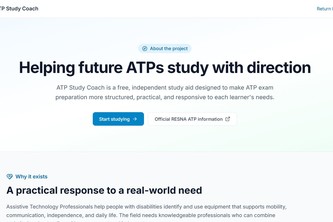
ATP Study Coach is a self-reported interactive learning platform for RESNA ATP exam preparation. The author states it is built with AI coding tools (Codex + GPT-5.6) and includes features like lessons, quizzes, progress tracking, flashcards, glossary, and an administrative content management system.
What changed
The project moved from a prototype built in Bolt to a GitHub-based workflow using Codex and GPT-5.6 during Build Week. The author reports improvements in reliability, security, testability, and maintainability through AI-assisted development.
The single most important open question
Is there any evidence of actual users or customers beyond the author's own testing and validation?
What The Product Actually Is
The description states that ATP Study Coach is an interactive learning and exam-preparation application for RESNA ATP candidates. It includes:
- Lessons and chapters
- Practice quizzes and customizable practice exams
- Progress tracking
- Scenario-based learning
- Glossary and flashcards
- Lesson notes and resume functionality
- Readiness feedback
The author reports that the platform uses React, TypeScript, Vite, Supabase, GitHub, and Vercel. It also includes an administrative content-management system for authorized users to validate, draft, review, and publish educational content without modifying source code.
Evidence The description states this is a working application with core learning features implemented, including progress tracking, quizzes, and administrative tools.
Inference The platform appears designed to support structured, client-centered judgment practice rather than simple fact memorization.
Positioning & Claim Evolution
The author claims that ATP Study Coach grew from their professional experience as a wheelchair case coordinator and computer science student. They state they wanted to create a learning platform that helps candidates prepare not only by reviewing facts but by practicing the client-centered judgment and professional reasoning expected of an ATP.
They describe it as going beyond memorizing definitions, asking learners to consider the entire service-delivery process including client goals, functional abilities, environments, safety, stakeholders, trials, documentation, implementation, and follow-up.
Evidence The description states this was inspired by their professional experience and aims to bridge knowledge gaps in ATP certification exam preparation.
Inference The positioning evolved from a personal project addressing a gap they observed professionally into a structured educational tool for certification prep.
Target Customer & ICP
The author identifies RESNA ATP candidates as the primary users. These are individuals preparing for the Assistive Technology Professional certification exam, which requires evaluating people's goals, abilities, environment, support system, and daily activities to select appropriate assistive technology.
Evidence The description states that ATP Study Coach is designed for RESNA ATP exam preparation and targets individuals who need to prepare for a broad range of knowledge areas in assistive technology and service delivery.
Inference The target customer is someone preparing for the ATP certification exam, likely working in or transitioning into assistive technology roles.
Business Model & Pricing Evidence
Not evidenced. The description does not mention any pricing model, monetization strategy, or business model details.
Technical & Delivery Signals
The author reports that the application was built using:
- Bolt (for initial prototype)
- GitHub (development workflow)
- Codex + GPT-5.6 (to extend and stabilize the application)
- Supabase (database)
- React, TypeScript, Vite, Tailwind CSS
- GitHub Actions for CI/CD
- Vercel (deployment)
Key technical improvements made during Build Week included:
- Better error handling
- Supabase configuration rebuild with reproducible migrations
- Row-level security strengthening
- Automated tests and quality checks
- Secure self-service account deletion
- Improved navigation, glossary tools, learner notes, missed-question review, and resume behavior
- Structured CMS with revisions, draft batches, validation, publishing controls, and safeguards
Evidence The description states these technical improvements were made using AI coding tools.
Traction & Maturity Signals
Not evidenced. There is no mention of users, customers, revenue, or adoption metrics beyond the author's own testing and development work.
Competitive Context
Not evidenced. The description does not reference competitors or market positioning relative to other ATP exam prep tools.
Open Questions & Risks
- No evidence of traction or users: The project appears to be a personal development effort with no external validation.
- Self-reported only: All claims are from the author and lack independent verification.
- Unproven commercial viability: No indication that the platform has been monetized or scaled beyond the author's own use.
- Dependency on AI tools: Heavy reliance on Codex + GPT-5.6 may not be sustainable or replicable without access to those specific tools.
- Lack of external validation: The description does not mention any third-party review, testing, or feedback from actual ATP candidates.
Questions the description leaves open
- What is the source of the educational content? Is it based on official RESNA materials or proprietary sources?
- Have you validated your approach with actual ATP candidates or professionals in the field?
- How do you plan to scale beyond a single developer?
- Are there any plans for monetization or commercial partnerships?
- What are the specific limitations of the current AI-assisted development approach that might affect long-term maintainability?
Overall Assessment
Not evidenced. The description lacks any information about funding, valuation, or investment history. No indication whether this is a commercial venture or personal project.
User Stories BotA demo video on every pull request
Get a demo video on every new feature
GitHub App that watches your pull requests and records a narrated, captioned demo.
Save time on demo prep and make informed decisions faster with a video walkthrough of every new feature.
Source
Submitted to the OpenAI 2026 hackathon on Devpost. Project home on Devpost. Back to the full gallery on Devpost.
This competitive analysis was produced by top-founders.com (opens in a new tab)
Generated by a language model from this project's public Devpost page — its tagline, the author's own write-up and any built-with tags listed there — as captured in August 2026. Short quotations are the author's words. It is an opinion on the idea as a business, not on the people behind it, and it reflects the description as published then. If the project has moved on, request a correction below. The analysis is not independent research and contains no verified traction, revenue or customer data.
An independent guide by KFG International LLC — not affiliated with, endorsed by, or connected to Devpost or OpenAI.