

Archive position — measured, not model output
0 likes on Devpost
2,263 of the 7,850 archived projects have more likes, and 5,587 share exactly 0 — so this project's #6,487 place in the like-ranked listing is a tie-break inside that group, not a ranking.
Projects (log scale)
Likes on Devpost. ▲ marks this project's group.
Show the figures
| Likes | Projects | Share of archive |
|---|---|---|
| 0 | 5,587 | 71.2% |
| 1 | 1,758 | 22.4% |
| 2 | 284 | 3.6% |
| 3–4 | 132 | 1.7% |
| 5–9 | 75 | 1.0% |
| 10+ | 14 | 0.2% |
 User Stories BotA demo video on every pull request
Get a demo video on every new feature
GitHub App that watches your pull requests and records a narrated, captioned demo.
Save time on demo prep and make informed decisions faster with a video walkthrough of every new feature.
Executive Summary
What the company appears to be
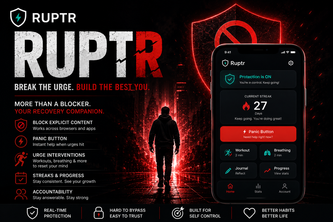
Ruptr is an Android application developed by a single founder (Kush Kumar) for a hackathon. The app aims to reduce compulsive pornography consumption through a combination of content blocking, behavioral interventions, and habit-building tools. It uses local VPN and DNS filtering, accessibility monitoring, and on-device intervention screens to redirect urges toward healthier alternatives like workouts or breathing exercises.
What changed
This is a self-reported hackathon project with no evidence of prior traction, revenue, or customer adoption. The description indicates the app was built using AI tools (Codex, GPT) and is currently in an early-stage prototype form.
Single most important open question
Is there any evidence that Ruptr has moved beyond a personal hackathon idea into a product with real-world usage or user feedback?
Note: This analysis is based solely on the self-reported project description provided by the author. No external verification, funding rounds, revenue figures, customer data, or independent sources are available.
What The Product Actually Is
The description states that Ruptr is an Android application designed to help users reduce compulsive pornography consumption. It combines:
- Content blocking using Local VPN and DNS filtering.
- Accessibility Service for detecting risky browsing behavior.
- Instant intervention screen before accessing blocked content.
- A panic button for immediate urge diversion.
- Workout and breathing exercises to redirect attention.
- Features such as recovery streak tracking, progress monitoring, and accountability-focused design.
The app performs all blocking locally on the device, avoiding sending user data to external servers. It is built using Kotlin with Android Jetpack components and integrates AI tools like Codex for development assistance.
Inference: The product appears to be a behavioral intervention tool focused on digital wellbeing, not just content restriction.
Positioning & Claim Evolution
The description claims that Ruptr is more than a simple blocker—it aims to "help change" compulsive behavior by diverting urges toward healthier alternatives. It positions itself as:
- A recovery companion, not just another content blocker.
- An application that focuses on habit-building and behavioral change, rather than just denying access.
It also references the author's personal struggle with pornography addiction, suggesting a narrative of empathy and lived experience in shaping the product’s mission.
Claim: The app is positioned as a tool for digital recovery, not merely technical control.
Inference: The positioning evolves from a personal solution to a scalable behavioral intervention platform.
Target Customer & ICP
The description states that Ruptr was inspired by the author's own teenage struggle with pornography consumption and aims to help others facing similar issues. It specifically mentions:
- Teenagers in the author’s neighborhood who are struggling with the same problem.
- Users looking for alternatives to traditional blockers, which they claim are ineffective at diverting urges.
There is no mention of specific demographics beyond age groups (teenagers), nor any segmentation strategy or market research behind the target audience.
Claim: The primary user base consists of young people dealing with compulsive pornography use.
Not evidenced: No data on actual users, usage patterns, or customer personas.
Business Model & Pricing Evidence
There is no evidence in the description of a business model or pricing structure. The project is described as a hackathon submission and does not reference monetization strategies, subscriptions, freemium models, or any form of revenue generation.
Not evidenced: No indication of how the app will be monetized or whether it intends to charge users.
Technical & Delivery Signals
The description provides some technical details about how Ruptr was built:
- Built entirely for Android using Kotlin.
- Uses Android components including:
- VpnService
- AccessibilityService
- Local DNS filtering
- Foreground services
- Material Design UI
- Gradle build system
- Developed with the help of AI tools (Codex, GPT).
- All blocking is done locally on the device.
- Architecture includes layers for risk detection, intervention, and recovery.
Inference: The app uses standard Android development practices and integrates modern security and privacy features.
Not evidenced: No information on scalability, performance metrics, or deployment strategy beyond prototype-level development.
Traction & Maturity Signals
The description makes no mention of any traction, user adoption, or product maturity. It is explicitly stated that this was a hackathon project, and the author notes it’s their first time participating in such an event. There are no references to:
- Users
- Downloads
- Feedback
- Iterations beyond initial development
- Product roadmap or future releases
Not evidenced: No evidence of traction, usage, or product evolution past the hackathon stage.
Competitive Context
The description does not provide any information about competitors or market positioning relative to existing tools. It only mentions that the author tried many blockers previously but found them lacking in terms of diversion capabilities.
Not evidenced: No competitive landscape analysis, benchmarking, or awareness of similar products.
Open Questions & Risks
Several key risks and open questions emerge from the self-reported description:
- Single-founder project with no team or external support.
- No evidence of product-market fit or user feedback.
- Unverified claims about effectiveness or impact.
- Lack of business model or monetization strategy.
- Prototype-level development, not a production-ready product.
- Reliance on AI for development, which may limit control and scalability.
- No mention of privacy compliance, data handling, or legal considerations.
Inference: The project lacks commercial viability indicators and appears to be in early conceptualization rather than execution.
Questions the description leaves open
- What specific behavioral outcomes have you observed from users (if any)?
- How do you plan to validate the effectiveness of interventions like breathing exercises or workouts?
- Have you conducted any user testing or gathered feedback beyond personal experience?
- Is there a clear path toward monetization or long-term sustainability?
- What are your plans for scaling beyond the current prototype?
- Are there any legal or regulatory concerns around collecting or analyzing sensitive behavioral data?
- How do you intend to differentiate Ruptr from existing apps in this space?
Overall Assessment
At this stage, Ruptr is a conceptual idea rooted in personal experience and hackathon development. There is no evidence of traction, revenue, or customer validation.
Assessment: Not suitable for investment or partnership at this time.
Confidence Level: Low — based entirely on self-reported content with no external corroboration.
Next Steps: If the founder wishes to pursue further development, they should demonstrate early traction, user feedback, and a clear go-to-market strategy.
User Stories BotA demo video on every pull request
Get a demo video on every new feature
GitHub App that watches your pull requests and records a narrated, captioned demo.
Save time on demo prep and make informed decisions faster with a video walkthrough of every new feature.
Source
Submitted to the OpenAI 2026 hackathon on Devpost. Project home on Devpost. Back to the full gallery on Devpost.
This competitive analysis was produced by top-founders.com (opens in a new tab)
Generated by a language model from this project's public Devpost page — its tagline, the author's own write-up and any built-with tags listed there — as captured in August 2026. Short quotations are the author's words. It is an opinion on the idea as a business, not on the people behind it, and it reflects the description as published then. If the project has moved on, request a correction below. The analysis is not independent research and contains no verified traction, revenue or customer data.
An independent guide by KFG International LLC — not affiliated with, endorsed by, or connected to Devpost or OpenAI.