

Archive position — measured, not model output
0 likes on Devpost
2,263 of the 7,850 archived projects have more likes, and 5,587 share exactly 0 — so this project's #3,079 place in the like-ranked listing is a tie-break inside that group, not a ranking.
Projects (log scale)
Likes on Devpost. ▲ marks this project's group.
Show the figures
| Likes | Projects | Share of archive |
|---|---|---|
| 0 | 5,587 | 71.2% |
| 1 | 1,758 | 22.4% |
| 2 | 284 | 3.6% |
| 3–4 | 132 | 1.7% |
| 5–9 | 75 | 1.0% |
| 10+ | 14 | 0.2% |
 User Stories BotA demo video on every pull request
Get a demo video on every new feature
GitHub App that watches your pull requests and records a narrated, captioned demo.
Save time on demo prep and make informed decisions faster with a video walkthrough of every new feature.
Executive Summary
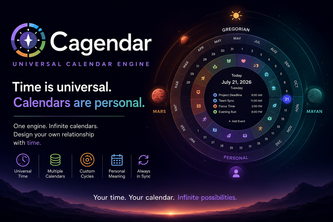
The company appears to be a solo-project calendar engine built during a hackathon, with no evidence of revenue, customers, or commercial traction. The author states that Cagendar is a "personalized calendar engine" that allows users to define their own cycles and switch between various calendar systems (Gregorian, Mars, Mayan, custom). It is described as a flexible backend engine rather than a finished product, built with GPT-5.6 and Codex during a hackathon.
What changed: The project evolved from a simple idea of renaming months into a broader system allowing users to define their own calendar cycles, including customizable week lengths, month structures, and visual layouts (circular or grid). It is positioned as an experiment in rethinking timekeeping conventions.
The single most important open question: Is there any evidence that this concept has traction, adoption, or a path to monetization beyond the prototype?
Analysis basis: Self-reported only. No third-party verification, no revenue, customer or traction data. The description is from the author’s own submission to a hackathon and is unverified.
What The Product Actually Is
- The description states that Cagendar is a personalized calendar engine.
- It allows users to define their own cycles and switch between:
- Gregorian
- Mars
- Mayan (Tzolk'in)
- Custom calendars
- It supports:
- Custom week lengths
- Month structures
- Names, symbols, recurring rhythms
- Overlay cycles
- It includes both circular and grid layouts
- The system is built with:
- FastAPI backend
- React frontend
- GPT-5.6 and Codex for development
- It is described as a flexible engine, not a finished application
Inference: The product is a prototype, not a commercial offering.
Positioning & Claim Evolution
- The author states that Cagendar is built around the idea of separating timekeeping from time interpretation.
- It challenges the assumption that calendars are fixed and immutable.
- The project is described as an experiment in rethinking timekeeping conventions, with a focus on personalization.
- The tagline: “A personalized calendar engine that lets people define their own cycles, switch between Gregorian, Mars, Mayan, and custom calendars, and view time through circular or grid layouts” — positions it as a flexible, customizable, and expressive calendar tool.
Claim: Cagendar is redefining how people interact with time.
Inference: This is a conceptual shift from traditional calendar systems, not a commercial product yet.
Target Customer & ICP
- The description does not identify specific customer segments or personas.
- It implies a personal user who wants to define their own calendar cycles and rhythms.
- The author states that the goal is to allow people to define the rhythms that matter most in their lives, while remaining connected to shared time.
Not evidenced: No explicit ICP, target market, or customer type identified.
Business Model & Pricing Evidence
- The description does not mention any pricing model or business model.
- It is described as a prototype built during a hackathon.
- There is no evidence of monetization, subscriptions, or revenue streams.
Not evidenced: No business model or pricing information provided.
Technical & Delivery Signals
- Built with:
- FastAPI (backend)
- React (frontend)
- GPT-5.6 and Codex
- Python, TypeScript, JavaScript, HTML5, CSS3
- SQLite, SQLAlchemy, JSON, REST APIs
- The system includes:
- Reusable calendar interpretation engine
- Multiple calendar systems with shared architecture
- Circular and grid views
- User-defined calendar structures
- Personal events, recurring rhythms, overlay cycles
Inference: The project is technically feasible but remains a prototype. No evidence of production-grade delivery or scalability.
Traction & Maturity Signals
- The project was built during a hackathon.
- It is described as a prototype, not a product in the market.
- There is no evidence of:
- Customers
- Revenue
- Usage metrics
- Product-market fit
- Adoption or retention data
Not evidenced: No traction, usage, or maturity signals.
Competitive Context
- The description does not mention any competitors.
- It is a conceptual prototype and not positioned against existing calendar tools.
- It appears to be in a space that includes:
- Traditional calendars (Google Calendar, Outlook)
- Niche time-tracking tools
- Customizable scheduling systems
Not evidenced: No competitive analysis or positioning against existing tools.
Open Questions & Risks
- The project is a solo hackathon effort, with no team or commercial structure.
- It is described as a prototype — not a product in the market.
- The author states that the biggest challenge was shifting from traditional assumptions about calendars, which suggests high complexity and potential usability issues.
- No evidence of:
- Product-market fit
- Revenue model
- Customer feedback or adoption
- Scalability or production readiness
Inference: High risk of failure due to lack of traction, commercial viability, and team structure.
Questions the description leaves open
- What is the intended path from prototype to product?
- Are there any users or early adopters who have expressed interest in this concept?
- How does the project plan to monetize or scale beyond a hackathon prototype?
- What are the technical challenges in making this system usable for mass adoption?
- Is there any evidence of user feedback or testing with real people?
Overall Assessment
- Not evidenced: No commercial traction, revenue, or customer data.
- The project is a conceptual prototype built during a hackathon by one person.
- It is described as an experiment in rethinking calendars, not a product ready for market.
- The author states that the prototype is only the beginning and that future work includes richer visualizations, AI-assisted creation, and deeper personalization.
Assessment: Not ready for investment or partnership. This is a pre-product concept with no evidence of commercial viability or traction. It requires further development, user testing, and business model validation before any serious consideration.
User Stories BotA demo video on every pull request
Get a demo video on every new feature
GitHub App that watches your pull requests and records a narrated, captioned demo.
Save time on demo prep and make informed decisions faster with a video walkthrough of every new feature.
Source
Submitted to the OpenAI 2026 hackathon on Devpost. Project home on Devpost. Back to the full gallery on Devpost.
This competitive analysis was produced by top-founders.com (opens in a new tab)
Generated by a language model from this project's public Devpost page — its tagline, the author's own write-up and any built-with tags listed there — as captured in August 2026. Short quotations are the author's words. It is an opinion on the idea as a business, not on the people behind it, and it reflects the description as published then. If the project has moved on, request a correction below. The analysis is not independent research and contains no verified traction, revenue or customer data.
An independent guide by KFG International LLC — not affiliated with, endorsed by, or connected to Devpost or OpenAI.