

Archive position — measured, not model output
0 likes on Devpost
2,263 of the 7,850 archived projects have more likes, and 5,587 share exactly 0 — so this project's #6,357 place in the like-ranked listing is a tie-break inside that group, not a ranking.
Projects (log scale)
Likes on Devpost. ▲ marks this project's group.
Show the figures
| Likes | Projects | Share of archive |
|---|---|---|
| 0 | 5,587 | 71.2% |
| 1 | 1,758 | 22.4% |
| 2 | 284 | 3.6% |
| 3–4 | 132 | 1.7% |
| 5–9 | 75 | 1.0% |
| 10+ | 14 | 0.2% |
 User Stories BotA demo video on every pull request
Get a demo video on every new feature
GitHub App that watches your pull requests and records a narrated, captioned demo.
Save time on demo prep and make informed decisions faster with a video walkthrough of every new feature.
Executive Summary
What the company appears to be
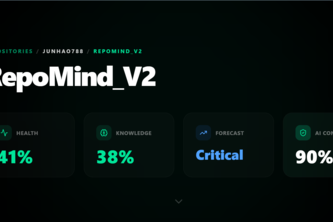
RepoMind is a self-reported engineering intelligence platform for Git repositories. The author describes it as an AI-powered system that transforms GitHub repositories into "Engineering Intelligence Platforms" by building structured knowledge layers from source code and Git history.
What changed
The project was submitted to the OpenAI 2026 hackathon, indicating a development phase focused on building a prototype with limited commercial traction or revenue data. It is described as a single-person effort (team size: 1) and lacks evidence of customers, funding, or product-market fit.
Single most important open question
Is there any evidence that RepoMind has moved beyond the prototype stage, or whether it has been tested in real engineering environments?
What The Product Actually Is
The description states that RepoMind is a system that "continuously transforms a GitHub repository into an Engineering Intelligence Platform." It performs analysis and constructs several outputs:
- Repository DNA
- Knowledge Graph
- Engineering Health
- Repository Evolution
- Semantic Pull Request Analysis
- Impact Analysis
- Decision Memory
- AI Workspace
It uses a "structured engineering pipeline" where data flows through multiple stages before reaching the AI layer. These include repository cloning, Git history extraction, dependency analysis, component discovery, semantic diff generation, and knowledge graph construction.
The system is built using technologies including FastAPI, Next.js, React, Docker, PostgreSQL, Redis, OpenAI, and others.
Inference The product appears to be a developer tool that leverages AI and structured data processing to help teams understand their codebase more deeply than traditional Git tools or AI coding assistants.
Positioning & Claim Evolution
The author positions RepoMind as an evolution of existing AI coding assistants. While those tools generate code, RepoMind aims to make repositories "understand themselves."
Key claims:
- It treats every repository as a "living engineering knowledge system."
- It builds understanding of how software evolves.
- It allows developers to ask engineering questions in natural language.
- Unlike traditional dashboards, it doesn't just visualize Git history but constructs an understanding of architectural decisions and risks.
Inference The positioning is that RepoMind is a knowledge management and decision-support tool for engineering teams, not a code generation assistant. It seeks to bridge the gap between raw source code and organizational knowledge.
Target Customer & ICP
The description does not explicitly name target customers or define an ideal customer profile (ICP). However, it implies that RepoMind is aimed at engineering teams working with Git repositories, particularly those who face challenges like:
- Loss of institutional knowledge when senior engineers leave
- Outdated documentation
- Difficulties understanding the impact of changes
It also suggests use cases for pull request analysis and architectural decision tracking.
Inference The likely ICP includes mid-to-large engineering teams managing complex software systems, especially those with distributed or remote developers who rely on Git-based workflows.
Business Model & Pricing Evidence
There is no evidence in the description of a business model or pricing structure. The project is described as a hackathon submission and lacks any mention of monetization, subscriptions, or sales processes.
Inference No commercial model has been defined or evidenced.
Technical & Delivery Signals
RepoMind is built using:
- Backend: FastAPI, Python, PostgreSQL, Redis, Celery
- Frontend: Next.js, React, Tailwind CSS
- Infrastructure: Docker, Vercel, Railway
- AI integration: OpenAI
- Parsing tools: Tree-sitter, Git, GitHub APIs
It uses a "centralized Intelligence Spine" architecture where all features derive from a single analysis pipeline.
Inference The technical stack suggests a modern, scalable backend with AI integration and containerization. However, no evidence of production deployment or performance metrics is provided.
Traction & Maturity Signals
The project is described as a hackathon submission (OpenAI 2026). It has:
- Team size: 1
- No mention of revenue, customers, or user adoption
- No evidence of product-market fit or usage beyond the author's own development
Inference The product appears to be in early prototype form with no demonstrated traction.
Competitive Context
The description does not provide information about competitors. It only states that existing tools help generate code but RepoMind aims to do something different — build understanding of how software evolves rather than just generating new code.
Inference RepoMind positions itself as a competitor or complement to AI coding assistants and traditional Git-based dashboards, though no specific names or market positioning are given.
Open Questions & Risks
- Single-person team: The entire project is attributed to one person (Lim JunHao), raising questions about scalability and execution capability.
- Prototype-only status: Submitted to a hackathon; no evidence of commercial viability or real-world usage.
- No revenue or customer data: No indication of monetization, users, or adoption.
- Unverified claims: All descriptions are self-reported and unverified.
- Technical complexity without demonstration: The architecture is described in detail but lacks proof of working implementation.
Questions the description leaves open
- What specific engineering problems does RepoMind solve today? Can you provide examples?
- Has the system been tested with real engineering teams or repositories?
- How does RepoMind handle large-scale repositories or those with complex dependencies?
- Are there any existing partnerships, early adopters, or pilot programs?
- What are the key assumptions behind RepoMind’s architecture and approach?
- Is there a plan to move beyond the prototype stage? If so, what are the next steps?
Overall Assessment
Not evidenced.
The description provides no information on financials, traction, or strategic fit for investment or partnership. The project is described as a hackathon submission with no indication of commercial readiness or market validation.
Confidence level Low. The analysis is based entirely on self-reported claims and lacks any external verification or evidence of product-market fit, revenue, or customer data.
User Stories BotA demo video on every pull request
Get a demo video on every new feature
GitHub App that watches your pull requests and records a narrated, captioned demo.
Save time on demo prep and make informed decisions faster with a video walkthrough of every new feature.
Source
Submitted to the OpenAI 2026 hackathon on Devpost. Project home on Devpost. Back to the full gallery on Devpost.
This competitive analysis was produced by top-founders.com (opens in a new tab)
Generated by a language model from this project's public Devpost page — its tagline, the author's own write-up and any built-with tags listed there — as captured in August 2026. Short quotations are the author's words. It is an opinion on the idea as a business, not on the people behind it, and it reflects the description as published then. If the project has moved on, request a correction below. The analysis is not independent research and contains no verified traction, revenue or customer data.
An independent guide by KFG International LLC — not affiliated with, endorsed by, or connected to Devpost or OpenAI.