

Archive position — measured, not model output
0 likes on Devpost
2,263 of the 7,850 archived projects have more likes, and 5,587 share exactly 0 — so this project's #6,330 place in the like-ranked listing is a tie-break inside that group, not a ranking.
Projects (log scale)
Likes on Devpost. ▲ marks this project's group.
Show the figures
| Likes | Projects | Share of archive |
|---|---|---|
| 0 | 5,587 | 71.2% |
| 1 | 1,758 | 22.4% |
| 2 | 284 | 3.6% |
| 3–4 | 132 | 1.7% |
| 5–9 | 75 | 1.0% |
| 10+ | 14 | 0.2% |
 User Stories BotA demo video on every pull request
Get a demo video on every new feature
GitHub App that watches your pull requests and records a narrated, captioned demo.
Save time on demo prep and make informed decisions faster with a video walkthrough of every new feature.
Executive Summary
What the company appears to be
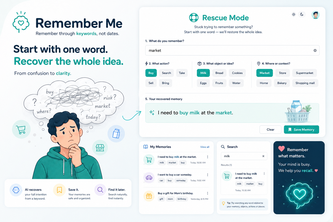
Remember Me is a self-reported personal memory assistant application built as a bilingual Progressive Web App (PWA). The author describes it as a tool for capturing and recovering fragmented personal intentions using remembered words or phrases, without requiring accounts, external APIs, or internet connectivity.
What changed
The project was developed during OpenAI Build Week 2026. It began as an idea inspired by everyday memory gaps and evolved into a working prototype with core functionality including saving and recalling memories via local storage, bilingual support, and classification of fragments into categories like action, object, place, or context.
Single most important open question
Is there any evidence that users have adopted or engaged with this product beyond the author's own testing? The description contains no data on usage, retention, or adoption — only a self-reported prototype.
Note: This analysis is based entirely on the self-reported, unverified project description provided by the caller. All claims are attributed to the author’s own account and not independently verified.
What The Product Actually Is
The description states that Remember Me is:
- A bilingual Progressive Web App (PWA) built with HTML, CSS, JavaScript.
- Designed to help users capture and recover personal intentions using remembered words or phrases.
- Capable of classifying fragments into categories such as:
- Action, Object, Idea
- Place, Context
- Uses a local JSON library for bilingual recommendations (Spanish and English).
- Stores memories locally in the browser using
localStorage. - Operates without an account, API key, or permanent internet connection.
- Deployed on Netlify with a manifest and service worker to support PWA functionality.
Inference: The product is described as a lightweight, private, offline-capable tool for personal memory management. It does not appear to be a commercial SaaS offering.
Positioning & Claim Evolution
The author claims:
- The app helps users recover incomplete memories by entering remembered fragments.
- It works in both Spanish and English, with local bilingual libraries.
- It supports no account or external API usage, emphasizing privacy and independence.
- It is designed for spontaneous, unplanned moments, not structured task management.
Inference: The positioning appears to be a niche personal utility — a lightweight memory aid rather than a productivity tool or enterprise solution.
Target Customer & ICP
The description states:
- The app targets individuals who experience memory gaps in daily life.
- Users may remember only a small part of something they wanted to recall (e.g., “There was a place here that sold something I liked”).
- It is intended for those who want to capture and recover personal intentions, not for business or team use.
Not evidenced: No specific customer personas, user segments, or target industries are identified. The author does not describe any market research or user interviews.
Business Model & Pricing Evidence
The description states:
- The application is free to use.
- It requires no account, no API key, and no external database.
- No pricing information or monetization strategy is mentioned.
Inference: There is no evidence of a business model beyond the prototype’s current state. The app seems to be a personal tool, not a commercial product.
Technical & Delivery Signals
The description states:
- Built using HTML, CSS, vanilla JavaScript.
- Uses Codex and GPT-5.6 during development for design, testing, and refinement.
- Stores data locally via
localStorage. - Delivered as a Progressive Web App (PWA) with manifest and service worker.
- Supports light, dark, and automatic appearance modes.
- Does not require an internet connection or external services.
Inference: The technical stack is minimal and self-contained. It suggests a low-cost, private, and portable solution — but no evidence of scalability or infrastructure beyond the prototype.
Traction & Maturity Signals
The description states:
- The app was built during OpenAI Build Week 2026.
- It is a working prototype, not yet a production-ready product.
- The author tested it with simple words like “dog,” “market,” and “database” to identify weaknesses.
- No data on user engagement, retention, or adoption is provided.
Not evidenced: There is no evidence of users, customers, or usage metrics. The project remains in the prototype phase.
Competitive Context
The description states:
- It is not a calendar, task manager, or shopping-list generator.
- It is designed for personal memory recovery, not structured productivity tools.
- No competitors are named or compared.
Not evidenced: No competitive landscape or market positioning relative to existing tools (e.g., Notion, Evernote, or AI memory apps) is described.
Open Questions & Risks
The description states:
- The app does not support cloud synchronization, accounts, or external APIs.
- It uses a local JSON library for recommendations — which may be limited in scope.
- Features like voice input, reminders, and export are listed as future enhancements.
- The author notes that the project was constrained by time (Build Week) and excluded features such as alarms and cloud sync.
Inference: The app is limited to local storage and lacks scalability or enterprise features. It may struggle to evolve into a broader product without significant development effort.
Questions the description leaves open
- What was the original inspiration behind Remember Me, and how did it evolve?
- How many people have tested the prototype, and what feedback did they provide?
- Are there any plans for monetization or commercial use beyond the current prototype?
- What are the technical limitations of local storage that could affect long-term usability?
- Has the author considered integrating with other tools or platforms (e.g., calendars, note-taking apps)?
- How does the app handle ambiguous or multi-meaning words in classification?
- Are there plans to expand beyond Spanish and English?
Overall Assessment
The description states:
- The project is a self-contained prototype built during a hackathon.
- It has no revenue, customers, or traction data.
- It is described as a personal tool, not a commercial product.
Not evidenced: No evidence of market demand, user adoption, or business viability exists. The app appears to be an experimental idea with no clear path to monetization or growth.
Confidence: Low — based on self-reported prototype description only.
User Stories BotA demo video on every pull request
Get a demo video on every new feature
GitHub App that watches your pull requests and records a narrated, captioned demo.
Save time on demo prep and make informed decisions faster with a video walkthrough of every new feature.
Source
Submitted to the OpenAI 2026 hackathon on Devpost. Project home on Devpost. Back to the full gallery on Devpost.
This competitive analysis was produced by top-founders.com (opens in a new tab)
Generated by a language model from this project's public Devpost page — its tagline, the author's own write-up and any built-with tags listed there — as captured in August 2026. Short quotations are the author's words. It is an opinion on the idea as a business, not on the people behind it, and it reflects the description as published then. If the project has moved on, request a correction below. The analysis is not independent research and contains no verified traction, revenue or customer data.
An independent guide by KFG International LLC — not affiliated with, endorsed by, or connected to Devpost or OpenAI.