

Archive position — measured, not model output
0 likes on Devpost
2,263 of the 7,850 archived projects have more likes, and 5,587 share exactly 0 — so this project's #6,328 place in the like-ranked listing is a tie-break inside that group, not a ranking.
Projects (log scale)
Likes on Devpost. ▲ marks this project's group.
Show the figures
| Likes | Projects | Share of archive |
|---|---|---|
| 0 | 5,587 | 71.2% |
| 1 | 1,758 | 22.4% |
| 2 | 284 | 3.6% |
| 3–4 | 132 | 1.7% |
| 5–9 | 75 | 1.0% |
| 10+ | 14 | 0.2% |
 User Stories BotA demo video on every pull request
Get a demo video on every new feature
GitHub App that watches your pull requests and records a narrated, captioned demo.
Save time on demo prep and make informed decisions faster with a video walkthrough of every new feature.
Executive Summary
What the company appears to be
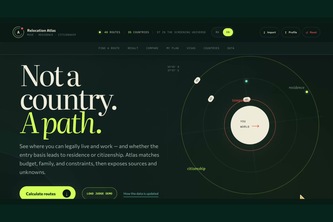
Relocation Atlas is a self-reported, local-first web application designed to help individuals and families plan international moves by comparing legal immigration routes across countries. It is built as a browser-based tool with no backend or account requirements, using AI-assisted development tools (Codex, GPT-5.6) during its creation.
What changed
The project evolved from an initial route comparison into a full decision workflow that includes trajectory roles, what-if scenarios, and portable plan export. It now supports 40 routes across 35 countries, with a focus on Russian passport holders, and includes features like child-education layers and a judge-safe demo.
Single most important open question
Is there any evidence of user adoption or feedback from real-world usage beyond the developer's own testing and public demo?
Note: This analysis is based solely on the self-reported project description provided by the author. No third-party verification, traction data, revenue figures, or customer information are available.
What The Product Actually Is
- The description states that Relocation Atlas is a browser-based tool for planning international relocations.
- It builds household profiles around outcome, budget, work, family, geography, and time horizon.
- It applies legal constraints before ranking softer preferences.
- It explains one leader and three distinct trajectories instead of returning an opaque top-three list.
- The tool allows users to compare routes, test changes in scenarios, inspect official sources, and export plans as JSON.
- It currently supports 40 routes across 35 countries and includes a child-education layer for the UK, Germany, and Portugal.
Inference: The product is described as a local-first decision engine that does not rely on backend services or user accounts. It uses AI during development but has no runtime dependency on AI.
Positioning & Claim Evolution
- The description states that Relocation Atlas turns trade-offs into a plan households can inspect.
- It positions itself as an alternative to generic immigration advice, which it claims ends where the difficult part begins: “Here are five countries you might like.”
- The tool emphasizes transparency by showing uncertainty in its interface rather than hiding it behind recommendations.
- It is optimized for Russian passport holders due to differences in consular access, work authorization, and route availability compared to generic advice.
- The product evolved from a simple comparison tool into a full decision workflow with roles, what-if testing, and export capabilities.
Inference: The positioning reflects a niche focus on legal clarity and user control over complex decisions, especially for those navigating immigration complexities.
Target Customer & ICP
- The description states that the tool is optimized for Russian passport holders.
- It targets individuals or families planning international moves who want to understand legal blockers, work rights, family effects, and unknowns.
- Users are expected to be able to assess their own situation in terms of outcome (temporary stay, renewable residence, citizenship path), budget, work, family, geography, and time horizon.
Inference: The ICP appears to be high-income or highly educated individuals or families with complex relocation needs, particularly those from countries with limited global mobility options.
Business Model & Pricing Evidence
- Not evidenced.
- The description does not mention any pricing model, monetization strategy, or business model.
- It is described as a non-commercial informational tool without legal advice or probability of approval claims.
Absence of evidence: No indication of how the product intends to generate revenue or sustain operations beyond its current open-source demo.
Technical & Delivery Signals
- Built with HTML5, CSS3, JavaScript, and GitHub.
- Uses Codex and GPT-5.6 for development, research, QA, and validation workflows.
- The public app intentionally has no runtime AI dependency; the AI was used only during build.
- Implements a local-first architecture with no backend or account requirements.
- Supports bilingual presentation, reduced-motion support, keyboard focus, and mobile/desktop behavior testing.
- Includes deterministic schema validation, locale validators, and privacy gates that prevent publishing unvalidated content.
Inference: The technical stack suggests a lightweight, client-side application designed for portability and auditability. The use of AI in development implies a strong emphasis on automation and reproducibility.
Traction & Maturity Signals
- Not evidenced.
- No mention of user base, customer acquisition, or usage metrics.
- The tool is described as being in beta and includes a public demo.
- It has no account system or data persistence beyond browser storage.
- The author mentions that the current dataset contains 40 routes, 35 countries, 50 city planning profiles, etc., but does not indicate how many users have interacted with these features.
Absence of evidence: No indication of traction, adoption, or user engagement beyond internal development and public demo access.
Competitive Context
- Not evidenced.
- The description does not reference competitors or market positioning relative to existing relocation tools or immigration platforms.
- It is implied that generic immigration advice lacks transparency about legal constraints and family impacts.
Absence of evidence: No competitive landscape analysis, pricing comparison, or differentiation from other tools is provided.
Open Questions & Risks
- The tool is described as a non-commercial informational tool without legal advice or approval guarantees.
- It relies heavily on the accuracy of official sources, which may be outdated or inconsistent.
- There is no evidence of user feedback loops or iterative improvements beyond the developer’s own testing.
- The lack of backend or account system could limit scalability or long-term data retention for users.
- The tool is optimized for Russian passport holders; it's unclear if this limits broader appeal or indicates a narrow market focus.
Inference: Risk lies in potential misalignment between user expectations and the tool’s non-binding nature, as well as limited ability to evolve based on real-world usage.
Questions the description leaves open
- What specific legal sources were used to build the dataset? Are they regularly updated?
- How is the accuracy of the information validated in practice?
- Has there been any external testing or feedback from users beyond the developer’s own use cases?
- Is there a plan for expanding coverage beyond Russian passport holders?
- What are the long-term sustainability plans for maintaining and updating the dataset?
- How does the tool handle edge cases or situations not covered in its current schema?
Overall Assessment
- Not evidenced.
- No financials, funding history, or commercial traction are provided.
- The project is described as a hackathon submission with no indication of future monetization or growth strategy.
- It is presented as a local-first tool for personal use rather than a scalable SaaS product.
Inference: Based on the self-reported description alone, there is insufficient evidence to support an investment or partnership decision. The project shows promise in solving a niche problem but lacks commercial viability signals.
User Stories BotA demo video on every pull request
Get a demo video on every new feature
GitHub App that watches your pull requests and records a narrated, captioned demo.
Save time on demo prep and make informed decisions faster with a video walkthrough of every new feature.
Source
Submitted to the OpenAI 2026 hackathon on Devpost. Project home on Devpost. Back to the full gallery on Devpost.
This competitive analysis was produced by top-founders.com (opens in a new tab)
Generated by a language model from this project's public Devpost page — its tagline, the author's own write-up and any built-with tags listed there — as captured in August 2026. Short quotations are the author's words. It is an opinion on the idea as a business, not on the people behind it, and it reflects the description as published then. If the project has moved on, request a correction below. The analysis is not independent research and contains no verified traction, revenue or customer data.
An independent guide by KFG International LLC — not affiliated with, endorsed by, or connected to Devpost or OpenAI.