

Archive position — measured, not model output
0 likes on Devpost
2,263 of the 7,850 archived projects have more likes, and 5,587 share exactly 0 — so this project's #6,320 place in the like-ranked listing is a tie-break inside that group, not a ranking.
Projects (log scale)
Likes on Devpost. ▲ marks this project's group.
Show the figures
| Likes | Projects | Share of archive |
|---|---|---|
| 0 | 5,587 | 71.2% |
| 1 | 1,758 | 22.4% |
| 2 | 284 | 3.6% |
| 3–4 | 132 | 1.7% |
| 5–9 | 75 | 1.0% |
| 10+ | 14 | 0.2% |
 User Stories BotA demo video on every pull request
Get a demo video on every new feature
GitHub App that watches your pull requests and records a narrated, captioned demo.
Save time on demo prep and make informed decisions faster with a video walkthrough of every new feature.
Executive Summary
Project: Release Guardian AI
Self-reported basis: The description is entirely from the project author’s own submission to the OpenAI 2026 hackathon on Devpost. It is unverified and contains no evidence of revenue, customers, or traction.
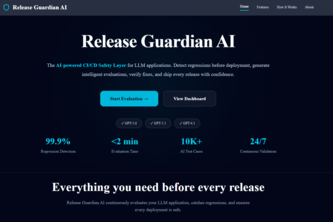
What it appears to be: A CI/CD platform for LLM applications that automates AI release validation by comparing configurations, generating evaluation tests, detecting regressions, and verifying safe deployments.
What changed: The project was built as a hackathon submission, with no evidence of prior development or commercial activity.
Single most important open question: Is there any evidence of real-world usage, customer feedback, or product-market fit beyond the self-reported build and demonstration?
What The Product Actually Is
The description states that Release Guardian AI is an AI-powered CI/CD platform for LLM applications. It is designed to:
- Compare previous and new release configurations
- Generate structured evaluation test cases
- Detect hallucination, safety, reasoning, and policy regressions
- Produce deployment risk analysis
- Recommend prompt and configuration improvements
- Verify deployment readiness
- Store evaluation history for future comparison
It is described as a full-stack application built with:
- Frontend: Next.js, TypeScript, Tailwind CSS, shadcn/ui, Framer Motion, Recharts
- Backend: FastAPI, SQLAlchemy, SQLite, Pydantic
- AI integration: GPT-5.6 and Codex
The system is said to generate structured JSON responses from LLMs for evaluation purposes.
Inference: The product appears to be a prototype or proof-of-concept built in a short timeframe (hackathon), not a production-ready SaaS offering.
Positioning & Claim Evolution
The author states that the platform aims to make AI release validation faster, repeatable, and more reliable, by replacing manual testing with automated evaluation workflows.
It positions itself as:
- A CI/CD tool for LLM applications
- An automated quality gate for AI deployments
- A solution to the problem of regressions in AI systems that are hard to detect manually
The claim is that it addresses a gap in current AI development practices where small changes can cause unexpected failures.
Inference: The positioning reflects an early-stage idea, likely shaped by hackathon constraints and developer pain points. No evidence of market research or customer validation.
Target Customer & ICP
The description states that the platform is for developers working with AI applications, particularly those using LLMs.
It targets:
- Developers building AI systems
- Teams managing AI release pipelines
- Organizations looking to automate AI deployment validation
There is no mention of enterprise customers, specific use cases beyond development teams, or segmentation beyond “AI developers.”
Inference: The ICP appears to be early-stage developers or small teams working on LLMs. No evidence of a defined persona or customer journey.
Business Model & Pricing Evidence
No information is provided about:
- Revenue model
- Pricing structure
- Monetization strategy
- Customer acquisition plans
The description focuses entirely on the technical build and functionality, not on how the product would be sold or used commercially.
Inference: No evidence of a business model or pricing strategy. The project appears to be a prototype, not a commercial offering.
Technical & Delivery Signals
The system is described as:
- A full-stack application
- Built with modern tools: Next.js, FastAPI, SQLite, Pydantic
- Uses GPT-5.6 and Codex for prompt engineering
- Has modular backend services (generation, analysis, recommendation, verification, persistence)
- Includes fallback mechanisms for API unavailability
It supports:
- Structured JSON output from LLMs
- Persistent evaluation history
- Risk scoring
- Deployment readiness verification
Inference: The architecture shows a basic understanding of software engineering and AI integration. However, no evidence of scalability, performance metrics, or production deployment.
Traction & Maturity Signals
The project is described as:
- A hackathon submission
- An end-to-end workflow, not a proof-of-concept
- Built in a short timeframe (implied by hackathon context)
There is no evidence of:
- Customers
- Revenue
- Usage data
- Product-market fit
- Prior versions or iterations
Inference: The project has no traction or maturity beyond its initial build. It is not a product with real-world adoption.
Competitive Context
The description does not mention any competitors or existing solutions in the AI release validation space.
It implies that there is a gap in the market for:
- Automated AI deployment validation
- CI/CD tools tailored to LLMs
No evidence of competitive analysis, market size, or differentiation from other tools.
Inference: No competitive context is provided. The project does not appear to be positioned against existing tools or markets.
Open Questions & Risks
- Unverified claims: All statements are self-reported and unverified.
- No traction or revenue: No evidence of customers, usage, or monetization.
- Prototype nature: Built as a hackathon project, not a product.
- Limited scope: No mention of enterprise features, integrations beyond GitHub, or scalability.
- Dependency on LLMs: Reliance on GPT-5.6 and Codex may limit flexibility or introduce cost risks.
- No commercialization plan: No roadmap for monetization or go-to-market strategy.
Inference: The project is a technical demonstration with no evidence of commercial viability or market traction.
Questions the description leaves open
- What specific problems are you solving in AI deployment that current tools don’t address?
- Have you validated this idea with potential users or customers?
- What is your plan for monetization and customer acquisition?
- How do you intend to scale beyond a hackathon prototype?
- What are the technical limitations of relying on GPT-5.6 and Codex for production use?
- Are there any existing tools in this space, and how does yours differ?
Overall Assessment
Not evidenced: There is no evidence to support a commercial or investment case.
The project is described as a hackathon submission, with no evidence of:
- Revenue
- Customers
- Product-market fit
- Scalable architecture
- Commercial strategy
It appears to be an early-stage idea, built by two individuals, without any indication of traction or viability beyond its own demonstration.
Inference: No basis for investment or partnership. The project is a prototype with no commercial or strategic value at this stage.
User Stories BotA demo video on every pull request
Get a demo video on every new feature
GitHub App that watches your pull requests and records a narrated, captioned demo.
Save time on demo prep and make informed decisions faster with a video walkthrough of every new feature.
Source
Submitted to the OpenAI 2026 hackathon on Devpost. Project home on Devpost. Back to the full gallery on Devpost.
This competitive analysis was produced by top-founders.com (opens in a new tab)
Generated by a language model from this project's public Devpost page — its tagline, the author's own write-up and any built-with tags listed there — as captured in August 2026. Short quotations are the author's words. It is an opinion on the idea as a business, not on the people behind it, and it reflects the description as published then. If the project has moved on, request a correction below. The analysis is not independent research and contains no verified traction, revenue or customer data.
An independent guide by KFG International LLC — not affiliated with, endorsed by, or connected to Devpost or OpenAI.