

Archive position — measured, not model output
0 likes on Devpost
2,263 of the 7,850 archived projects have more likes, and 5,587 share exactly 0 — so this project's #6,318 place in the like-ranked listing is a tie-break inside that group, not a ranking.
Projects (log scale)
Likes on Devpost. ▲ marks this project's group.
Show the figures
| Likes | Projects | Share of archive |
|---|---|---|
| 0 | 5,587 | 71.2% |
| 1 | 1,758 | 22.4% |
| 2 | 284 | 3.6% |
| 3–4 | 132 | 1.7% |
| 5–9 | 75 | 1.0% |
| 10+ | 14 | 0.2% |
 User Stories BotA demo video on every pull request
Get a demo video on every new feature
GitHub App that watches your pull requests and records a narrated, captioned demo.
Save time on demo prep and make informed decisions faster with a video walkthrough of every new feature.
Executive Summary
What the company appears to be
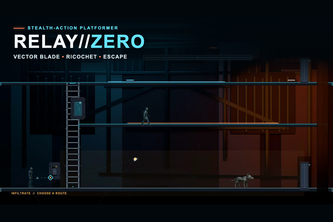
RELAY//ZERO is a browser-based stealth-action game built around a single mechanic — ricocheting a "Vector Blade" to manipulate light, sound, cameras, doors, and enemy behavior in an autonomous surveillance facility. It is described as a handcrafted platformer with deterministic gameplay, no installation or account required, and runs on desktop browsers.
What changed
The project was submitted as part of the OpenAI 2026 hackathon. The author states that it was built over a short timeframe (likely Build Week), progressing through three stages: greybox, procedural gameplay, and final visual release. It includes original art, audio, and character rigs, with no runtime AI or generated missions.
Single most important open question
Is there evidence of any traction, revenue, or user engagement beyond the author’s own development and submission to a hackathon? The description contains no data on users, monetization, or adoption — only self-reported claims about design, implementation, and testing.
What The Product Actually Is
The description states that RELAY//ZERO is:
- A browser stealth-action platformer.
- Built with Phaser 4.2.1, TypeScript, and Vite.
- Runs on desktop browsers, with no installation or account required.
- Uses a single reusable tool — the Vector Blade — to control light, sound, cameras, doors, enemy routes, and environmental interactions.
- Features trajectory preview that matches actual gameplay.
- Includes deterministic systems for stealth visibility (light zones), sound events, and guard behavior.
- Has no runtime AI or generated missions, and is fully handcrafted.
Inferred: The game is a single-player experience with one mission, built as part of a hackathon project. It uses a specific physics-based mechanic (ricochet) to enable player interaction with the environment.
Positioning & Claim Evolution
The author claims:
- The game captures the arc of a classic side-view infiltration adventure.
- The core mechanic — the Vector Blade — is designed to create meaningful stealth choices without weapons or skill trees.
- It draws inspiration from classic platformers, angle-based games, and modern stealth systems.
- The focus is on readable cause-and-effect in gameplay, with deterministic systems that make stealth legible.
Inferred: The positioning is to appeal to fans of stealth mechanics, platformers, and browser-based indie games. It positions itself as a design-focused, single-tool game rather than a genre-imitator or commercial product.
Target Customer & ICP
The description does not state:
- Who the target customer is.
- What the ideal customer profile (ICP) might be.
- Whether there are any existing users or players.
Not evidenced: No information on demographics, user personas, or intended audience beyond a general interest in stealth games or browser-based indie titles.
Business Model & Pricing Evidence
The description does not state:
- How the product is monetized.
- What pricing model (if any) is used.
- Whether there are plans for paid content, subscriptions, or in-game purchases.
Not evidenced: No business model or pricing information is provided. The game is described as a browser-based build with no login, suggesting it may be free-to-play or a one-time download — but this is not confirmed.
Technical & Delivery Signals
The description states:
- Built with Phaser.js, TypeScript, Vite.
- Uses typed raycasts and vector reflection for the Vector Blade mechanic.
- The trajectory preview and actual throw use the same solver.
- Stealth visibility uses explicit light zones, not rendered pixels.
- Sound events are handled by typed state machines for guards and Tracker Hound.
- Codex with GPT-5.6 was used to implement and review systems.
- The game is deterministic, with no runtime AI or procedural missions.
- Includes 468 unit tests and 62 Chromium scenarios.
- Has cross-browser smoke tests, full playthroughs, lifecycle checks, and packaging verification.
Inferred: The technical stack suggests a highly controlled, test-driven development process, with attention to gameplay fidelity and deterministic behavior. The use of AI tools (Codex) is noted but not as a core product feature.
Traction & Maturity Signals
The description states:
- The project was submitted to the OpenAI 2026 hackathon.
- It includes a public browser build with no login required.
- The game has 468 unit tests and 62 Chromium scenarios, plus full playthroughs and visual checks.
- The author completed one coherent 8–12 minute mission.
- It went through three clear development stages: greybox, procedural gameplay, final visual release.
Not evidenced:
- No data on user engagement or retention.
- No evidence of revenue, monetization, or customer adoption.
- No mention of any external feedback, reviews, or downloads beyond the hackathon submission.
Competitive Context
The description does not state:
- Who the competitors are.
- What similar products exist in the market.
- How RELAY//ZERO differentiates from other stealth games or browser-based platformers.
Not evidenced: No competitive analysis or positioning against existing titles is provided. The author only references inspirations (classic platformers, stealth systems), but does not name specific games or platforms.
Open Questions & Risks
Inferred risks:
- No commercial traction: The project was submitted to a hackathon and has no evidence of monetization or user base.
- Single-player focus with limited scope: The game is described as one mission, with no indication of plans for content expansion.
- Highly specialized mechanic: The Vector Blade may limit appeal unless it resonates strongly with niche audiences.
- Unproven scalability: The project is a single build from a hackathon — no evidence of long-term product development or team growth.
Open questions:
- No mention of any monetization strategy, user feedback loops, or analytics.
- The game is described as handcrafted, which may imply limited scalability or sustainability beyond the author’s own efforts.
Questions the description leaves open
- What is the intended path to monetization, if any?
- Are there plans for additional missions or content beyond the current one?
- How do you plan to gather user feedback and iterate on gameplay?
- Is there any interest in expanding to mobile or console platforms?
- What are your long-term goals for the project — is it a hobby or a commercial venture?
- Do you have any plans for analytics, tracking, or user engagement beyond the hackathon submission?
Overall Assessment
The description states that RELAY//ZERO is a single-player browser stealth game built as part of a hackathon project. It is described as handcrafted, deterministic, and test-driven, with no evidence of commercial traction, revenue, or user engagement.
Not evidenced:
- No data on users, monetization, or adoption.
- No indication of any team beyond the single author.
- No mention of partnerships, funding, or investor interest.
Inferred: This is a personal project or hackathon submission, not a commercial product. It lacks evidence of a viable business model or scalable growth path. The project may be of interest for creative or technical reasons, but not as an investment or partnership opportunity without further development and traction.
User Stories BotA demo video on every pull request
Get a demo video on every new feature
GitHub App that watches your pull requests and records a narrated, captioned demo.
Save time on demo prep and make informed decisions faster with a video walkthrough of every new feature.
Source
Submitted to the OpenAI 2026 hackathon on Devpost. Project home on Devpost. Back to the full gallery on Devpost.
This competitive analysis was produced by top-founders.com (opens in a new tab)
Generated by a language model from this project's public Devpost page — its tagline, the author's own write-up and any built-with tags listed there — as captured in August 2026. Short quotations are the author's words. It is an opinion on the idea as a business, not on the people behind it, and it reflects the description as published then. If the project has moved on, request a correction below. The analysis is not independent research and contains no verified traction, revenue or customer data.
An independent guide by KFG International LLC — not affiliated with, endorsed by, or connected to Devpost or OpenAI.