

Archive position — measured, not model output
0 likes on Devpost
2,263 of the 7,850 archived projects have more likes, and 5,587 share exactly 0 — so this project's #6,303 place in the like-ranked listing is a tie-break inside that group, not a ranking.
Projects (log scale)
Likes on Devpost. ▲ marks this project's group.
Show the figures
| Likes | Projects | Share of archive |
|---|---|---|
| 0 | 5,587 | 71.2% |
| 1 | 1,758 | 22.4% |
| 2 | 284 | 3.6% |
| 3–4 | 132 | 1.7% |
| 5–9 | 75 | 1.0% |
| 10+ | 14 | 0.2% |
 User Stories BotA demo video on every pull request
Get a demo video on every new feature
GitHub App that watches your pull requests and records a narrated, captioned demo.
Save time on demo prep and make informed decisions faster with a video walkthrough of every new feature.
Executive Summary
What the company appears to be
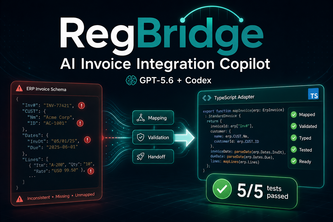
RegBridge is a self-reported AI integration copilot designed to help engineers interpret unfamiliar ERP invoice schemas and generate validated, testable engineering handoffs. It uses GPT-5.6 for semantic interpretation and deterministic code for validation, reconstruction, remediation, and artifact generation.
What changed
The author states that RegBridge evolved from an initial prototype that could normalize schemas but did not properly isolate model-generated artifacts. The rebuilt version enforces strict deterministic boundaries after AI interpretation to ensure only validated outputs are used in engineering handoffs.
Single most important open question
Is there evidence of real-world usage or feedback from ERP integrators, localization teams, or enterprise implementation consultants that validates the problem RegBridge addresses?
What The Product Actually Is
The description states that RegBridge accepts synthetic ERP invoice payloads and processes them through a workflow involving:
- GPT-5.6 interpreting source structures and proposing declarative semantic mapping plans.
- Deterministic code validating these mappings against strict rules for paths, fields, transformations, data types, and collections.
- Canonical reconstruction of invoices.
- Explicit validation identifying missing or inconsistent information.
- Truth-first remediation applying only safe formatting and arithmetic corrections.
- Generation of TypeScript adapters and executable tests.
- Compilation, execution, and verification of generated artifacts locally.
- A central trust boundary where GPT interprets meaning while deterministic code decides validity.
This is described as a vertical slice for multiple synthetic ERP schemas, with the author claiming successful generation, compilation, and execution of 5 out of 5 tests during controlled real-model verification.
Evidence Self-reported workflow steps and architecture. No independent confirmation or demonstration beyond the author’s own account.
Positioning & Claim Evolution
The author positions RegBridge as a solution for companies entering new markets who must connect unfamiliar ERP invoice structures to local integration requirements. It is framed as more trustworthy than relying solely on AI, emphasizing that financial integration workflows should not depend on an AI model alone.
Key claims include:
- GPT-5.6 interprets meaning.
- Deterministic code controls validation, reconstruction, remediation, artifact generation, and verification.
- Missing identifiers remain unresolved instead of being invented.
- The engineering handoff is marked ready only when generation, compilation, execution, and testing have genuinely passed.
The author also notes that the first prototype was stronger in appearance than it actually was — it replaced missing tax identifiers with fabricated values. This led to a rebuild focused on architectural integrity rather than presentation.
Evidence Self-reported claims about positioning and evolution. No external validation or product-market fit data provided.
Target Customer & ICP
The description implies RegBridge targets:
- ERP integrators.
- Localization teams.
- Enterprise implementation consultants.
These groups are said to face challenges when connecting unfamiliar ERP invoice structures to local integration requirements.
However, no explicit customer segmentation, personas, or use cases beyond the hackathon prototype are detailed.
Evidence Inferred from context and stated target audience. No specific customer data or feedback included.
Business Model & Pricing Evidence
There is no evidence of a business model or pricing strategy in the provided description.
The author mentions future steps such as:
- Developing an API.
- Introducing collaborative review workflows.
- Testing commercial models based on integration projects, usage, or enterprise subscriptions.
But none of these are described as implemented or tested.
Evidence Not evidenced. No revenue streams, pricing tiers, or monetization strategies mentioned.
Technical & Delivery Signals
The system is built using:
- Next.js
- TypeScript
- Node.js
- Zod
- Vitest
- OpenAI Responses API
- GPT-5.6 Structured Outputs
- Codex
Key technical features include:
- GPT-5.6 returns declarative mapping plans, not executable code.
- Mapping plan is treated as untrusted input and validated via deterministic contracts.
- Generated adapters come from templates and validated source-path segments.
- Local execution uses fixed commands, limited output, strict timeouts, and temporary-directory cleanup.
- Mock mode included for demonstration without external AI requests.
The author also notes:
- 66 automated repository tests covering various aspects of the system.
- Structured-output failures, refusals, incomplete responses, and transport errors are classified safely.
- No secret paths, stack traces, or raw process outputs exposed to the browser.
Evidence Self-reported technical stack and design decisions. No performance metrics, scalability data, or production deployment details provided.
Traction & Maturity Signals
The project is described as a hackathon prototype submitted to the OpenAI 2026 hackathon on Devpost. It includes:
- A working end-to-end vertical slice for multiple synthetic ERP schemas.
- Successful validation of a real GPT-5.6 transformation of an alternate ERP structure.
- Generation and execution of 5 out of 5 tests in controlled verification.
However, there is no evidence of:
- Real-world adoption or customer feedback.
- Revenue or monetization activity.
- Product-market fit beyond the author’s own testing.
- Any traction indicators like user growth, engagement, or retention.
Evidence Not evidenced. No data on users, customers, or business traction available.
Competitive Context
No competitive analysis is provided in the description.
The author does not mention competitors or similar tools in the market for ERP integration or AI-assisted engineering workflows.
Evidence Not evidenced. No information about existing solutions or competitive positioning.
Open Questions & Risks
- Unverified claims: All descriptions are self-reported and unverified.
- Prototype status: The system is described as a hackathon prototype, not yet validated in production environments.
- No commercial traction: No evidence of revenue, customers, or market validation.
- Limited scope: Only synthetic ERP schemas were tested; no real-world data or integration experience shared.
- Unclear path to monetization: Future plans for API and subscription models are speculative without proof of demand.
Inference The lack of real-world usage or feedback raises questions about whether the problem RegBridge solves is significant enough to warrant commercial investment.
Questions the description leaves open
- What specific ERP integrators, localization teams, or enterprise consultants have you engaged with to validate this problem?
- How do you plan to scale beyond synthetic data and into real-world ERP environments?
- Have you conducted any user research or interviews with potential customers?
- What are the key assumptions in your current architecture that could break under load or complexity?
- Can you provide evidence of how much time or effort this tool saves compared to manual processes?
- Are there any regulatory or compliance considerations around financial data handling that you're addressing?
- What is your roadmap for moving from a prototype to a production-grade solution?
Overall Assessment
Based on the self-reported description, RegBridge appears to be an early-stage hackathon prototype with a clear technical architecture and some initial validation of its core idea.
However, there is no evidence of:
- Real-world usage or customer feedback.
- Revenue or monetization activity.
- Market traction or product-market fit.
- Any commercial viability beyond the author’s own testing.
The project shows promise in addressing a niche but potentially valuable problem — AI-assisted ERP integration with deterministic validation. But without external validation, user feedback, or business traction, it remains speculative.
Confidence level Low
Next steps
Engage with the founder to explore whether they have begun validating the problem with actual users or partners.
User Stories BotA demo video on every pull request
Get a demo video on every new feature
GitHub App that watches your pull requests and records a narrated, captioned demo.
Save time on demo prep and make informed decisions faster with a video walkthrough of every new feature.
Source
Submitted to the OpenAI 2026 hackathon on Devpost. Project home on Devpost. Back to the full gallery on Devpost.
This competitive analysis was produced by top-founders.com (opens in a new tab)
Generated by a language model from this project's public Devpost page — its tagline, the author's own write-up and any built-with tags listed there — as captured in August 2026. Short quotations are the author's words. It is an opinion on the idea as a business, not on the people behind it, and it reflects the description as published then. If the project has moved on, request a correction below. The analysis is not independent research and contains no verified traction, revenue or customer data.
An independent guide by KFG International LLC — not affiliated with, endorsed by, or connected to Devpost or OpenAI.