

Archive position — measured, not model output
1 like on Devpost
505 of the 7,850 archived projects have more likes, and 1,758 share exactly 1 — so this project's #1,102 place in the like-ranked listing is a tie-break inside that group, not a ranking.
Projects (log scale)
Likes on Devpost. ▲ marks this project's group.
Show the figures
| Likes | Projects | Share of archive |
|---|---|---|
| 0 | 5,587 | 71.2% |
| 1 | 1,758 | 22.4% |
| 2 | 284 | 3.6% |
| 3–4 | 132 | 1.7% |
| 5–9 | 75 | 1.0% |
| 10+ | 14 | 0.2% |
 User Stories BotA demo video on every pull request
Get a demo video on every new feature
GitHub App that watches your pull requests and records a narrated, captioned demo.
Save time on demo prep and make informed decisions faster with a video walkthrough of every new feature.
Executive Summary
What the company appears to be
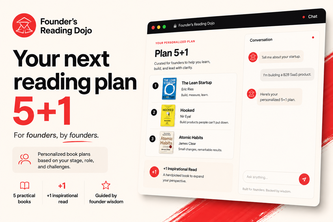
Founder’s Reading Dojo is an AI-powered platform that generates personalized reading recommendations for entrepreneurs. It uses a conversational interface to understand the user's stage, role, and challenges, then recommends a 5+1 reading plan (five practical books + one inspirational book) curated by experienced founders.
What changed
The project was built in collaboration with AI tools (ChatGPT, Codex, GPT-5.6), starting from an idea and evolving through iterative development into a functional prototype. It includes both the user-facing Dojo experience and a back-office platform called Bookia for managing content and recommendations.
Single most important open question
Is there sufficient evidence of traction or early adoption to validate that entrepreneurs are actively seeking personalized reading plans, or is this still an unproven concept?
Note: This analysis is based entirely on the self-reported description provided by the author. No independent verification or external data has been used.
What The Product Actually Is
The description states that Founder’s Reading Dojo is:
- An AI-powered platform.
- Designed to help entrepreneurs receive personalized reading recommendations.
- Built using a conversational interface.
- Generates a 5+1 reading plan:
- Five practical or technical books.
- One inspirational book.
- Recommends books based on the user's entrepreneurial context (stage, role, challenges).
- Operates from a library curated by real founders.
- Uses AI to interpret user context and connect it with relevant titles in a knowledge base built by people with firsthand entrepreneurial experience.
The platform also includes a back-office system called Bookia, which manages content, knowledge associated with each title, and rules for generating recommendations. The architecture is designed to be reusable for other topics beyond entrepreneurship.
Inference: The product appears to be a prototype or MVP, developed using AI tools as part of its creation process.
Positioning & Claim Evolution
The author claims:
- The platform turns experienced founders’ wisdom into personalized reading plans.
- It helps every entrepreneur read what they need, exactly when they need it.
- It addresses the informal nature of knowledge transfer among entrepreneurs.
- It combines AI availability and personalization with human judgment and experience.
The positioning evolves from a simple idea — “What if any entrepreneur could receive personalized reading recommendations?” — to a functional system that uses AI to interpret user context and match it with curated content from real founders.
Inference: The platform positions itself as a bridge between informal knowledge sharing and structured, scalable learning tools. It emphasizes human-curated content over generic lists or algorithmic suggestions.
Target Customer & ICP
The description states:
- The target customer is “every entrepreneur.”
- The platform aims to help entrepreneurs navigate specific stages of their projects.
- Users are defined by:
- Their entrepreneurial stage.
- Their role.
- Their current challenges.
- Areas where they need progress.
There is no explicit segmentation beyond the general category of “entrepreneurs.” However, the system is designed to tailor recommendations based on context, implying a focus on individuals who are actively engaged in building or growing their businesses.
Inference: The ICP likely includes early-stage and mid-stage entrepreneurs seeking guidance tailored to their current situation. No evidence of specific verticals, geographies, or business sizes is provided.
Business Model & Pricing Evidence
The description states:
- Founder’s Reading Dojo will be available for free through SaaS Sensey.
- SaaS Sensey is described as an entrepreneurship community where the founder shares experiences, lessons, and resources.
- The platform is offered via a newsletter and access to platforms built by the founder.
There is no mention of monetization strategies beyond this distribution channel. No pricing tiers, subscriptions, or paid features are referenced.
Inference: The business model appears to be community-based and free-to-access, possibly supported by affiliate marketing, partnerships, or future premium offerings not yet detailed.
Technical & Delivery Signals
The description states:
- The entire project was developed in collaboration with AI tools: ChatGPT, Codex, GPT-5.6.
- Development started with a Markdown document describing the system and its components.
- The platform includes:
- Conversational flows.
- Recommendation logic.
- Interface design.
- Back office (Bookia).
- Bookia is designed to separate content infrastructure from user-facing experience.
- The architecture supports reuse for other reading dojos focused on different topics.
Technology stack mentioned:
- CakePHP
- Codex
- CSS3
- GPT-5.6
- HTML5
- JavaScript
- PHP
Inference: The technical approach is iterative and AI-assisted, with a focus on modularity and scalability. However, no evidence of production deployment or performance metrics is provided.
Traction & Maturity Signals
The description states:
- The project was submitted to the OpenAI 2026 hackathon.
- It includes both a functional Dojo experience and a back-office platform (Bookia).
- The founder built the full project using AI tools from idea to first version.
- The system is described as “functional and accessible.”
There is no evidence of:
- Revenue
- Customers
- User engagement
- Adoption rates
- Product usage statistics
Inference: This is a prototype or MVP, likely in early-stage development. No traction data or user feedback is available.
Competitive Context
The description does not reference any direct competitors. It implies that the platform addresses a gap in how entrepreneurial knowledge is shared — particularly the informal nature of current practices.
It positions itself as distinct from generic reading lists or AI-generated book recommendations by emphasizing:
- Human curation.
- Personalization based on context.
- Practical relevance for entrepreneurs at different stages.
Inference: The competitive landscape is not clearly defined. It may overlap with educational platforms, mentorship tools, or AI-powered learning systems, but no direct comparison is made.
Open Questions & Risks
- Lack of traction or adoption: No evidence of users, customers, or engagement.
- Unproven demand: The idea is self-reported and lacks validation through market testing.
- AI dependency risk: Heavy reliance on AI tools for development raises questions about scalability and control over the product.
- Content quality and curation: While the platform claims to use curated content from founders, there’s no evidence of how this curation is managed or validated.
- Monetization uncertainty: The free model via a newsletter/community may not be sustainable without clear monetization paths.
Inference: The project lacks commercial proof-of-concept and faces significant risk if the market demand for such a tool does not exist.
Questions the description leaves open
- What specific feedback have you received from entrepreneurs who tried the platform?
- How do you plan to scale the library of curated books beyond your own experience?
- Are there any early adopters or users currently testing the platform?
- What are the key assumptions behind the 5+1 format, and how did you validate it?
- How do you intend to monetize the platform beyond the current free model?
- Can you describe the process of selecting and validating the books in the knowledge base?
- What is the long-term vision for Bookia, and how does it support reuse across domains?
Overall Assessment
Not evidenced.
Note: This analysis is based solely on the self-reported description provided by the author. No financial data, revenue figures, customer feedback, or traction metrics are available to assess investment or partnership viability. The project appears to be an early-stage prototype with no demonstrated commercial traction or clear path to monetization.
User Stories BotA demo video on every pull request
Get a demo video on every new feature
GitHub App that watches your pull requests and records a narrated, captioned demo.
Save time on demo prep and make informed decisions faster with a video walkthrough of every new feature.
Source
Submitted to the OpenAI 2026 hackathon on Devpost. Project home on Devpost. Back to the full gallery on Devpost.
This competitive analysis was produced by top-founders.com (opens in a new tab)
Generated by a language model from this project's public Devpost page — its tagline, the author's own write-up and any built-with tags listed there — as captured in August 2026. Short quotations are the author's words. It is an opinion on the idea as a business, not on the people behind it, and it reflects the description as published then. If the project has moved on, request a correction below. The analysis is not independent research and contains no verified traction, revenue or customer data.
An independent guide by KFG International LLC — not affiliated with, endorsed by, or connected to Devpost or OpenAI.