

Archive position — measured, not model output
0 likes on Devpost
2,263 of the 7,850 archived projects have more likes, and 5,587 share exactly 0 — so this project's #5,028 place in the like-ranked listing is a tie-break inside that group, not a ranking.
Projects (log scale)
Likes on Devpost. ▲ marks this project's group.
Show the figures
| Likes | Projects | Share of archive |
|---|---|---|
| 0 | 5,587 | 71.2% |
| 1 | 1,758 | 22.4% |
| 2 | 284 | 3.6% |
| 3–4 | 132 | 1.7% |
| 5–9 | 75 | 1.0% |
| 10+ | 14 | 0.2% |
 User Stories BotA demo video on every pull request
Get a demo video on every new feature
GitHub App that watches your pull requests and records a narrated, captioned demo.
Save time on demo prep and make informed decisions faster with a video walkthrough of every new feature.
Executive Summary
What the company appears to be
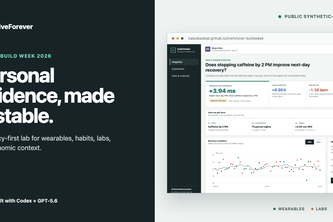
LiveForever is a self-reported personal health evidence lab built as a prototype for an OpenAI hackathon. It combines synthetic wearable, lab, and genomic data with deterministic analysis and AI interpretation to support testable personal experiments. The author states it is designed for "serious self-trackers and biohackers" who want inspectable evidence, uncertainty visibility, and safer next experiments.
What changed
The project evolved from a private prototype into a public-facing demo using Codex and GPT-5.6 during Build Week. It added deterministic analysis capabilities, synthetic data handling, and a reusable AI agent skill while maintaining a clear boundary between code-calculated results and model interpretation.
Single most important open question
Is there evidence of traction or commercial interest beyond the hackathon submission? The description states no revenue, customers, or adoption data exist — only a self-reported prototype.
What The Product Actually Is
The description states that LiveForever is a privacy-first personal evidence lab. It combines:
- Longitudinal wearable signals (e.g., Oura Ring, Apple Watch)
- Daily habits
- Laboratory trends
- Genomic context (e.g., 23andMe)
It processes these inputs to investigate one personal question at a time, such as whether stopping caffeine by 2 PM affects recovery.
Key features include:
- Pairing exposure days with following night outcomes.
- Calculating effect sizes and 95% confidence intervals.
- Checking sample size, missingness, condition balance, and confounders.
- Producing transparent evidence scores and grades.
- Showing which observations contributed to results.
- Using a synthetic CYP1A2 marker only for hypothesis context, not diagnosis or recommendation.
- Generating a 14-day replication plan with decision rules.
- Leveraging GPT-5.6 to explain bounded evidence, identify blind spots, and adapt experiments.
All displayed data is synthetic. The system supports wellness evidence and experiment planning but does not provide diagnosis or treatment.
Inference The product appears to be a proof-of-concept prototype, not a production-ready service. It uses deterministic code for calculations and AI for interpretation, with an emphasis on transparency and uncertainty.
Positioning & Claim Evolution
The author states that LiveForever is designed for serious self-trackers and biohackers who want:
- Evidence they can inspect
- Uncertainty they can see
- A safer next experiment (not opaque scores or medical-sounding conclusions)
It positions itself as an alternative to health products that display historical charts or generate confident AI recommendations.
The project evolved from a broad longevity dashboard concept into an auditable personal evidence lab focused on:
- Making uncertainty and null-result language first-class features.
- Connecting genomic context to longitudinal self-tracking without treating genotype as advice.
- Supporting testable personal experiments using synthetic data.
Inference Positioning has shifted from general wellness tracking toward evidence-based experimentation, emphasizing transparency, reproducibility, and cautious interpretation over diagnosis or recommendation.
Target Customer & ICP
The description states that LiveForever is intended for:
- Serious self-trackers
- Biohackers
These users are described as wanting inspectable evidence, visible uncertainty, and safer next experiments — not opaque scores or medical-sounding conclusions.
No specific customer segments beyond this general group are identified. No mention of enterprise use cases, clinicians, or health professionals.
Inference The ICP is likely individuals with high engagement in personal health tracking, possibly including early adopters of wearable tech and biohacking communities.
Business Model & Pricing Evidence
There is no evidence of a business model or pricing structure in the description. The project is presented as a prototype built for a hackathon, not a commercial product.
The author notes that:
- Private wearable, lab, medication, genomic, and profile records remain outside the submission.
- All data used is synthetic.
- No account, API key, or personal health data are required to access the demo.
Inference No commercial model or pricing strategy is evident. The project may be exploratory or intended for future monetization through private profiles, premium features, or integration with wearables/labs — but nothing is stated.
Technical & Delivery Signals
The author describes building LiveForever using:
- Codex and GPT-5.6 as primary development tools
- A deterministic Python analysis engine
- Lagged within-person exposure and outcome pairing
- Seven-day moving-block bootstrap confidence intervals
- Pearson correlations with Fisher-transformed intervals
- Minimum-sample, missing-data, balance, and confounder checks
- Deterministic evidence-quality score and grade
- PhenoAge calculation with completeness enforcement
- Genetics-to-hypothesis workflow with non-diagnostic boundary
- A deterministic 14-day replication planner
- Responsive public interface generated from an immutable analysis contract
- Reusable Codex Agent Skill for running the evidence workflow
The system includes:
- Eleven automated tests covering new analytical behavior
- Compatibility with 41 private baseline tests
- Public demo requiring no account or API key
Inference Technical architecture shows a hybrid deterministic-AI approach, where code handles calculations and AI supports explanation. The use of Codex and GPT-5.6 suggests an emphasis on rapid prototyping and AI-assisted development.
Traction & Maturity Signals
The description states:
- This is a hackathon submission.
- No revenue, customers, or traction data are available beyond the author’s own account.
- The earlier private prototype exists but is not part of this submission.
- A public demo is available with no account or API key required.
There is no evidence of:
- User adoption
- Customer feedback
- Product usage metrics
- Market validation
Inference The project is at a very early stage, likely a prototype or proof-of-concept. No traction or maturity indicators are evident beyond the hackathon submission.
Competitive Context
No direct competitors are named in the description. However, the author positions LiveForever as an alternative to:
- Health products that display historical charts
- AI tools that generate confident recommendations without transparency
It is implied to compete with:
- Wearable analytics platforms (e.g., Oura, Apple Health)
- Biohacking and self-tracking apps
- Generic health AI assistants
There is no mention of existing solutions or competitive differentiation beyond the stated focus on transparency, uncertainty, and evidence-based experimentation.
Inference LiveForever operates in a nascent space, potentially competing with fragmented personal health tools. Its unique positioning lies in its emphasis on deterministic analysis and cautious AI interpretation.
Open Questions & Risks
- No commercial traction or revenue: The project is presented as a hackathon prototype, with no evidence of market adoption.
- Synthetic-only data: All data used is synthetic; real-world performance or validation is unproven.
- Limited scope: No indication of integration with real wearables, labs, or health systems.
- Unverified AI boundaries: While the author claims GPT-5.6 is restricted from changing values or presenting medical advice, this is self-reported and not independently verified.
- No monetization strategy: No business model or pricing structure is evident.
Inference The project lacks commercial viability or scalability without further development, integration, or user validation.
Questions the description leaves open
- What was the original vision for LiveForever beyond the hackathon submission?
- How does the deterministic code handle edge cases or missing data in real-world scenarios?
- Are there plans to integrate with real wearable or lab APIs?
- Has the AI interpretation layer been tested with actual users or feedback?
- What is the roadmap for moving from prototype to product, and what resources are needed?
- How does the project plan to scale beyond synthetic data and a single user persona?
- Is there any intention to collect or store real personal health data, and how will privacy be maintained?
Overall Assessment
Not evidenced
There is no evidence of:
- Revenue
- Customers
- Traction
- Market validation
- Commercial strategy
- Product-market fit
The project is described as a hackathon prototype, not a commercial product or venture. No investment or partnership opportunity is evident from the description alone.
Inference This is a preliminary idea or proof-of-concept, not a viable investment or partnership target at this stage. Any future value would depend on further development, user adoption, and integration with real health data sources.
User Stories BotA demo video on every pull request
Get a demo video on every new feature
GitHub App that watches your pull requests and records a narrated, captioned demo.
Save time on demo prep and make informed decisions faster with a video walkthrough of every new feature.
Source
Submitted to the OpenAI 2026 hackathon on Devpost. Project home on Devpost. Back to the full gallery on Devpost.
This competitive analysis was produced by top-founders.com (opens in a new tab)
Generated by a language model from this project's public Devpost page — its tagline, the author's own write-up and any built-with tags listed there — as captured in August 2026. Short quotations are the author's words. It is an opinion on the idea as a business, not on the people behind it, and it reflects the description as published then. If the project has moved on, request a correction below. The analysis is not independent research and contains no verified traction, revenue or customer data.
An independent guide by KFG International LLC — not affiliated with, endorsed by, or connected to Devpost or OpenAI.