

Archive position — measured, not model output
0 likes on Devpost
2,263 of the 7,850 archived projects have more likes, and 5,587 share exactly 0 — so this project's #6,225 place in the like-ranked listing is a tie-break inside that group, not a ranking.
Projects (log scale)
Likes on Devpost. ▲ marks this project's group.
Show the figures
| Likes | Projects | Share of archive |
|---|---|---|
| 0 | 5,587 | 71.2% |
| 1 | 1,758 | 22.4% |
| 2 | 284 | 3.6% |
| 3–4 | 132 | 1.7% |
| 5–9 | 75 | 1.0% |
| 10+ | 14 | 0.2% |
 User Stories BotA demo video on every pull request
Get a demo video on every new feature
GitHub App that watches your pull requests and records a narrated, captioned demo.
Save time on demo prep and make informed decisions faster with a video walkthrough of every new feature.
Executive Summary
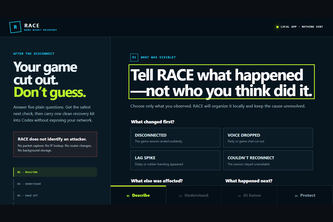
The company appears to be a solo project named "RACE Game Night Recovery", self-described as a tool for helping users recover from internet outages or voice-chat drops by turning observations into structured recovery steps. The author states it uses local AI (Ollama) optionally, and exports Codex-ready packets for further help.
The most important open question is: what real-world use cases exist for this tool, and how does it differ from existing troubleshooting methods or tools?
This analysis is based entirely on the self-reported project description provided by the author — no third-party verification, no archived data, no revenue or customer evidence. The author describes a specific workflow but provides no evidence of adoption, traction, or commercial viability.
What The Product Actually Is
The description states that RACE Game Night Recovery is a tool for handling internet outages or voice-chat drops. It allows users to describe what happened ("what you saw"), separates observations from assumptions, and offers three low-risk checks before more disruptive steps. It optionally integrates with a local Ollama model to propose one bounded next step, which must be validated and edited by the user before export.
It exports a "Codex-ready packet" that includes evidence, unknowns, completed checks, and permission boundaries for deeper help — but never claims to identify an attacker or change network settings automatically.
Not evidenced: Whether this is a desktop app, browser extension, mobile tool, or command-line utility; what the actual UI looks like; how it captures symptoms; or whether it has been tested beyond the author's own use.
Positioning & Claim Evolution
The author positions RACE as a calm, offline-safe recovery tool for internet-related disruptions. It is described as not guessing, not changing networks, and not sending data automatically — instead offering structured steps and optional local AI help.
It claims to be useful during unreliable internet access, avoiding generic chatbots that lack context or knowledge of what was actually observed.
Inference: The positioning suggests a niche in consumer-facing network troubleshooting or incident response. However, the claim evolution is limited to the author’s own narrative — no evidence of prior versions, user feedback loops, or market positioning beyond this one submission.
Target Customer & ICP
The description states that RACE is for people who experience game night drops or internet outages and are uncertain about what happened next. It targets users who want clarity during disruptions without risking network changes or exposure.
It does not specify a segment beyond "users of voice chat or gaming platforms", nor does it describe any targeting strategy, persona, or customer journey beyond the author’s own use case.
Not evidenced: Who these users are, how many there might be, whether they pay for services, or if this is a consumer or enterprise product.
Business Model & Pricing Evidence
The description does not mention pricing, monetization, or any business model. It says that RACE works without API keys, cloud accounts, or paid services — but also does not indicate how it would be distributed or sold.
Not evidenced: Whether there is a plan to charge for access, offer premium features, or sell the tool as part of a larger suite.
Technical & Delivery Signals
The tool reportedly:
- Works offline
- Uses local Ollama models (optional)
- Does not download or start Ollama itself
- Validates model outputs before allowing export
- Exports Codex-ready packets
- Has deterministic recovery paths
- Is accessible on desktop and phone
It was built with JavaScript, and the author used GPT-5.6 through Codex for design and implementation.
Not evidenced: How the tool is packaged or delivered (e.g., web app, desktop, mobile), whether it has a UI, how it captures symptoms, or if it integrates with any existing platforms.
Traction & Maturity Signals
The author states:
- 18 focused tests, zero failures
- Desktop and phone accessibility scans with zero violations
- Zero automatic network changes
- A real-motion demo was created
However, there is no evidence of:
- Customers or users
- Revenue or usage metrics
- Product adoption or feedback
- Market traction or growth indicators
- Any form of product release beyond the hackathon submission
Not evidenced: Whether this has been used by others, how many people have tried it, or if it has evolved since its initial build.
Competitive Context
The description does not reference competitors or similar tools. It implies that generic chatbots or network troubleshooting tools are insufficient — but does not name or describe what those tools are.
Not evidenced: What existing tools exist in this space, how RACE compares to them, or whether there is a competitive market for such a product.
Open Questions & Risks
- Unproven utility: The tool is described only by its author; no evidence of real-world usage or effectiveness.
- Limited scope: It appears to be a niche solution for internet outages, not a broad platform or service.
- No commercial viability: No pricing, monetization, or distribution strategy is evident.
- Self-contained nature: The tool works offline and without cloud services — but this may limit its scalability or appeal.
- Unclear adoption path: There is no indication of how users would discover or adopt the tool beyond a hackathon submission.
Questions the description leaves open
- What specific types of internet outages or voice-chat drops does RACE address?
- How did you validate that users actually need this tool, and what feedback have you received?
- Are there any plans to expand beyond the current scope (e.g., more outage patterns, mobile support)?
- How do you plan to distribute or monetize the product?
- What are the key assumptions in your approach, and how might they be wrong?
- Have you tested this with users outside of yourself?
Overall Assessment
Not evidenced: Whether this project is ready for investment or partnership.
The author describes a functional prototype that addresses a specific problem — but there is no evidence of traction, market validation, or commercial readiness. The tool appears to be a solo effort with no clear path to scale or monetize.
This is a self-contained hackathon submission, not a product in development or a company in formation. It may be an idea worth exploring, but it does not yet constitute a viable business opportunity based on the evidence provided.
User Stories BotA demo video on every pull request
Get a demo video on every new feature
GitHub App that watches your pull requests and records a narrated, captioned demo.
Save time on demo prep and make informed decisions faster with a video walkthrough of every new feature.
Source
Submitted to the OpenAI 2026 hackathon on Devpost. Project home on Devpost. Back to the full gallery on Devpost.
This competitive analysis was produced by top-founders.com (opens in a new tab)
Generated by a language model from this project's public Devpost page — its tagline, the author's own write-up and any built-with tags listed there — as captured in August 2026. Short quotations are the author's words. It is an opinion on the idea as a business, not on the people behind it, and it reflects the description as published then. If the project has moved on, request a correction below. The analysis is not independent research and contains no verified traction, revenue or customer data.
An independent guide by KFG International LLC — not affiliated with, endorsed by, or connected to Devpost or OpenAI.