

Archive position — measured, not model output
0 likes on Devpost
2,263 of the 7,850 archived projects have more likes, and 5,587 share exactly 0 — so this project's #2,301 place in the like-ranked listing is a tie-break inside that group, not a ranking.
Projects (log scale)
Likes on Devpost. ▲ marks this project's group.
Show the figures
| Likes | Projects | Share of archive |
|---|---|---|
| 0 | 5,587 | 71.2% |
| 1 | 1,758 | 22.4% |
| 2 | 284 | 3.6% |
| 3–4 | 132 | 1.7% |
| 5–9 | 75 | 1.0% |
| 10+ | 14 | 0.2% |
 User Stories BotA demo video on every pull request
Get a demo video on every new feature
GitHub App that watches your pull requests and records a narrated, captioned demo.
Save time on demo prep and make informed decisions faster with a video walkthrough of every new feature.
Executive Summary
The description states that ABAKADA Lesson Plan Generator is a low-cost AI-powered system built to help Philippine teachers convert curriculum data into editable daily lesson plans using Google Workspace and OpenAI. It was submitted as a project to the OpenAI 2026 hackathon by one developer, Renz Rodney Ramido.
The author claims it supports multiple K–12 subjects and grade levels, uses Google Forms for input, Google Sheets for control, Google Apps Script for processing, and OpenAI for content generation. The system is described as designed to be practical, teacher-centered, auditable, and low-cost.
Key commercial due-diligence questions remain: Is there evidence of actual teacher adoption or use? What is the true cost structure and scalability potential? How does it differ from existing tools or manual processes? There is no evidence of revenue, customers, traction, or market validation beyond the author's self-reporting.
The single most important open question is whether this tool has been tested in real classrooms and if there is any indication of actual demand or usage from teachers. The project appears to be a proof-of-concept prototype with no demonstrated commercial traction.
What The Product Actually Is
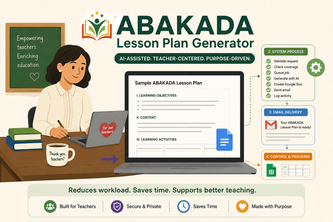
The description states that ABAKADA Lesson Plan Generator is an automated system for generating lesson plans based on Philippine K–12 curriculum data. It converts structured input (grade level, subject, term) into editable Google Docs via a workflow involving:
- Google Forms for teacher requests
- Google Sheets as control database
- Google Apps Script for validation, queuing, processing, document generation, and email delivery
- Google Docs for output
- OpenAI for lesson plan content generation
The system is described as supporting multiple Philippine K–12 subjects including Mathematics, Science, English, Filipino, Araling Panlipunan, GMRC, Values Education, MAPEH, Makabansa, and senior high/general subject coverage.
This is a self-reported product description. The author states it was built using codex, gmail, google-apps-script, google-docs, google-drive, google-sheets, gpt-5.6, javascript, openai — but no evidence of actual deployment or usage exists beyond the project submission.
Positioning & Claim Evolution
The author states that ABAKADA was built as a philanthropy project in honor of their parents, both teachers, who experienced the workload challenges of lesson plan preparation. The positioning is described as helping public-school teachers by making lesson plan generation faster, cheaper, and more accessible.
The claim evolution shows a shift from personal motivation (to help parents) to broader social impact (helping Philippine teachers). It positions itself as a low-cost solution that leverages existing Google Workspace tools rather than requiring new infrastructure or expensive software.
The author emphasizes practicality over flashiness, describing the system as designed to be "low-cost, teacher-centered, auditable, and easy to operate using tools schools already understand."
Target Customer & ICP
The description states that ABAKADA targets Philippine public-school teachers who struggle with lesson plan preparation workload. It is specifically positioned for use by teachers in the Philippine K–12 system.
The target customer profile appears to be:
- Public school teachers
- Those preparing lesson plans and required documents every semester
- Users of Google Workspace tools (which are common in Philippine schools)
- Teachers seeking faster, cheaper, more accessible lesson plan generation
There is no evidence provided about specific grade levels or subject specializations beyond what the author mentions. The system claims to support multiple subjects and terms but does not specify which teachers would be most likely to use it.
Business Model & Pricing Evidence
The description states that ABAKADA is designed as a social-impact education tool, with no explicit pricing model described. The author states they are actively looking for donors, sponsors, LGUs, NGOs, schools, and education foundations to subsidize generation costs so teachers can use the system for free or at the lowest possible cost.
There is no evidence of any revenue streams, pricing tiers, or monetization strategy beyond seeking sponsorship support. The project appears to be positioned as a non-commercial tool with a social mission rather than a commercial product.
Technical & Delivery Signals
The author states that ABAKADA was built using:
- Google Forms for teacher requests
- Google Sheets as control database
- Google Apps Script for validation, queuing, processing, document generation, and email delivery
- Google Docs for editable outputs
- OpenAI for lesson plan generation
- Codex/GPT assistance for code auditing, import validation, and system hardening
The system includes curriculum import pipelines, audit backups, support matrices, subject profiles, preflight validation, queue workers, generated history tracking, and controlled teacher-review safeguards.
The technical stack is described as low-cost and leveraging existing Google Workspace tools. The author mentions that the hardest part was building a "safe curriculum system" around lesson plan generation, including validating curriculum records, preventing unsupported requests, avoiding duplicate jobs, preserving teacher-review notes, supporting many subjects and terms, and keeping costs realistic for public-school use.
Traction & Maturity Signals
The description states that ABAKADA has a working end-to-end system:
- Teacher submits a request
- System validates grade, subject, and term
- Job is queued
- Lesson plan is generated
- Google Doc is created
- Teacher receives output by email
- Logs and audit sheets track the process
The author describes it as designed to be practical, not flashy: low-cost, teacher-centered, auditable, and easy to operate using tools schools already understand.
There is no evidence of actual user adoption or usage beyond the project submission. No customer data, revenue figures, or performance metrics are provided. The system appears to be a prototype submitted for a hackathon rather than a mature product in use.
Competitive Context
The description does not provide any information about existing competitive products or market landscape. It does not mention other lesson plan generators, educational automation tools, or similar systems that might exist in the Philippine education market or more broadly.
There is no evidence of market analysis, competitive positioning, or differentiation from existing solutions. The author focuses on their own development approach rather than comparing to competitors.
Open Questions & Risks
Several key risks and open questions are evident:
- No demonstrated traction: The system appears to be a hackathon prototype with no evidence of real-world usage or adoption by teachers.
- Unproven market demand: There is no evidence that teachers actually want or need this tool, or that there's sufficient demand to justify development resources.
- Social impact vs commercial viability: The project is positioned as a social-impact tool seeking sponsors rather than a commercial product with sustainable revenue streams.
- Limited scalability assumptions: The system uses Google Workspace tools which may not scale well for large numbers of users or institutions.
- Dependency on external services: Heavy reliance on OpenAI and Google Workspace could create vulnerabilities if those services change or become unavailable.
- Single developer team: Only one person built the entire system, raising questions about capacity to maintain or expand it.
Questions the description leaves open
- Has the system been tested with actual teachers in classrooms? What feedback have you received?
- How many teachers have used the system so far, and what is their satisfaction level?
- What specific problems are teachers currently solving manually that this tool addresses?
- What are the actual costs of using OpenAI APIs for lesson plan generation at scale?
- How do you plan to transition from seeking sponsors to sustainable funding or revenue?
- What are the technical limitations of Google Workspace-based automation for handling large volumes of requests?
- Have you considered how to handle curriculum variations across different schools or regions?
- What is your long-term vision for scaling this beyond a single developer's capacity?
- How do you plan to ensure quality and accuracy of AI-generated lesson plans?
- What are the legal considerations around curriculum content generation and educational standards compliance?
Overall Assessment
The description states that ABAKADA is a philanthropy project built by one developer for public-school teachers in the Philippines. It was submitted to the OpenAI 2026 hackathon.
There is no evidence of commercial traction, revenue, customers, or demonstrated market demand beyond the author's self-reporting. The system appears to be a prototype with no proven adoption or usage patterns.
The project is positioned as a social-impact tool seeking sponsorship rather than a commercial venture with sustainable business model. It lacks any indication of scalability, monetization strategy, or competitive advantage.
Confidence Level: Low
This analysis is based entirely on self-reported information from the project description and submission. No independent verification exists for any claims about product functionality, user adoption, market demand, or commercial viability. The project appears to be a proof-of-concept prototype rather than a mature commercial offering with demonstrated traction or revenue potential.
User Stories BotA demo video on every pull request
Get a demo video on every new feature
GitHub App that watches your pull requests and records a narrated, captioned demo.
Save time on demo prep and make informed decisions faster with a video walkthrough of every new feature.
Source
Submitted to the OpenAI 2026 hackathon on Devpost. Project home on Devpost. Back to the full gallery on Devpost.
This competitive analysis was produced by top-founders.com (opens in a new tab)
Generated by a language model from this project's public Devpost page — its tagline, the author's own write-up and any built-with tags listed there — as captured in August 2026. Short quotations are the author's words. It is an opinion on the idea as a business, not on the people behind it, and it reflects the description as published then. If the project has moved on, request a correction below. The analysis is not independent research and contains no verified traction, revenue or customer data.
An independent guide by KFG International LLC — not affiliated with, endorsed by, or connected to Devpost or OpenAI.