

Archive position — measured, not model output
0 likes on Devpost
2,263 of the 7,850 archived projects have more likes, and 5,587 share exactly 0 — so this project's #6,157 place in the like-ranked listing is a tie-break inside that group, not a ranking.
Projects (log scale)
Likes on Devpost. ▲ marks this project's group.
Show the figures
| Likes | Projects | Share of archive |
|---|---|---|
| 0 | 5,587 | 71.2% |
| 1 | 1,758 | 22.4% |
| 2 | 284 | 3.6% |
| 3–4 | 132 | 1.7% |
| 5–9 | 75 | 1.0% |
| 10+ | 14 | 0.2% |
 User Stories BotA demo video on every pull request
Get a demo video on every new feature
GitHub App that watches your pull requests and records a narrated, captioned demo.
Save time on demo prep and make informed decisions faster with a video walkthrough of every new feature.
Executive Summary
The company appears to be a solo developer project named "PTE Flow AI Mistake Coach", submitted as part of an OpenAI hackathon. The author states it is an extension to an existing PTE (Pearson Test of English) learning app, adding AI-powered coaching for Write From Dictation errors. The core functionality involves generating targeted listening drills after a learner's mistake, using local scoring and AI for explanation and drill generation.
What changed
The project description indicates the author built this as part of an OpenAI hackathon, suggesting it is a prototype or proof-of-concept rather than a production product. It was developed using AI tools like Codex and GPT-5.6, with Kotlin Multiplatform for mobile and a serverless backend.
The single most important open question
Is there any evidence that this project has been integrated into a live PTE Flow app or used by learners beyond the hackathon context? The description states it is an extension to an existing app but provides no evidence of adoption, usage, or integration.
What The Product Actually Is
- The description states: "PTE Flow AI Mistake Coach" is an extension to an existing PTE learning app
- It focuses on Write From Dictation (WFD) errors in the Pearson Test of English
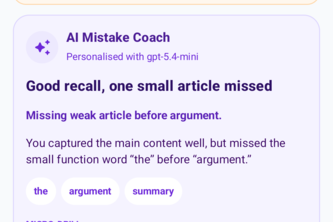
- After a learner makes a mistake in WFD, the system evaluates the answer locally and identifies exact missing, extra, or misspelled words
- AI Mistake Coach returns:
- A concise diagnosis of the listening pattern
- A plain-English explanation grounded in the detected error
- Focus words taken from the correct sentence
- A short listen-and-repeat micro-drill
- One practical instruction for the next replay
- The system maintains deterministic scoring and spaced repetition schedules, with AI only used for explanation and drill generation
Positioning & Claim Evolution
- The description states: "Turn every missed WFD word into the learner's next targeted listening drill"
- The author claims this closes a gap between seeing an error and knowing how to train it
- The positioning is described as addressing a specific pain point in PTE learning where learners understand meaning but miss small words like articles, plural endings, and prepositions
- The evolution from "normal answer checking" to AI-powered coaching is framed as improving the learning loop
- The author states they chose not to use a generic chatbot approach, instead constraining the AI output to be specific, explainable, and useful within a ten-minute daily practice session
Target Customer & ICP
- Not evidenced. The description does not state who the target customers are beyond "PTE learners"
- No evidence of customer segmentation or ideal customer profile (ICP)
- The project is described as an extension to an existing PTE learning app, but no information about the app's user base or demographics is provided
Business Model & Pricing Evidence
- Not evidenced. There is no mention of pricing, revenue model, monetization strategy, or business model in the description
- The description states this is part of a hackathon project and an extension to an existing app, but provides no information about how it would be sold or funded
Technical & Delivery Signals
- Built with: azure-openai, codex, compose-multiplatform, gpt-5.6, kotlin-multiplatform, ktor, openai-api, vercel
- Mobile app uses Kotlin Multiplatform and Compose Multiplatform for shared Android and iOS code
- The new shared Ktor client sends only the current sentence, learner answer, and machine-detected mistakes to a protected Vercel function
- The backend never receives learner identity, account data, subscription state, or long-term history
- Credentials remain server-side, and the mobile build uses a separate judging secret
- The system is described as having offline-first flow with network feature added without breaking existing functionality
- The main human product decision was to avoid a generic chatbot approach
Traction & Maturity Signals
- Not evidenced. No evidence of revenue, customers, user adoption, or traction beyond the hackathon context
- The description states this is a working prototype built during an OpenAI Build Week hackathon
- There is no information about whether it has been integrated into a production app or used by learners
- The author mentions "a live protected backend with automated validation tests" and "a verified end-to-end Android flow with video and runtime evidence", but these are not independent measures of traction
Competitive Context
- Not evidenced. No mention of competitors, market analysis, or competitive positioning in the description
- The project is described as an extension to an existing PTE learning app, but no information about the broader PTE learning market or competing products is provided
Open Questions & Risks
- Solo developer project: Only one team member (Cao Ky Nguyen) is mentioned, suggesting limited resources for scaling
- Hackathon prototype: The project was built during a hackathon, indicating it may be a proof-of-concept rather than a mature product
- No evidence of integration or adoption: While described as an extension to an existing app, there's no evidence it has been integrated into a live product or used by learners beyond the hackathon
- Limited scope: The system is constrained to specific error types (WFD) and does not appear to address broader PTE learning needs
- Dependency on AI tools: Heavy reliance on Codex and GPT-5.6 for development raises questions about long-term maintainability and scalability
Questions the description leaves open
- Has this been integrated into a live version of the PTE Flow app?
- What is the current user base or adoption rate of the parent PTE Flow app?
- How does the AI coaching integrate with existing spaced repetition algorithms in the parent app?
- What are the technical challenges in scaling this solution beyond the hackathon prototype?
- Are there any plans to monetize this feature, and if so, what is the business model?
- How does the system handle edge cases or unusual error patterns not covered by the current implementation?
Overall Assessment
- Not evidenced. The description provides no information about funding rounds, valuations, or investment status
- This appears to be a hackathon project with no evidence of commercial traction or viability beyond the prototype stage
- The solo developer structure and hackathon context suggest limited scalability potential at this stage
- Without evidence of integration into a production app or user adoption, it's unclear whether this represents a viable business opportunity or just a technical demonstration
User Stories BotA demo video on every pull request
Get a demo video on every new feature
GitHub App that watches your pull requests and records a narrated, captioned demo.
Save time on demo prep and make informed decisions faster with a video walkthrough of every new feature.
Source
Submitted to the OpenAI 2026 hackathon on Devpost. Project home on Devpost. Back to the full gallery on Devpost.
This competitive analysis was produced by top-founders.com (opens in a new tab)
Generated by a language model from this project's public Devpost page — its tagline, the author's own write-up and any built-with tags listed there — as captured in August 2026. Short quotations are the author's words. It is an opinion on the idea as a business, not on the people behind it, and it reflects the description as published then. If the project has moved on, request a correction below. The analysis is not independent research and contains no verified traction, revenue or customer data.
An independent guide by KFG International LLC — not affiliated with, endorsed by, or connected to Devpost or OpenAI.