

Archive position — measured, not model output
1 like on Devpost
505 of the 7,850 archived projects have more likes, and 1,758 share exactly 1 — so this project's #1,743 place in the like-ranked listing is a tie-break inside that group, not a ranking.
Projects (log scale)
Likes on Devpost. ▲ marks this project's group.
Show the figures
| Likes | Projects | Share of archive |
|---|---|---|
| 0 | 5,587 | 71.2% |
| 1 | 1,758 | 22.4% |
| 2 | 284 | 3.6% |
| 3–4 | 132 | 1.7% |
| 5–9 | 75 | 1.0% |
| 10+ | 14 | 0.2% |
 User Stories BotA demo video on every pull request
Get a demo video on every new feature
GitHub App that watches your pull requests and records a narrated, captioned demo.
Save time on demo prep and make informed decisions faster with a video walkthrough of every new feature.
Executive Summary
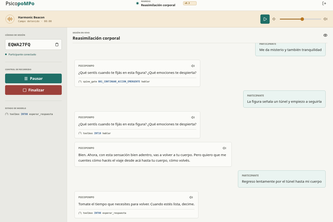
What the company appears to be: PsicopoMPo is a self-reported facilitator-controlled AI workspace for Harmonic Myth Projection (HMP), combining an acoustic field device called the Harmonic Beacon with a 15-year symbolic practice. It is described as a digital operating layer that supports structured human processes, not an autonomous chatbot.
What changed: The project emerged from existing research and practice—Harmonic Information Theory (HIT), Phideus, Harmonic Beacon, and Personal Myth Projection (PMP)—and was built to operationalize these in a digital form. It began as a beta with browser-based interfaces for facilitators and participants, but the authors describe an intended future version that would be voice-first and eyes-closed.
Single most important open question: Is there evidence of real-world adoption or traction beyond the author’s own practice and development work?
Analysis basis: This report is based entirely on the self-reported project description provided by the caller. No external verification, revenue data, customer names, or independent sources are available. All claims in this document are stated by the author and not independently confirmed.
What The Product Actually Is
The description states that PsicopoMPo is a facilitator-controlled AI workspace for Harmonic Myth Projection (HMP). It supports structured symbolic journeys through fixed protocol phases, with human intervention and oversight. The system includes:
- Separate synchronized interfaces for facilitators and participants.
- A browser dictation and speech playback layer.
- Integration of a representative Beacon track without controlling the physical device.
- Export functionality triggered only by explicit facilitator request.
- Use of multiple models (Gemma 4 E4B, LoRA adapters) to manage decision-making, gatekeeping, and language generation within a defined state machine.
Inference: The product is not an autonomous AI assistant but rather a tool for guiding and documenting structured human experiences. It is described as a beta that exposes system state and decisions for validation purposes.
Positioning & Claim Evolution
The description positions PsicopoMPo as part of a broader research ecosystem—AlterMundi—which includes:
- Harmonic Information Theory (HIT)
- Phideus (computational exploration)
- Harmonic Beacon (acoustic field device)
- Personal Myth Projection (PMP) — a 15-year-old symbolic practice
- PsicopoMPo — the digital layer for running PMP
The authors state that PsicopoMPo did not begin as an AI looking for a use case; it emerged from an existing method and physical system. It is framed as a facilitator workspace, not a chatbot or general-purpose AI.
Claim: The product is positioned as a tool to support repeated, structured human processes rather than autonomous interaction.
Inference: This evolution suggests that the team prioritized fidelity to an existing symbolic framework over generic AI capabilities.
Target Customer & ICP
The description indicates that PsicopoMPo targets:
- Facilitators who run HMP sessions
- Participants in structured symbolic journeys
- Wellness and retreat operators in Costa Rica (mentioned as current go-to-market focus)
It is described as a facilitator workspace, implying the primary user is someone managing or guiding a session, not the end-user directly.
Claim: The target customer is facilitators who operate within a specific symbolic framework.
Inference: There is no evidence of broader market segmentation or commercial adoption beyond local practitioners and operators.
Business Model & Pricing Evidence
There is no pricing information or business model described in the self-report. The project is presented as a beta, and there are no mentions of monetization, licensing, or customer acquisition costs.
Claim: No evidence of pricing, revenue streams, or commercial models.
Inference: The lack of any financial or commercial detail suggests either early-stage development or non-commercial intent.
Technical & Delivery Signals
The system uses a multi-model architecture:
- Gemma 4 E4B as base model
- Decision LoRA, Gate LoRA, Execution LoRA adapters
- Contextual Gemma for live execution
- Post-session Gemma for myth expansion
- BGE-M3 for semantic embeddings
- SQLite FTS5 and BM25 for retrieval (not vector-based)
- Groq for translation
- Web Speech API for voice controls
The system is described as local-first, with training and inference running on a single RTX 3090 workstation. Synthetic data generation, benchmarking, and evaluation tools were also developed in-house.
Claim: The architecture is modular, task-specific, and local.
Inference: This suggests a strong emphasis on reproducibility, control, and minimal external dependencies.
Traction & Maturity Signals
The description mentions:
- A public beta
- Use with local facilitators and wellness/retreat operators in Costa Rica
- A 15-year symbolic practice underpinning the system
- In-house training of models and benchmarking tools
However, there is no evidence of:
- Revenue or ARR
- Customer base or adoption metrics
- Product-market fit validation
- Any measurable traction beyond internal development and testing
Claim: The product exists in beta form and has been tested with local practitioners.
Inference: No external validation, usage data, or performance metrics are provided.
Competitive Context
The description does not reference any direct competitors. It situates itself within a niche area combining:
- Symbolic practices
- Acoustic fields
- AI facilitation tools
It is unclear whether similar products exist in the market, as no competitive landscape is described.
Claim: No mention of existing or comparable solutions.
Inference: The lack of competitive context makes it difficult to assess positioning or differentiation.
Open Questions & Risks
- Unclear commercial viability: No revenue, pricing, or customer data.
- Highly specialized domain: The symbolic and acoustic nature may limit scalability.
- Limited external validation: Traction is only described in internal terms.
- No clear path to monetization: No evidence of a go-to-market strategy beyond local testing.
- Dependency on niche expertise: Relies heavily on the creator's own practice and training.
Inference: The project appears to be an experimental or research tool, not a scalable commercial product.
Questions the description leaves open
- What is the current level of engagement from facilitators and participants in Costa Rica?
- How is the symbolic practice validated or tested outside of internal cycles?
- Are there plans for broader market expansion beyond local practitioners?
- What are the key metrics used to evaluate success in beta sessions?
- How does the team plan to transition from a research tool to a scalable product?
- Is there any intention to license or commercialize the underlying symbolic framework?
Overall Assessment
Not evidenced: There is no evidence of revenue, ARR, customer traction, or financial performance. The project is described as a beta with limited real-world use beyond internal development and local facilitators.
Assessment: Based on the self-reported description alone, PsicopoMPo appears to be an experimental research tool in a niche domain. It lacks commercial signals or evidence of product-market fit. Any investment or partnership decision would require further validation of adoption, scalability, and monetization potential beyond what is described here.
User Stories BotA demo video on every pull request
Get a demo video on every new feature
GitHub App that watches your pull requests and records a narrated, captioned demo.
Save time on demo prep and make informed decisions faster with a video walkthrough of every new feature.
Source
Submitted to the OpenAI 2026 hackathon on Devpost. Project home on Devpost. Back to the full gallery on Devpost.
This competitive analysis was produced by top-founders.com (opens in a new tab)
Generated by a language model from this project's public Devpost page — its tagline, the author's own write-up and any built-with tags listed there — as captured in August 2026. Short quotations are the author's words. It is an opinion on the idea as a business, not on the people behind it, and it reflects the description as published then. If the project has moved on, request a correction below. The analysis is not independent research and contains no verified traction, revenue or customer data.
An independent guide by KFG International LLC — not affiliated with, endorsed by, or connected to Devpost or OpenAI.