

Archive position — measured, not model output
1 like on Devpost
505 of the 7,850 archived projects have more likes, and 1,758 share exactly 1 — so this project's #1,725 place in the like-ranked listing is a tie-break inside that group, not a ranking.
Projects (log scale)
Likes on Devpost. ▲ marks this project's group.
Show the figures
| Likes | Projects | Share of archive |
|---|---|---|
| 0 | 5,587 | 71.2% |
| 1 | 1,758 | 22.4% |
| 2 | 284 | 3.6% |
| 3–4 | 132 | 1.7% |
| 5–9 | 75 | 1.0% |
| 10+ | 14 | 0.2% |
 User Stories BotA demo video on every pull request
Get a demo video on every new feature
GitHub App that watches your pull requests and records a narrated, captioned demo.
Save time on demo prep and make informed decisions faster with a video walkthrough of every new feature.
Executive Summary
What the company appears to be
PromiseProof is a self-reported developer tool built by one person (Alexandre Paiva) during a 1-week hackathon. It is described as a system that investigates, repairs and verifies user-facing promises in software — specifically, ensuring that when a feature like personalization is turned off, no user-identifying data reaches recommendations. The system uses AI for diagnosis and repair but excludes AI from the final verification step.
What changed
The project was built entirely during a single week (Build Week) as a solo effort. It includes a reference application, deterministic evidence collection, an AI-assisted investigation workflow using GPT-5.6, a Codex-based repair process, human patch approval, and a deterministic verifier that excludes AI from declaring PASS.
The single most important open question
Is there any evidence of real-world adoption or traction beyond the author’s own demonstration? The description states no revenue, customers, or usage data exist outside of the self-contained demo environment.
What The Product Actually Is
The description states:
- PromiseProof is a system that takes one concrete user-facing promise and turns it into a deterministic check.
- It uses Playwright journeys and network captures to observe broken promises.
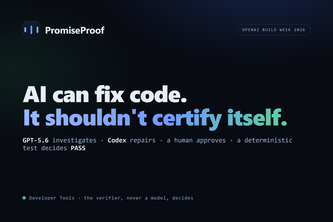
- GPT-5.6 investigates, Codex repairs, and a human approves the patch.
- A deterministic verifier (Playwright + evaluator) decides PASS or FAIL without AI involvement.
- The system supports three developer surfaces: browser, CLI, and GitHub Action.
Inference The product is a proof-of-concept tool for integrity verification in software systems, focused on ensuring that user-facing features behave correctly under specific conditions.
Positioning & Claim Evolution
The description states:
- The project was submitted to the OpenAI 2026 hackathon.
- It aims to solve two problems: hidden system defects and AI's inability to be trusted as a judge of its own repairs.
- The author positions it as a way to let AI do diagnosis and repair while structurally preventing AI from declaring success.
Inference The positioning is that PromiseProof is a tool for developers to validate software behavior with integrity, using AI in a controlled way without granting it authority over final outcomes.
Target Customer & ICP
The description states:
- The system supports three developer surfaces: browser, CLI, and GitHub Action.
- It targets developers working on distributed systems where user-facing promises can be broken in subtle ways.
- The tool is built for use in CI/CD pipelines via a GitHub Action.
Inference The primary customer is likely software engineers or DevOps teams working with complex, distributed applications where integrity of user-facing features is critical.
Business Model & Pricing Evidence
Not evidenced.
Explanation
There is no mention of pricing, monetization, or business model in the description. The project is described as a hackathon submission and not a commercial product.
Technical & Delivery Signals
The description states:
- Built using Node.js, TypeScript, Express.js, Playwright, GitHub Actions, Cloudflare Workers, OpenAI API, Codex SDK, Zod, esbuild, Vite.
- Uses deterministic testing, git worktrees, and a pinned evaluator fingerprint.
- Supports Windows, Ubuntu, macOS via CLI and GitHub Action.
- The verifier path excludes all model calls and uses unchanged Playwright + evaluator.
Inference The tool is built with modern developer tooling and emphasizes determinism and security in verification.
Traction & Maturity Signals
Not evidenced.
Explanation
There is no evidence of revenue, customers, usage metrics, or product adoption beyond the author’s own demonstration. The project is described as a solo-built hackathon submission.
Competitive Context
Not evidenced.
Explanation
No mention of competitors or market context in the description. The tool is presented as a novel approach but not positioned against existing tools.
Open Questions & Risks
- Solo developer: The entire project was built by one person, which raises questions about scalability and long-term maintenance.
- Limited scope: Only one synthetic reference application and one contract family are supported.
- No real-world validation: The system is described as a demo with seeded failures; no evidence of use in production or third-party validation.
- No external evidence collection attestation: While binding proves reports match evidence, it does not prove the evidence was collected honestly.
Questions the description leaves open
- What are the actual use cases for this tool beyond the demo?
- Has there been any independent testing or validation of the system?
- How would you scale this to support more than one contract family?
- Are there plans to integrate with real-world applications or platforms?
- What is the long-term roadmap for developer adoption and product maturity?
Overall Assessment
Not evidenced.
Explanation
There is no evidence of funding, valuation, or investment interest in this project. The description makes no claims about commercial traction or investor interest. It is a solo-built hackathon submission with no indication of commercial viability or market readiness.
User Stories BotA demo video on every pull request
Get a demo video on every new feature
GitHub App that watches your pull requests and records a narrated, captioned demo.
Save time on demo prep and make informed decisions faster with a video walkthrough of every new feature.
Source
Submitted to the OpenAI 2026 hackathon on Devpost. Project home on Devpost. Back to the full gallery on Devpost.
This competitive analysis was produced by top-founders.com (opens in a new tab)
Generated by a language model from this project's public Devpost page — its tagline, the author's own write-up and any built-with tags listed there — as captured in August 2026. Short quotations are the author's words. It is an opinion on the idea as a business, not on the people behind it, and it reflects the description as published then. If the project has moved on, request a correction below. The analysis is not independent research and contains no verified traction, revenue or customer data.
An independent guide by KFG International LLC — not affiliated with, endorsed by, or connected to Devpost or OpenAI.