

Archive position — measured, not model output
1 like on Devpost
505 of the 7,850 archived projects have more likes, and 1,758 share exactly 1 — so this project's #1,724 place in the like-ranked listing is a tie-break inside that group, not a ranking.
Projects (log scale)
Likes on Devpost. ▲ marks this project's group.
Show the figures
| Likes | Projects | Share of archive |
|---|---|---|
| 0 | 5,587 | 71.2% |
| 1 | 1,758 | 22.4% |
| 2 | 284 | 3.6% |
| 3–4 | 132 | 1.7% |
| 5–9 | 75 | 1.0% |
| 10+ | 14 | 0.2% |
 User Stories BotA demo video on every pull request
Get a demo video on every new feature
GitHub App that watches your pull requests and records a narrated, captioned demo.
Save time on demo prep and make informed decisions faster with a video walkthrough of every new feature.
Executive Summary
What the company appears to be
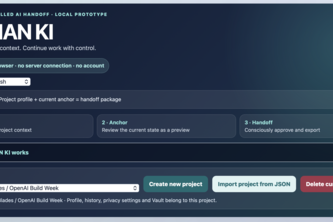
ProMAN KI – Continuity Anchor is a self-reported single-person project that describes itself as a local, human-controlled handoff layer for AI workflows. It aims to preserve project context, privacy boundaries, decisions, and next steps across different AI systems without connecting directly to them.
What changed
The author states this is an evolution from their personal experience with interrupted AI-supported projects and a desire to maintain continuity and control over project data in a fragmented AI landscape.
Single most important open question — the commercial due-diligence read
Is there evidence of product-market fit or early traction beyond the single developer’s own use case, or is this an unvalidated concept that has not yet been tested with users?
What The Product Actually Is
The description states that ProMAN KI – Continuity Anchor is:
- A neutral, human-controlled continuity layer between a person, a project, and different AI systems.
- Not another AI assistant.
- A portable handoff package that includes current work state, completed work, next steps, blockers, decisions, relevant files, and notes.
- Available in formats such as Markdown, structured JSON, or an encrypted backup.
- Designed to work with various AI tools (e.g., ChatGPT/GPT, Codex, Claude, Gemini, Perplexity) but does not connect directly to them.
- A single HTML file using semantic HTML, responsive CSS, Vanilla JavaScript, localStorage, and the Web Crypto API.
- Does not include a framework, cloud backend, account system, telemetry, or external runtime dependencies.
Inference It is a local-first, client-side tool that allows users to manage project continuity manually and securely across AI systems. It emphasizes user control over data and handoff structure, not model performance or integration.
Positioning & Claim Evolution
The author claims:
- ProMAN KI addresses the problem of losing continuity in long-running AI-supported projects.
- It is built from personal experience with interrupted workflows and loss of important decisions and context.
- The tool preserves privacy boundaries and allows for human-controlled handoffs.
- It avoids rewriting user content or connecting directly to AI systems.
- It supports both German and English interfaces.
- It aims to remain neutral, not part of a closed AI ecosystem.
Inference The positioning is centered on user control, privacy, and interoperability across AI platforms. It positions itself as a middleware layer for managing project context rather than a standalone AI assistant or platform.
Target Customer & ICP
The description states:
- The tool was built by someone with lived experience, including personal loss and rebuilding.
- It emerged from the need to protect work and keep it usable across interrupted chats, changing tools, and different AI systems.
- It supports both German and English interfaces.
- It is intended for people who use multiple AI tools in a project and want to maintain continuity.
Inference The ICP appears to be individuals or teams working on long-term projects using multiple AI tools, particularly those who value privacy, control, and context preservation. The tool may appeal to creators, developers, researchers, or professionals managing complex workflows.
Business Model & Pricing Evidence
Not evidenced.
Inference No information is provided about pricing, monetization, or business model. The project is described as a single-person effort, not a commercial product.
Technical & Delivery Signals
The description states:
- Built with: aes-gcm, api, codex, crypto, css, gpt-5.6, html, javascript, json, localstorage, markdown, web.
- Single HTML file using semantic HTML, responsive CSS, Vanilla JavaScript, localStorage, and the Web Crypto API.
- No framework, cloud backend, account system, telemetry, or external runtime dependency.
- Uses Codex for implementation and GPT-5.6 for product reasoning and prioritization.
- Supports local data migration, project-specific history with search, filters, tags, favorites.
- Includes encrypted Vault and password-encrypted backups.
- Handoff quality and privacy review features.
Inference The technical stack is client-side and self-contained, suggesting a lightweight, portable solution. The use of encryption and local storage indicates an emphasis on privacy and data ownership, but no evidence of scalability or enterprise-grade infrastructure.
Traction & Maturity Signals
Not evidenced.
Inference There is no mention of users, customers, revenue, adoption, or usage metrics. The project is described as a prototype built during a hackathon and is not reported to have moved beyond the developer’s own use case.
Competitive Context
Not evidenced.
Inference No direct competitors are named or described. The author positions ProMAN KI as a middleware layer, which may overlap with tools for AI workflow management, project documentation, or privacy-preserving AI interfaces, but no competitive landscape is provided.
Open Questions & Risks
- Single-person development: The entire product was built by one developer (Stev Rösel), raising questions about scalability and long-term maintenance.
- No evidence of traction or user feedback: The tool has not been tested with a broader audience, nor is there any indication of real-world adoption.
- Self-reported only: All claims are unverified; no third-party validation or data exists to confirm product utility or market demand.
- Limited scope and functionality: The tool is described as a prototype, not a production-ready product.
- No monetization strategy: No business model or pricing information is provided.
Questions the description leaves open
- What specific problems have you observed in your own workflow that led to building this?
- Have you tested the tool with others? If so, what feedback did you receive?
- How do you plan to scale beyond a single developer’s use case?
- Are there any plans for monetization or commercialization?
- What are the technical limitations of the current architecture that would prevent it from being used by more users or in more complex workflows?
Overall Assessment
Not evidenced.
Inference Given the lack of traction, revenue, customer data, or business model, there is no basis for a commercial due-diligence conclusion. The project appears to be an early-stage prototype with strong positioning around user control and privacy but no demonstrated market fit or product-market traction. It may be a promising concept, but it has not yet been validated in the marketplace.
User Stories BotA demo video on every pull request
Get a demo video on every new feature
GitHub App that watches your pull requests and records a narrated, captioned demo.
Save time on demo prep and make informed decisions faster with a video walkthrough of every new feature.
Source
Submitted to the OpenAI 2026 hackathon on Devpost. Project home on Devpost. Back to the full gallery on Devpost.
This competitive analysis was produced by top-founders.com (opens in a new tab)
Generated by a language model from this project's public Devpost page — its tagline, the author's own write-up and any built-with tags listed there — as captured in August 2026. Short quotations are the author's words. It is an opinion on the idea as a business, not on the people behind it, and it reflects the description as published then. If the project has moved on, request a correction below. The analysis is not independent research and contains no verified traction, revenue or customer data.
An independent guide by KFG International LLC — not affiliated with, endorsed by, or connected to Devpost or OpenAI.