

Archive position — measured, not model output
0 likes on Devpost
2,263 of the 7,850 archived projects have more likes, and 5,587 share exactly 0 — so this project's #6,078 place in the like-ranked listing is a tie-break inside that group, not a ranking.
Projects (log scale)
Likes on Devpost. ▲ marks this project's group.
Show the figures
| Likes | Projects | Share of archive |
|---|---|---|
| 0 | 5,587 | 71.2% |
| 1 | 1,758 | 22.4% |
| 2 | 284 | 3.6% |
| 3–4 | 132 | 1.7% |
| 5–9 | 75 | 1.0% |
| 10+ | 14 | 0.2% |
 User Stories BotA demo video on every pull request
Get a demo video on every new feature
GitHub App that watches your pull requests and records a narrated, captioned demo.
Save time on demo prep and make informed decisions faster with a video walkthrough of every new feature.
Executive Summary
The description states that Project .taste is a zero-dependency TypeScript SDK for deterministic 16-byte social preview packets. It is positioned as a developer tool for progressive social timeline rendering, aiming to improve client-side performance by allowing clients to reserve interface elements before full content loads. The author claims the project reduces data size from ~47KB to ~1.6KB for a test fixture, with a public benchmark and MIT-licensed codebase. However, no evidence of revenue, customers, or adoption is provided. The single most important open question is whether this approach has traction in real-world applications beyond a hackathon prototype.
What The Product Actually Is
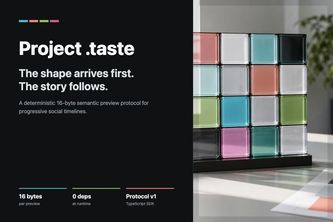
The description states that Project .taste is a developer tool implemented as a TypeScript SDK (xtaste-client-sdk). It provides two core functions: TasteEncoder for server or edge projection and TasteDecoder for client-side expansion. The SDK produces deterministic 16-byte (128-bit) packets arranged as a 4x4 semantic matrix, containing visual palette indexes, motion hints, layout geometry, interaction state, and protocol versioning. These packets are designed to work alongside existing REST, GraphQL, gRPC, or edge APIs while full content loads asynchronously. The SDK is described as having zero runtime dependencies and using synchronous operations with Uint8Array and bitwise operations.
Positioning & Claim Evolution
The description states that Project .taste explores a different ordering of social timeline data, where clients receive a tiny preview contract first rather than loading all data upfront. It positions itself as a tool for progressive rendering, allowing clients to reserve interface elements before full content arrives. The author claims this approach reduces data size from ~47KB to ~1.6KB for a test fixture, and that the project's "smallest useful protocol" is more valuable than flexible alternatives. The claim evolution shows a shift from a hackathon prototype to a potential edge/API sidecar solution with compatibility planning.
Target Customer & ICP
The description states that Project .taste is a developer tool for social timeline rendering, targeting developers who work with REST, GraphQL, gRPC, or edge APIs. It appears aimed at teams building social applications or timelines where performance optimization and progressive loading are priorities. The author notes that the packet works alongside existing APIs rather than replacing them, suggesting it's designed for integration into existing systems rather than standalone use.
Business Model & Pricing Evidence
Not evidenced. The description does not contain any information about pricing, monetization, or business model.
Technical & Delivery Signals
The description states that Project .taste is built with TypeScript and uses node.js, npm, and GitHub. It includes a published TypeScript SDK (xtaste-client-sdk) with zero runtime dependencies. The implementation uses synchronous operations with Uint8Array and bitwise operations rather than runtime frameworks. The repository contains an executable end-to-end test that verifies the 16-byte invariant, encode/decode round trip, and invalid packet rejection. It also includes a browser demo and deterministic benchmark comparing a 100-post Twitter v2-shaped fixture.
Traction & Maturity Signals
Not evidenced. The description does not contain any information about revenue, customers, adoption, or usage metrics beyond the author's own claims about performance improvements in a test fixture.
Competitive Context
Not evidenced. The description does not contain any information about competitors, market positioning, or competitive landscape.
Open Questions & Risks
The description states that Project .taste is a hackathon submission from the OpenAI 2026 hackathon, suggesting it may be an early-stage prototype without proven market traction. It also notes that the project avoids inventing a second transport protocol, leaving delivery and ordering to applications, which could limit its adoption if developers prefer integrated solutions. The author's own admission that "the hard part was deciding what belongs in 16 bytes" suggests potential limitations in content representation.
Questions the description leaves open
- What specific social timeline use cases have been validated beyond the hackathon prototype?
- How does this approach handle edge cases or complex content types not covered in the benchmark?
- What is the actual performance impact on real-world user experience, beyond the test fixture numbers?
- Are there any integration challenges with existing APIs or frameworks that developers might encounter?
- What are the plans for backward compatibility and protocol evolution given the reserved bytes?
Overall Assessment
Not evidenced. The description does not contain any information about funding rounds, valuations, or investment status. The project appears to be a hackathon submission with no evidence of commercial traction or market validation beyond the author's own claims.
User Stories BotA demo video on every pull request
Get a demo video on every new feature
GitHub App that watches your pull requests and records a narrated, captioned demo.
Save time on demo prep and make informed decisions faster with a video walkthrough of every new feature.
Source
Submitted to the OpenAI 2026 hackathon on Devpost. Project home on Devpost. Back to the full gallery on Devpost.
This competitive analysis was produced by top-founders.com (opens in a new tab)
Generated by a language model from this project's public Devpost page — its tagline, the author's own write-up and any built-with tags listed there — as captured in August 2026. Short quotations are the author's words. It is an opinion on the idea as a business, not on the people behind it, and it reflects the description as published then. If the project has moved on, request a correction below. The analysis is not independent research and contains no verified traction, revenue or customer data.
An independent guide by KFG International LLC — not affiliated with, endorsed by, or connected to Devpost or OpenAI.