

Archive position — measured, not model output
1 like on Devpost
505 of the 7,850 archived projects have more likes, and 1,758 share exactly 1 — so this project's #1,708 place in the like-ranked listing is a tie-break inside that group, not a ranking.
Projects (log scale)
Likes on Devpost. ▲ marks this project's group.
Show the figures
| Likes | Projects | Share of archive |
|---|---|---|
| 0 | 5,587 | 71.2% |
| 1 | 1,758 | 22.4% |
| 2 | 284 | 3.6% |
| 3–4 | 132 | 1.7% |
| 5–9 | 75 | 1.0% |
| 10+ | 14 | 0.2% |
 User Stories BotA demo video on every pull request
Get a demo video on every new feature
GitHub App that watches your pull requests and records a narrated, captioned demo.
Save time on demo prep and make informed decisions faster with a video walkthrough of every new feature.
Executive Summary
Project: Prism
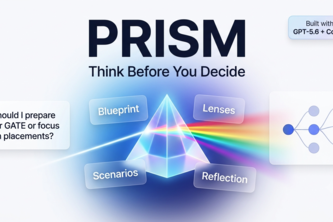
Tagline: Prism: An AI Native Decision Workspace
Author's Self-Description: A single-person hackathon project built with Next.js, React, Tailwind CSS, and OpenAI’s GPT 5.6 API. The author states that the product is an AI-native workspace to help users reason through complex decisions, rather than simply recommend a path forward.
What Changed: The author reports building a tool that shifts from providing direct answers to helping users understand the reasoning process behind decisions. It is described as a structured decision-making interface that explores goals, constraints, risks, and assumptions using AI.
Key Open Question: Is there evidence of a real user need or market traction for this type of AI-powered reasoning workspace? The description contains no data on usage, adoption, revenue, or customer feedback beyond the author’s own account.
What The Product Actually Is
The description states that Prism is an AI native Decision Workspace. It is described as a tool that:
- Helps users understand complex decisions before making them.
- Identifies goals, constraints, assumptions, risks, opportunities, and unknowns.
- Explores the decision through dynamic reasoning lenses.
- Generates alternative scenarios and stress-tests assumptions.
- Ends with thoughtful reflections to support informed decision-making.
It is built using:
- Frontend: Next.js, React, Tailwind CSS, Framer Motion
- Backend/API: OpenAI Responses API with GPT 5.6
- Development Tools: Codex, GitHub, Vercel
Inference: The product appears to be a web-based interface that uses AI to structure decision-making processes. It is not a chatbot or a general-purpose assistant but a specialized tool for reasoning.
Positioning & Claim Evolution
The author states that the inspiration came from personal uncertainty about academic decisions (GATE vs placements), and that existing AI assistants were too quick to give answers without explaining the thinking process.
Claim: Prism is designed to help users reason through decisions rather than simply recommend one path.
Inference: The positioning evolved from a personal problem-solving tool into a broader concept of an AI-powered decision workspace. It is not described as competing with existing AI assistants but as offering a different interaction model — one that emphasizes understanding over recommendation.
Target Customer & ICP
The author states that the long-term vision includes:
- Students
- Professionals
- Founders
- Anyone facing important decisions
Inference: The target audience is broad and not yet defined by specific personas or use cases. The description does not indicate a clear customer segment or early adopter profile.
Business Model & Pricing Evidence
Not evidenced.
The author does not describe any pricing model, monetization strategy, or business model. There is no mention of subscriptions, freemium tiers, enterprise licensing, or revenue streams.
Technical & Delivery Signals
The project was built using:
- Frontend: Next.js, React, Tailwind CSS, Framer Motion
- Backend/API: OpenAI Responses API with GPT 5.6
- Development Tools: Codex, GitHub, Vercel
- Deployment: Vercel
- Demo Mode: Included to allow judges to explore the workflow without API access
Inference: The product is a web application built in a modern stack and deployed on Vercel. It includes a demo mode for limited access during development or presentation.
Traction & Maturity Signals
Not evidenced.
There is no mention of:
- Users
- Customers
- Revenue
- Usage metrics
- Product adoption
- Feedback loops
- Iteration history beyond the hackathon
The project is described as a hackathon submission, and the author notes it was built within a short timeframe.
Competitive Context
Not evidenced.
There is no mention of competitors, market analysis, or positioning relative to existing tools for decision-making or AI reasoning. The author does not reference any similar products or services in the market.
Open Questions & Risks
- No traction or user data: The project is described as a single-person hackathon effort with no evidence of real-world usage.
- Unproven commercial viability: No business model, pricing, or revenue streams are described.
- Limited scope and maturity: The product is presented as a proof-of-concept, not a production-ready solution.
- No competitive differentiation: The author does not explain how Prism differs from existing AI tools or decision-making frameworks.
- Self-reported only: All claims are based on the author’s own description — no independent verification.
Questions the description leaves open
- What specific user problems are you solving, and how do you know they exist?
- Have you tested this with real users or potential customers?
- How do you plan to monetize this product?
- What is your roadmap for moving from a hackathon prototype to a scalable product?
- Are there any existing tools that perform similar functions? How does Prism differ?
- What are the technical limitations of relying on GPT 5.6 for decision reasoning?
Overall Assessment
Not evidenced.
There is no evidence of:
- Revenue
- Customers
- Product-market fit
- Team traction
- Market validation
- Financials or funding history
The project is described as a single-person hackathon effort and lacks any commercial due-diligence signals. It is not clear whether this represents a viable business opportunity or just an idea in early development.
Confidence Level: Low. The description contains no evidence of traction, revenue, or customer adoption. The author’s claims are self-reported and unverified.
User Stories BotA demo video on every pull request
Get a demo video on every new feature
GitHub App that watches your pull requests and records a narrated, captioned demo.
Save time on demo prep and make informed decisions faster with a video walkthrough of every new feature.
Source
Submitted to the OpenAI 2026 hackathon on Devpost. Project home on Devpost. Back to the full gallery on Devpost.
This competitive analysis was produced by top-founders.com (opens in a new tab)
Generated by a language model from this project's public Devpost page — its tagline, the author's own write-up and any built-with tags listed there — as captured in August 2026. Short quotations are the author's words. It is an opinion on the idea as a business, not on the people behind it, and it reflects the description as published then. If the project has moved on, request a correction below. The analysis is not independent research and contains no verified traction, revenue or customer data.
An independent guide by KFG International LLC — not affiliated with, endorsed by, or connected to Devpost or OpenAI.