

Archive position — measured, not model output
0 likes on Devpost
2,263 of the 7,850 archived projects have more likes, and 5,587 share exactly 0 — so this project's #6,026 place in the like-ranked listing is a tie-break inside that group, not a ranking.
Projects (log scale)
Likes on Devpost. ▲ marks this project's group.
Show the figures
| Likes | Projects | Share of archive |
|---|---|---|
| 0 | 5,587 | 71.2% |
| 1 | 1,758 | 22.4% |
| 2 | 284 | 3.6% |
| 3–4 | 132 | 1.7% |
| 5–9 | 75 | 1.0% |
| 10+ | 14 | 0.2% |
 User Stories BotA demo video on every pull request
Get a demo video on every new feature
GitHub App that watches your pull requests and records a narrated, captioned demo.
Save time on demo prep and make informed decisions faster with a video walkthrough of every new feature.
Executive Summary
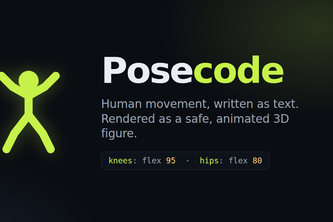
What the company appears to be: Posecode is a self-reported human-readable kinematic Domain Specific Language (DSL) designed to enable LLMs to describe, validate, and render complex 3D biomechanical movements. It includes components such as an MCP server, WebGL renderer, and biomechanical scorecard.
What changed: The author states that the project was built for the OpenAI 2026 hackathon. No evidence of prior versions or evolution is provided.
Single most important open question: Is there any evidence of real-world usage, adoption, or traction beyond the author's own development?
What The Product Actually Is
The description states that Posecode is a human-readable kinematic DSL for LLMs. It enables them to describe, validate, and render complex 3D biomechanical movements.
It includes:
- A human-readable kinematic DSL
- A client-side WebGL renderer
- An MCP server for agent workflows
- A biomechanical fidelity scorecard
The system translates natural language into structured Posecode using GPT-5.6, then validates syntax and biomechanical plausibility before rendering.
Inference: The product is a software toolchain that bridges natural language input and 3D motion representation for AI systems.
Positioning & Claim Evolution
The author claims that LLMs are good at generating text and code but struggle with describing precise movement in 3D space. They state that prompts like “raise the left arm, rotate the torso, and bend the knees” are ambiguous for renderers or simulation systems.
Posecode is positioned as a structured way to describe movement, aiming to give AI spatial reasoning capabilities.
The author also states:
- The final score is calculated using a weighted sum of biomechanical checks.
- It was built for the OpenAI 2026 hackathon.
- It includes components that can evolve independently (language, validation engine, renderer, MCP layer).
Inference: This is a proof-of-concept or prototype tool aimed at bridging language and physical motion in AI systems.
Target Customer & ICP
The description does not identify any specific customer segment or target market. It mentions potential use cases such as:
- Game and character animation
- Fitness and exercise visualization
- Dance and choreography
- Education and anatomy
- Rehabilitation demonstrations
- Sports analysis
- Robotics
- Synthetic motion generation
However, these are listed as possibilities rather than confirmed targets.
Inference: No clear ICP is defined. The author implies a broad audience of developers or AI researchers working with 3D motion data, but no evidence of actual users or customers.
Business Model & Pricing Evidence
There is no evidence of any business model or pricing structure in the description.
The project was submitted to a hackathon and appears to be a personal development effort by one individual.
Inference: No commercialization or monetization strategy is evident from the provided information.
Technical & Delivery Signals
The author reports:
- Built with GPT-5.6 and Codex
- Uses Node.js, TypeScript, Three.js, WebGL, Vite, Zod
- Includes a parser, validator, renderer, MCP server, and biomechanical scorecard
- The system follows a pipeline: natural language → GPT-5.6 → Posecode → validation → scoring → rendering
Inference: The technical stack suggests a developer-focused toolchain with web-based visualization capabilities.
Traction & Maturity Signals
There is no evidence of traction, customers, or adoption beyond the author's own work.
The project was submitted to a hackathon and built by one person (Baran Orhan).
Inference: No signs of product-market fit, user feedback, or market validation are present.
Competitive Context
The description does not mention any competitors or existing solutions in this space.
It does not reference prior work or tools that address similar problems in spatial reasoning for LLMs or 3D motion generation.
Inference: No competitive landscape is described; the author may be entering an uncharted area or building a novel solution.
Open Questions & Risks
- No evidence of traction or adoption: The project appears to be a prototype with no real-world usage.
- Unverified claims: All statements are self-reported and unverified.
- Single-person team: No indication of scaling, support, or ongoing development beyond the author’s efforts.
- Limited commercialization strategy: No roadmap for monetization or market entry.
Inference: The project lacks any signal of viability or scalability as a business.
Questions the description leaves open
- What is the intended path from prototype to product?
- Are there any users or partners interested in adopting this tool?
- How does Posecode compare to existing tools for 3D motion generation or spatial reasoning?
- Is there a plan for ongoing development, maintenance, or support?
- Has the author considered how to integrate this into larger AI workflows or platforms?
Overall Assessment
There is no evidence of commercial traction, revenue, customers, or even a clear product-market fit.
The project is described as a hackathon submission by one individual and lacks any indication of real-world application or adoption.
Inference: At this stage, there is no basis for investment or partnership consideration. The author states that the system works conceptually but provides no data on performance, usage, or impact.
User Stories BotA demo video on every pull request
Get a demo video on every new feature
GitHub App that watches your pull requests and records a narrated, captioned demo.
Save time on demo prep and make informed decisions faster with a video walkthrough of every new feature.
Source
Submitted to the OpenAI 2026 hackathon on Devpost. Project home on Devpost. Back to the full gallery on Devpost.
This competitive analysis was produced by top-founders.com (opens in a new tab)
Generated by a language model from this project's public Devpost page — its tagline, the author's own write-up and any built-with tags listed there — as captured in August 2026. Short quotations are the author's words. It is an opinion on the idea as a business, not on the people behind it, and it reflects the description as published then. If the project has moved on, request a correction below. The analysis is not independent research and contains no verified traction, revenue or customer data.
An independent guide by KFG International LLC — not affiliated with, endorsed by, or connected to Devpost or OpenAI.