

Archive position — measured, not model output
3 likes on Devpost
128 of the 7,850 archived projects have more likes, and 93 share exactly 3 — so this project's #189 place in the like-ranked listing is a tie-break inside that group, not a ranking.
Projects (log scale)
Likes on Devpost. ▲ marks this project's group.
Show the figures
| Likes | Projects | Share of archive |
|---|---|---|
| 0 | 5,587 | 71.2% |
| 1 | 1,758 | 22.4% |
| 2 | 284 | 3.6% |
| 3–4 | 132 | 1.7% |
| 5–9 | 75 | 1.0% |
| 10+ | 14 | 0.2% |
 User Stories BotA demo video on every pull request
Get a demo video on every new feature
GitHub App that watches your pull requests and records a narrated, captioned demo.
Save time on demo prep and make informed decisions faster with a video walkthrough of every new feature.
Executive Summary
What the company appears to be
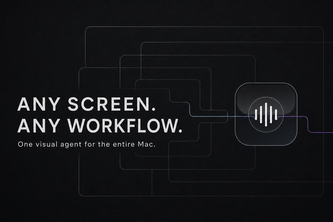
Porter is a self-reported macOS-native personal AI agent built by one developer (Saicharan Ramineni) that turns any Mac screen into an interface for voice-controlled automation. The author states it uses GPT-5.6 and Codex as development collaborators, and is built with Swift, SwiftUI, AppKit, ScreenCaptureKit, AVFoundation, and Python.
What changed
The project description does not indicate a prior version or evolution — this appears to be the first public release of Porter as described by the author.
The single most important open question
Is there sufficient evidence that Porter has achieved any meaningful level of user adoption or commercial traction beyond its solo developer prototype?
Note: This analysis is based entirely on the self-reported, unverified description provided by the author. No third-party verification, revenue data, customer list, or usage metrics are available.
What The Product Actually Is
The description states that Porter is a native macOS personal AI agent designed to be invoked via voice ("Hey Porter") or keyboard shortcut (⌘K). It observes the current screen using ScreenCaptureKit and Accessibility APIs, understands visible UI elements, and performs actions through real mouse/keyboard input.
It claims to:
- See the exact window in front of the user
- Understand the visible interface
- Operate the computer through real mouse and keyboard input
- Continue across applications
- Verify results
- Learn user preferences over time via a local memory system
The author describes it as not being a chatbot, macro, or workflow builder — instead positioning it as an OS-level agent that uses natural language to define outcomes while relying on the existing macOS interface for action.
Inference: The product is described as a native macOS application with voice control and screen observation capabilities. It is not a web-based tool or browser extension.
Positioning & Claim Evolution
The author positions Porter as solving an "access problem" rather than an intelligence problem — arguing that most AI agents are still technically complex to use, requiring users to configure workflows, manage prompts, and understand integrations.
Key claims:
- “AI agents are becoming more capable faster than they are becoming accessible.”
- “Porter does not give people another place to use AI. It turns the computer they already use into the agent interface.”
- “One sentence can replace dozens of fields, repeated uploads, copied dates, context switching, and an hour of mechanical work.”
The evolution of claims centers on:
- Reducing complexity for everyday users
- Making AI accessible through natural language interaction
- Eliminating the need to build or configure workflows
Inference: The positioning has evolved from a general statement about accessibility to a specific model of how Porter operates — using screen observation, voice input, and local memory.
Target Customer & ICP
The author states that Porter is designed for:
- Students
- Families
- Caregivers
- Everyday computer users who could benefit most but are least interested in becoming “agent engineers”
They also note that the product aims to remove the need for people to become programmers or workflow builders.
Inference: The target customer segment includes non-technical users seeking automation without learning new tools or interfaces. However, no explicit segmentation beyond this broad group is provided.
Business Model & Pricing Evidence
There is no evidence in the description of a business model or pricing structure. The author does not mention monetization, subscriptions, freemium tiers, or any commercial strategy.
Finding: Not evidenced.
Technical & Delivery Signals
The project is built with:
- Swift, SwiftUI, AppKit
- ScreenCaptureKit, AVFoundation, Accessibility APIs
- Python and Codex (used as a development collaborator)
- GPT-5.6 for engineering assistance
It includes:
- Native macOS application architecture
- Local memory system
- Voice recognition and speech synthesis
- Safety checks before action dispatch
- Visual observation and semantic UI understanding
- Cross-application execution
- Test suite with hundreds of native tests
Inference: The technical stack suggests a high-fidelity, OS-integrated solution. The use of Codex and GPT-5.6 implies iterative development with AI assistance.
Traction & Maturity Signals
The description does not include any evidence of:
- Revenue
- Customers or user base
- Product adoption
- Market traction
- Product roadmap or version history
It is described as a prototype, and the author notes that “the current build is still a prototype.”
Finding: Not evidenced.
Competitive Context
The description does not reference competitors directly. However, it positions Porter in contrast to:
- Chatbots (which wait for user context)
- Macros (which assume interface stability)
- Workflow builders (which require user programming)
It implies that Porter is part of a broader category of AI agents but differentiates itself by being OS-native and accessible without configuration.
Inference: Porter appears to be positioned in the emerging space of personal AI agents, though no specific competitive landscape is described.
Open Questions & Risks
- No commercial traction or revenue evidence — the project is described as a solo developer prototype.
- Unverified claims about performance and safety — assertions about memory, verification loops, and action validation are self-reported.
- Single-founder team — no indication of scaling or support structure beyond one person.
- Limited external validation — no third-party reviews, testimonials, or usage data.
- Potential overstatement of capabilities — the description is heavily promotional without concrete demonstration.
Inference: The lack of evidence for adoption, revenue, or user feedback raises concerns about viability and market readiness.
Questions the description leaves open
- What specific use cases have you tested Porter on? How many times has it successfully completed a task?
- Can you provide examples of how Porter handles failure states or unexpected UI changes?
- Have you conducted any usability studies with non-technical users?
- Is there a plan for monetization or commercial deployment beyond the prototype?
- What are the limitations of the current implementation, and how do you intend to scale them?
- How does Porter handle sensitive data (e.g., passwords, personal documents)?
- Are there any known issues with macOS compatibility or security constraints?
Overall Assessment
The description presents Porter as a technical prototype built by one developer using advanced tools like GPT-5.6 and Codex. It is positioned as an OS-level agent that simplifies AI access for everyday users.
However, there is no evidence of commercial traction, revenue, or user adoption beyond the solo developer’s own account.
Assessment: The project is a compelling technical concept with strong execution potential, but lacks any demonstrated market validation. It is not ready for investment or partnership without further evidence of product-market fit, user engagement, or business model development.
Confidence Level: Low — based on thin self-reported evidence only.
User Stories BotA demo video on every pull request
Get a demo video on every new feature
GitHub App that watches your pull requests and records a narrated, captioned demo.
Save time on demo prep and make informed decisions faster with a video walkthrough of every new feature.
Source
Submitted to the OpenAI 2026 hackathon on Devpost. Project home on Devpost. Back to the full gallery on Devpost.
This competitive analysis was produced by top-founders.com (opens in a new tab)
Generated by a language model from this project's public Devpost page — its tagline, the author's own write-up and any built-with tags listed there — as captured in August 2026. Short quotations are the author's words. It is an opinion on the idea as a business, not on the people behind it, and it reflects the description as published then. If the project has moved on, request a correction below. The analysis is not independent research and contains no verified traction, revenue or customer data.
An independent guide by KFG International LLC — not affiliated with, endorsed by, or connected to Devpost or OpenAI.